One-line Hook
Sometimes a simple 🤷 says “I have no idea” better than a whole sentence.
Introduction
You get asked, “What happened?” or “Which one should I choose?” and honestly, you have no idea. Instead of typing a long answer, you send 🤷. That is exactly why the don’t know emoji has become such a useful part of everyday digital conversation. The person shrugging emoji can express genuine uncertainty, a lack of information, indifference, or a relaxed “what can I do?” attitude.
In texting, WhatsApp, Instagram comments, TikTok captions, and casual chats, 🤷 can change slightly depending on the words around it. A message like “I don’t know 🤷” sounds straightforward, while “Well, I warned you 🤷” may feel more dismissive. The relationship between the sender and receiver matters too. A close friend may read it as playful, while the same emoji in a serious conversation could sound uninterested. That context is what makes emoji meanings interesting.
Standout Snippet
One little shrug can communicate uncertainty, acceptance, or a casual “who knows?” 🤷
What Does the Don’t Know Emoji Mean? 🤷
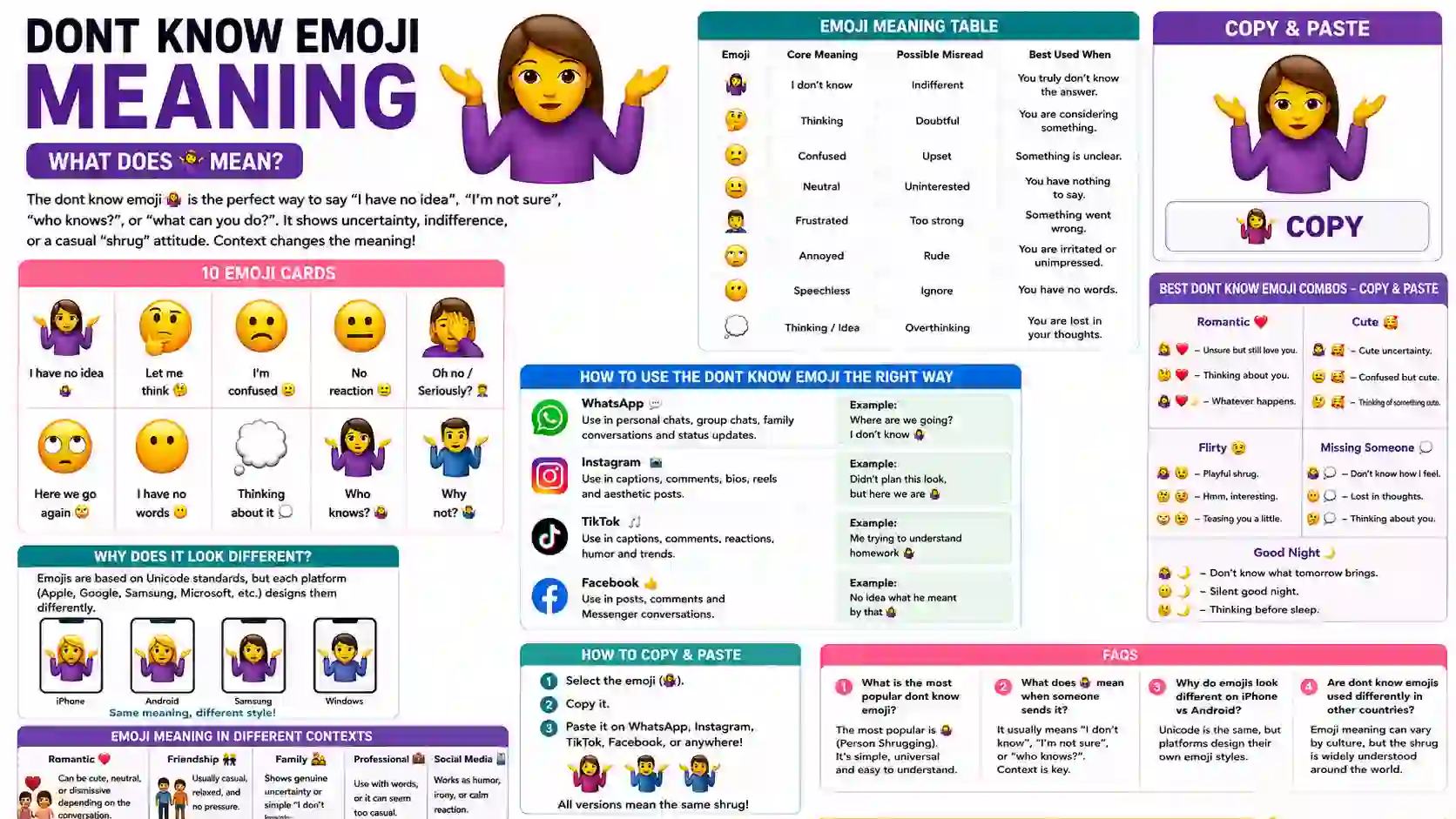
The 🤷 person shrugging emoji is the most common answer when people search for an “I don’t know emoji.” Its basic visual idea is simple: a person raises their shoulders and hands as if they have no answer. Unicode describes the gesture around lack of knowledge or lack of care about an outcome.

In texting, 🤷 often means “I don’t know,” “I have no idea,” “who knows?” or “what can you do?” For example, “Why did he leave early? 🤷” communicates that the sender does not know the answer. It can also show uncertainty when someone has been asked to make a choice.
The emoji can become more casual or dismissive depending on the message. “I don’t know how this happened 🤷” sounds fairly neutral. “They didn’t listen, so 🤷” can suggest resignation or a feeling that the situation is no longer the sender’s responsibility.
Related expressions can add different shades of meaning. 🤔 suggests active thinking or questioning, while 😕 can suggest confusion. 😐 feels more neutral, and 🤦 can communicate frustration about a situation. 🙄 may add an eye-rolling or annoyed tone. The gender variations 🤷♀️ and 🤷♂️ express the same basic shrugging gesture.
Context is always important. A friend asked “Movie or game tonight?” might get “🤷” as a relaxed way of saying either option is fine. In a professional message, however, sending only 🤷 to a question you are expected to answer could seem careless. So the best interpretation comes from the wording, relationship, situation, and surrounding emojis.
Meaning Table
| Emoji | Core meaning | Possible misread | Best used when |
| 🤷 | I don’t know, uncertainty | Dismissive | You genuinely have no answer |
| 🤷♀️ | Woman shrugging | Overly specific | A feminine shrug fits the context |
| 🤷♂️ | Man shrugging | Overly specific | A masculine shrug fits the context |
| 🤔 | Thinking, questioning | Doubtful or skeptical | You are considering something |
| 😕 | Confusion | Disapproval | Something is unclear |
| 😐 | Neutral reaction | Cold or uninterested | You have little to say |
| 🤦 | Frustration or disbelief | Stronger annoyance | Something went badly |
| 🙄 | Eye-rolling | Rude or sarcastic | You want a mildly annoyed tone |
| 😶 | Speechless | Uncomfortable silence | You have no words |
| 💭 | Thought or idea | Too abstract | You are showing a thought |
Emoji Cards
🤷 Person Shrugging
Meaning: Uncertainty, lack of knowledge, indifference, or “what can you do?”
Example 1: I honestly have no idea 🤷
Example 2: Maybe we should just wait and see 🤷
🤷♀️ Woman Shrugging
Meaning: A feminine version of the shrugging gesture used for uncertainty or indifference.
Example 1: I asked her, but she doesn’t know either 🤷♀️
Example 2: Which dress should I choose? 🤷♀️
🤷♂️ Man Shrugging
Meaning: A masculine version of the shrugging gesture used to show uncertainty or a casual attitude.
Example 1: He said he doesn’t know 🤷♂️
Example 2: Where should we meet? Honestly, anywhere 🤷♂️
🤔 Thinking Face
Meaning: Thinking, questioning, considering, or being unsure about something.
Example 1: Let me think about that 🤔
Example 2: I’m not sure that makes sense 🤔
😕 Confused Face
Meaning: Confusion, uncertainty, or difficulty understanding something.
Example 1: I don’t understand what happened 😕
Example 2: That explanation confused me 😕
😐 Neutral Face
Meaning: A neutral, restrained, or low-reaction response.
Example 1: Okay, I guess 😐
Example 2: I really don’t know what to say 😐
🤦 Person Facepalming
Meaning: Frustration, disbelief, embarrassment, or “I can’t believe this.”
Example 1: I forgot my homework again 🤦
Example 2: He sent it to the wrong group 🤦
🙄 Face with Rolling Eyes
Meaning: Annoyance, skepticism, sarcasm, or disbelief.
Example 1: Here we go again 🙄
Example 2: She actually said that 🙄
😶 Face Without Mouth
Meaning: Silence, speechlessness, or having nothing to say.
Example 1: I have absolutely no response 😶
Example 2: You really said that? 😶
💭 Thought Balloon
Meaning: A thought, idea, reflection, or something being considered.
Example 1: Still thinking about it 💭
Example 2: Maybe there is another option 💭
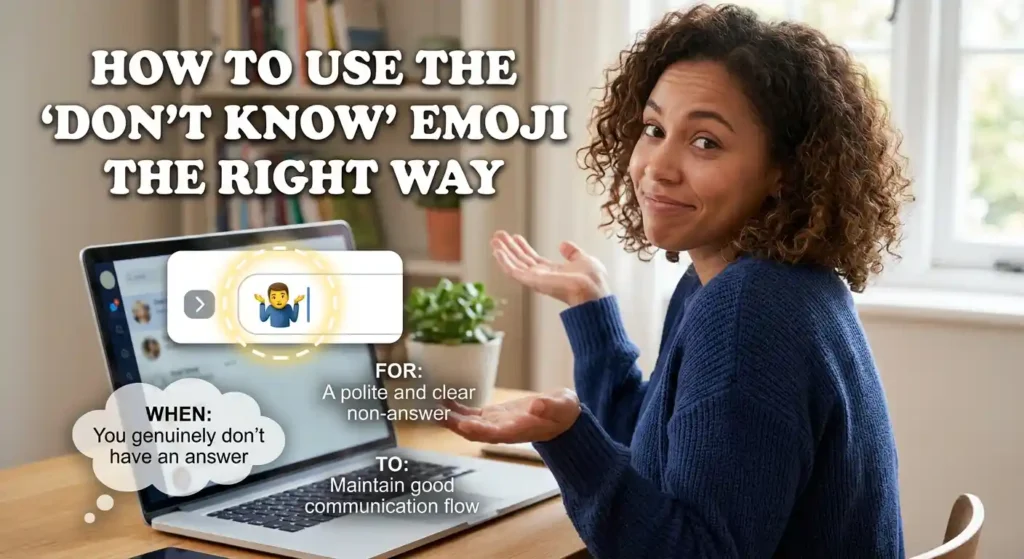
How to Use the Don’t Know Emoji the Right Way
Using 🤷 effectively is mostly about matching it to the tone of your message. On WhatsApp 💬, it works naturally in personal chats, family conversations, group discussions, and status updates. If someone asks, “Do you know when they are coming?” replying “No idea 🤷” is casual and clear. With friends, it can also soften a statement that might otherwise sound too serious.
On Instagram 📸, 🤷 works well in captions and comments when you want to show uncertainty, casual humor, or a “that’s just how it is” attitude. A caption such as “I didn’t plan this outfit, but here we are 🤷” feels relaxed. In comments, the emoji can be a quick reaction when you genuinely do not know what to say.
On TikTok, the shrug often appears in captions, comments, and reaction-style conversations. It can work with humor or irony, especially when someone presents a situation and does not intend to explain it further. “Me trying to understand the homework 🤷” gives the sentence a playful tone.
On Facebook, 🤷 can fit posts, comments, and Messenger conversations. It is useful when discussing everyday decisions or situations where there is no obvious answer.
The important point is that the emoji does not automatically mean “I don’t care.” Sometimes it means genuine uncertainty. Sometimes it means “either option is fine.” Other times it can sound dismissive. Adding words around it makes your intended meaning clearer. “I genuinely don’t know 🤷” is easier to interpret than sending only 🤷.
Why Does the Don’t Know Emoji Look Different on iPhone and Android?
If 🤷 looks slightly different on your phone compared with someone else’s, that does not usually mean you are using a different emoji. Emojis are standardized through Unicode, while individual technology companies create their own visual artwork for those characters. Emojipedia notes that the person shrugging emoji is the same Unicode character even though platforms can display it with different designs.
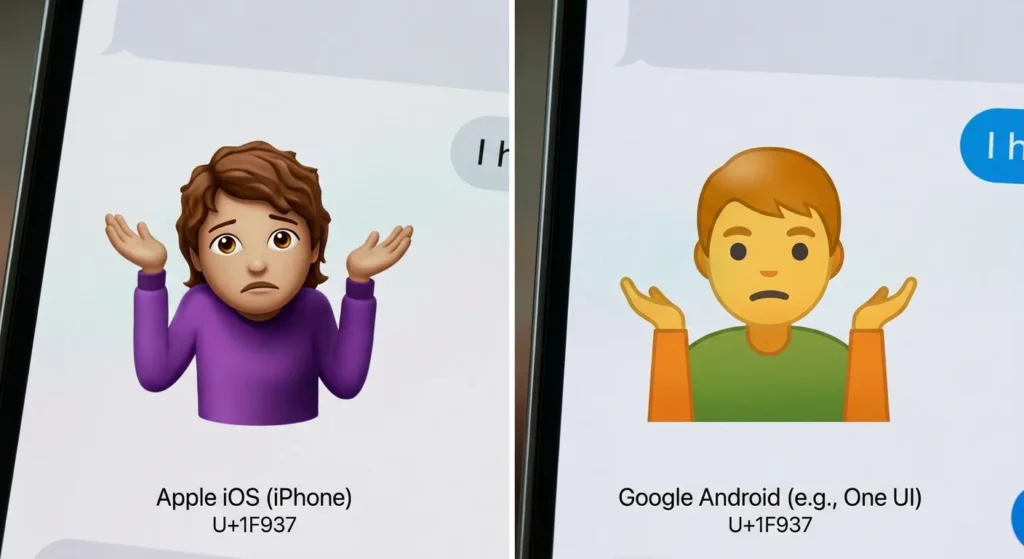
That means an iPhone, Android phone, Windows computer, or social platform can give 🤷 a slightly different appearance. The character can have changes in facial expression, hand position, proportions, colors, hairstyle, clothing, or overall artistic style. The basic gesture remains recognizable as a person shrugging.
The same principle applies to 🤷♀️ and 🤷♂️. These are gender-specific versions created using emoji sequences, and supported platforms render those sequences as a single emoji.
You may also notice differences in size. An emoji can look larger in one messaging app and smaller in another because the app controls how text and emoji characters are displayed.
So there is no single artwork that every device must copy. The Unicode standard identifies the underlying character, while platforms create their own visual interpretations. If your friend sends 🤷 from an iPhone and you see a slightly different-looking shrug on Android, the intended character is still the same.
This is why emoji meaning should be based primarily on the character and context, not tiny differences in artwork. A different hairstyle or facial style does not automatically create a different meaning.
Best Don’t Know Emoji Combos: Copy & Paste
Romantic ❤️
1.👉 🤷❤️, Use this when you are unsure but still expressing affection.
2.👉 🤔❤️, Use this when you are thinking about a romantic situation.
3.👉 😉❤️, Use this for a playful, affectionate message.
Cute 🥰
1.👉 🤷🥰, Use this when you are unsure in a lighthearted way.
2.👉 😕🥰, Use this for cute confusion.
3.👉 🤔🥰, Use this when you are thinking something over sweetly.
Flirty 😉
1.👉 🤷😉, Use this for playful uncertainty.
2.👉 🤔😉, Use this when pretending to think about a playful question.
3.👉 🙄😉, Use this for teasing someone you know well.
Missing Someone 💭
1.👉 🤷💭, Use this when thinking about someone and feeling unsure.
2.👉 😶💭, Use this when you have thoughts but cannot express them.
3.👉 🤔💭, Use this when someone is on your mind.
Good Night 🌙
1.👉 🤷🌙, Use this when ending the day without knowing what tomorrow brings.
2.👉 😶🌙, Use this for a quiet good-night mood.
3.👉 🤔🌙, Use this when you are thinking before going to sleep.
Trending Don’t Know Emoji in 2026
The 🤷 emoji remains useful in 2026 because its basic gesture is instantly recognizable and flexible. Current emoji discussions continue to describe shrugging as a practical way to express uncertainty, indifference, resignation, or a casual lack of an answer.
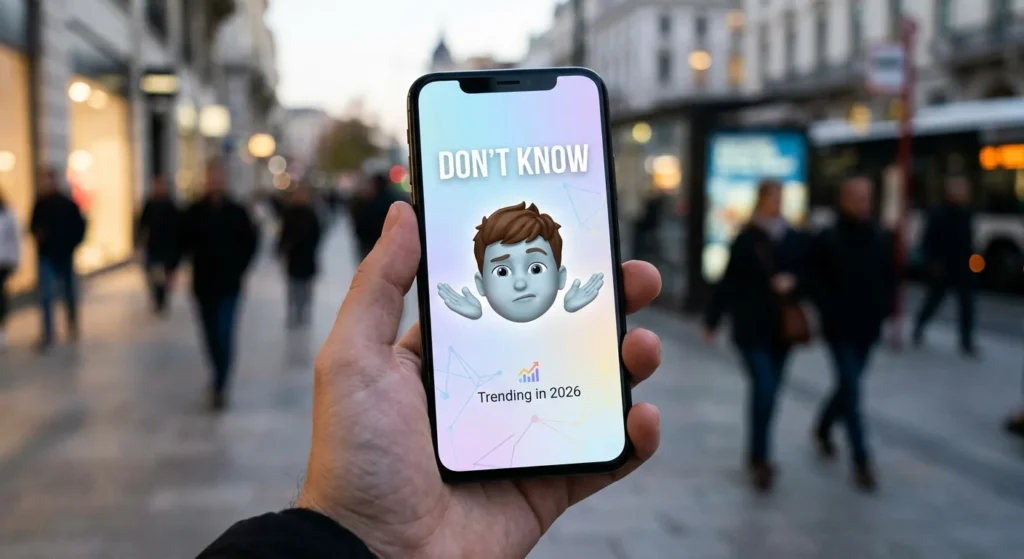
Rather than treating 🤷 as a fixed “trending number,” it is more useful to look at how it functions in everyday digital communication. It frequently appears in casual messaging, comments, captions, and reaction-style conversations. The gender variants 🤷♀️ and 🤷♂️ can be chosen when a sender wants a more specific visual representation.
🤔 is another useful companion because it communicates active thinking rather than simply shrugging. 😕 can make uncertainty feel more confused, while 😐 can make a response feel emotionally neutral.
In 2026, online emoji language continues to change through memes, short-form videos, comments, private chats, and community-specific habits. That means an emoji can develop a slightly different tone depending on where it appears. There is no need to assume that a particular emoji has one universal online interpretation.
| Emoji | Why trending | Who uses it | Platform |
| 🤷 | Quick uncertainty or resignation | General users | WhatsApp, TikTok, Instagram |
| 🤔 | Thinking and questioning | General users | Comments, chats, captions |
| 😕 | Confusion or uncertainty | General users | Messaging, comments |
| 🤦 | Frustration or disbelief | General users | Chats, posts, reactions |
The broader takeaway is simple: emoji communication keeps evolving because people use small visual symbols to add tone to short digital messages.
Don’t Know Emoji Meaning in Different Contexts
The meaning of 🤷 can shift considerably depending on who sends it and what comes before it. In a romantic conversation, “I don’t know 🤷” might simply mean the person is uncertain about a choice. It should not automatically be interpreted as flirting or rejection. The surrounding words matter more than the emoji by itself.
Among friends, 🤷 is usually relaxed. Someone might ask, “Where should we eat?” and receive “🤷” to mean that they have no preference. In this situation, it can mean “you choose” rather than “I don’t care.”
In a family chat, the same emoji may be used when someone genuinely does not know an answer. A parent asking, “Who left this here?” could receive 🤷 from someone who was not involved.
In professional or school communication, context becomes especially important. A standalone 🤷 can sometimes look too casual if someone expects you to provide information. Adding words such as “I’m not sure yet 🤷” makes the uncertainty clearer and friendlier.
In social media comments, 🤷 can become more humorous or ironic. A creator might use it after describing an unexpected situation, while a commenter might use it as a quick reaction. The same character can therefore feel playful in one conversation and dismissive in another.
For captions, 🤷 often supports a casual attitude. It can suggest that the person is not interested in overexplaining something.
The safest approach is to read the whole message rather than assigning a fixed definition to the emoji. Relationship, wording, cultural context, platform, and tone can all influence interpretation.
How to Copy and Paste the Don’t Know Emoji
If you want the don’t know emoji for a message, caption, comment, or status, you can simply copy the character below:
🤷
Select the emoji, copy it, and paste it wherever you want. It can be used in WhatsApp messages, Instagram captions and comments, TikTok captions and comments, Facebook posts, Messenger chats, and many other text fields.
You can also copy the gender variants when they fit your intended context:
🤷♀️ 🤷♂️
On supported devices, these appear as single emoji characters. Their visual design may differ between platforms, but the underlying emoji remains recognizable as a shrugging gesture.
If you want a quick copy-paste phrase, try:
I don’t know 🤷
For a more thoughtful tone:
I’m not really sure 🤔
For genuine confusion:
I’m confused 😕
Using a few words alongside the emoji is often the easiest way to make your intended tone clear.
FAQs
What is the most popular don’t know emoji?
The most recognizable “I don’t know” emoji is 🤷 Person Shrugging. It commonly expresses uncertainty, lack of knowledge, indifference, or a relaxed “what can you do?” reaction.
What does 🤷 mean when someone sends it?
It usually means “I don’t know,” “I’m not sure,” “who knows?” or “what can you do?” The exact tone depends on the conversation, relationship, and wording around the emoji. It should not be interpreted through gender stereotypes.
Why do emojis look different on iPhone vs Android?
Unicode standardizes the underlying emoji character, but companies such as Apple, Google, Samsung, and Microsoft can create their own artwork. As a result, the same 🤷 character can have slightly different visual designs across devices.
Don’t you know emojis are used differently in other countries?
Emoji interpretation can vary with culture, community, platform, and personal communication style. The shrug gesture is widely recognizable, but the surrounding message usually determines whether 🤷 feels neutral, playful, dismissive, or resigned.
Conclusion
The don’t know emoji 🤷 is a simple way to communicate uncertainty, lack of information, indifference, or “what can you do?” in digital conversations. Its meaning becomes clearer when you consider the words, relationship, and situation around it.
Use 🤷 naturally, especially when a casual shrug is exactly the tone you want. When the situation is serious or sensitive, adding a few words can prevent misunderstandings. 🤷💭