One-line Hook: One little green face can instantly say, “My stomach is not okay.” 🤢
You send a friend a message about a terrible smell, a rough morning, or something you definitely did not want to see, and suddenly 🤢 feels like the perfect response. The queasy emoji is commonly used to express nausea, feeling sick, disgust, or strong discomfort. Depending on the conversation, though, it can communicate more than physical illness. Someone might use it after seeing an unpleasant photo, hearing a gross story, reacting to a bad taste, or joking about something they find revolting. 🤢 can also appear in playful exaggeration, especially between friends who already understand each other’s humor. Like many emoji meanings, the exact message depends on the words around it, the relationship between people, and the situation. In texting, WhatsApp, Instagram comments, TikTok reactions, and casual posts, context helps determine whether 🤢 is serious, humorous, dramatic, or simply expressive.
Sometimes 🤢 says “I feel sick,” while other times it simply says “That is seriously gross.”
What Does the Queasy Emoji Mean? 🤢
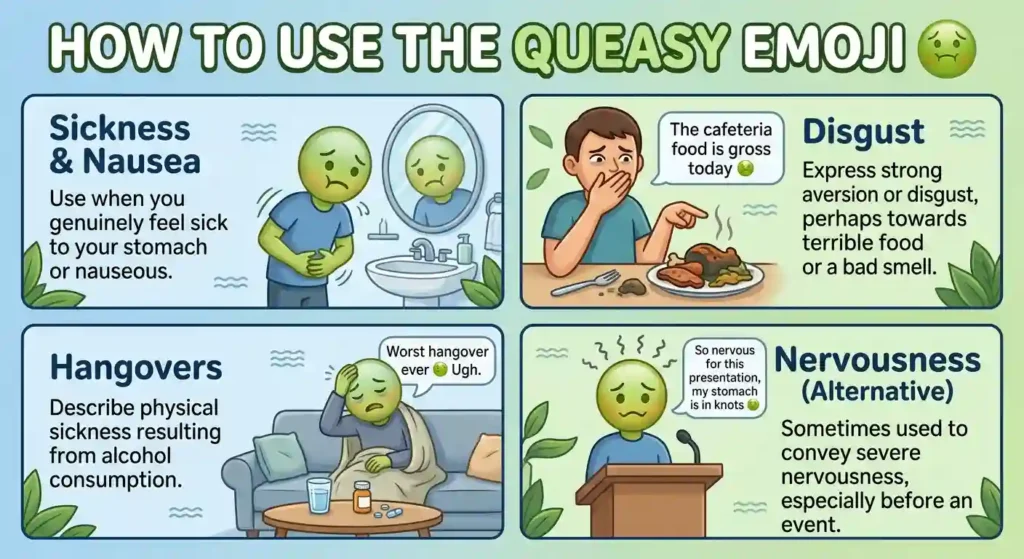
The queasy emoji, 🤢, is generally associated with nausea, sickness, disgust, or a strong feeling that something is unpleasant. Its green face, uncomfortable expression, and queasy appearance make the intended emotion fairly easy to recognize, but the exact meaning still changes with context. If someone writes “I ate something weird 🤢,” the emoji probably refers to physical nausea. If they comment “That smell 🤢,” it is more likely expressing disgust. In a conversation about a disturbing scene, it can communicate an uncomfortable reaction without requiring a long explanation.

In texting, 🤢 can be direct and expressive. A friend might send “I feel so sick 🤢,” while another person could use “That was disgusting 🤢” for something they strongly dislike. It can also be playful. Someone joking about an awful food combination may use 🤢 without actually feeling ill. Related emojis such as 🤮 can make a reaction seem more intense, while 😵💫 may suggest dizziness or overwhelming discomfort. 🤧 usually points more specifically toward sneezing or cold symptoms, and 😖 can communicate distress or discomfort.
On social media, 🤢 often appears in comments, captions, reactions, and humorous posts. A user might add it to a post about an unpleasant experience or comment it under something they find gross. It can also be used positively in a strange way, such as jokingly saying a friend’s extremely sweet romantic post is “too much” with 🤢. The relationship matters too. From a close friend, it may be obvious teasing. From someone unfamiliar, it can sound genuinely negative.
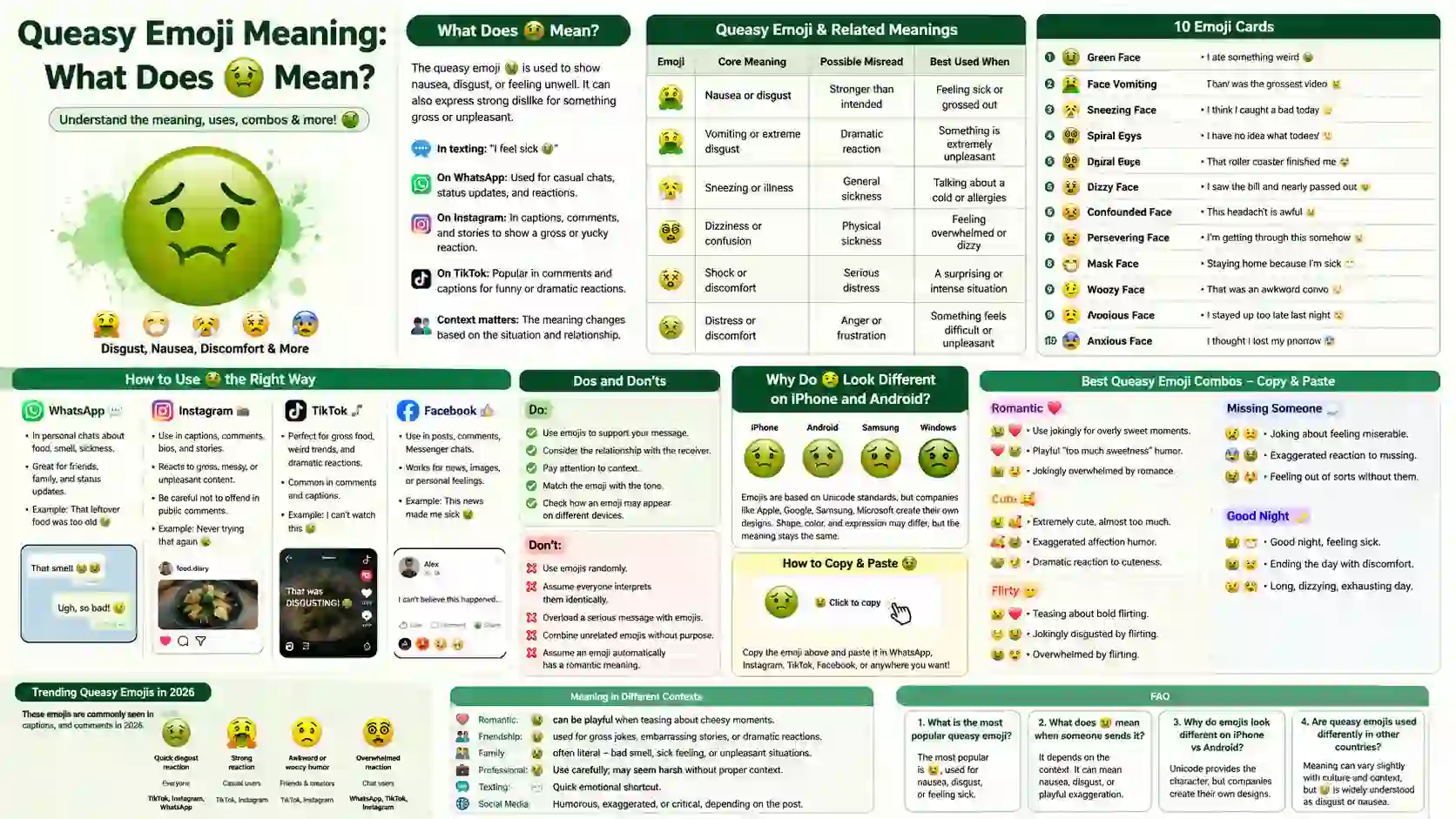
| Emoji | Core meaning | Possible misread | Best used when |
| 🤢 | Nausea or disgust | Stronger than intended | Feeling sick or grossed out |
| 🤮 | Vomiting or extreme disgust | Dramatic reaction | Something is extremely unpleasant |
| 🤧 | Sneezing or illness | General sickness | Talking about a cold or allergies |
| 😵💫 | Dizziness or confusion | Physical sickness | Feeling overwhelmed or dizzy |
| 😵 | Shock or discomfort | Serious distress | A surprising or intense situation |
| 😖 | Distress or discomfort | Anger or frustration | Something feels difficult or unpleasant |
| 😣 | Strain or discomfort | Sadness | Dealing with something uncomfortable |
| 😷 | Illness or protection | Serious medical concern | Discussing sickness or health precautions |
| 🥴 | Feeling woozy or awkward | Nausea | Strange, uncomfortable, or woozy moments |
| 😰 | Anxiety or nervousness | Physical discomfort | Stress, worry, or nervous reactions |
🤢 Green Face
Meaning: Nausea, disgust, or feeling physically unwell.
Example 1: That food smelled terrible 🤢
Example 2: I woke up feeling sick today 🤢
🤮 Face Vomiting
Meaning: Extreme nausea, vomiting, or intense disgust.
Example 1: That was the grossest video ever 🤮
Example 2: I can’t believe I actually ate that 🤮
🤧 Sneezing Face
Meaning: Sneezing, having a cold, or feeling under the weather.
Example 1: My allergies are terrible today 🤧
Example 2: I think I caught a cold 🤧
😵💫 Face with Spiral Eyes
Meaning: Dizziness, confusion, overwhelm, or feeling disoriented.
Example 1: I have no idea what just happened 😵💫
Example 2: That schedule has me completely confused 😵💫
😵 Dizzy Face
Meaning: Shock, dizziness, exhaustion, or an overwhelming reaction.
Example 1: That roller coaster finished me 😵
Example 2: I saw the bill and nearly passed out 😵
😖 Confounded Face
Meaning: Distress, discomfort, frustration, or an unpleasant experience.
Example 1: This headache is awful 😖
Example 2: I really did not expect that result 😖
😣 Persevering Face
Meaning: Struggle, discomfort, effort, or trying to endure something difficult.
Example 1: Just five more minutes of studying 😣
Example 2: I’m getting through this somehow 😣
😷 Face with Medical Mask
Meaning: Illness, germs, health precautions, or feeling sick.
Example 1: Staying home today because I’m sick 😷
Example 2: The air quality is rough today 😷
🥴 Woozy Face
Meaning: Feeling woozy, awkward, uncomfortable, or slightly out of sorts.
Example 1: That was an awkward conversation 🥴
Example 2: I stayed up way too late last night 🥴
😰 Anxious Face with Sweat
Meaning: Nervousness, worry, stress, or an uncomfortable situation.
Example 1: I have to present tomorrow 😰
Example 2: I thought I lost my phone 😰
How to Use the Queasy Emoji the Right Way
WhatsApp 💬
On WhatsApp, 🤢 works especially well in personal conversations where the meaning can be understood from the surrounding message. You can use it when talking about food, motion sickness, unpleasant smells, illness, or something visually disgusting. For example, “That leftover food was definitely too old 🤢” makes the physical reaction clear.
Among friends, the emoji can also be humorous. A friend might send a strange recipe, and replying “Who would eat that? 🤢” can be playful rather than genuinely hostile. In family chats, it can describe a bad smell, an unpleasant task, or feeling unwell. It can even work in a WhatsApp status when you want to express a general reaction without explaining everything.
Instagram 📸
Instagram gives 🤢 a slightly broader role. You might see it in comments reacting to an unpleasant image, strange food combination, messy situation, or deliberately gross content. In captions, it can add an expressive reaction to a personal story.
Because Instagram communication is often public, be careful with direct comments. Sending 🤢 under someone’s appearance or personal post can easily sound insulting. The same emoji that is funny between close friends can be hurtful when used with strangers. A playful context makes the intention clearer.
TikTok 🎵
TikTok is especially suited to expressive reactions. Users may place 🤢 in comments when reacting to gross food experiments, uncomfortable moments, bizarre situations, or intentionally disgusting humor. It can also exaggerate a reaction for comedic effect.
For example, a creator showing an unusual food combination might receive “I cannot watch this 🤢” as a humorous response. The emoji can therefore communicate genuine disgust or exaggerated online drama.
On Facebook, 🤢 can appear in posts, comments, Messenger chats, and reactions. It may describe sickness, unpleasant news, a gross image, or an uncomfortable experience. Since Facebook includes both personal and public communication, context is important. A simple 🤢 can be interpreted differently depending on whether it appears between close friends or under a public post.
Dos and Don’ts
Do:
- Use 🤢 when the message genuinely involves nausea, disgust, or discomfort.
- Consider your relationship with the receiver.
- Let the surrounding words clarify your intention.
- Use related emojis when they add a meaningful distinction.
- Check how the emoji appears on different devices.
Don’t:
- Use 🤢 randomly in serious conversations.
- Assume everyone interprets it in exactly the same way.
- Use it to criticize someone’s appearance.
- Combine many reaction emojis without a clear purpose.
- Assume 🤢 automatically means illness when the context may suggest disgust.
Why Does the Queasy Emoji Look Different on iPhone and Android?
You may notice that 🤢 does not look exactly the same on an iPhone, Android phone, computer, or social media platform. That is normal. Emojis are characters defined through the Unicode standard, but the visual artwork used to represent those characters is created by individual technology companies and platforms.
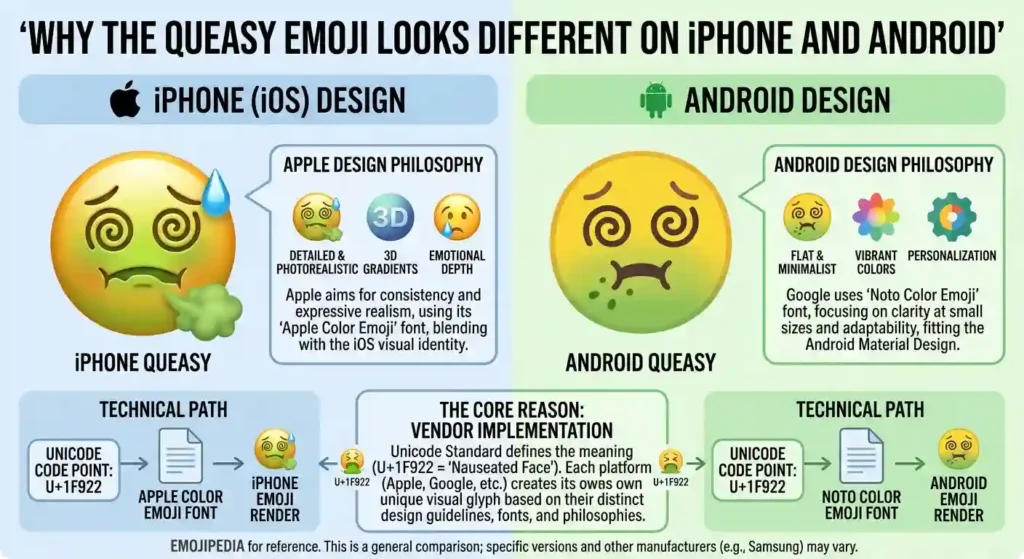
Apple, Google, Samsung, Microsoft, and other companies can design their own version of the same Unicode emoji. As a result, the green shade, facial details, mouth shape, eyes, proportions, and overall style may vary slightly. One version of 🤢 may look more cartoon-like, while another may have a somewhat different expression.
The important point is that the underlying emoji character remains the same. If you send 🤢 from one device to another, the recipient’s device or app may display its own design. The difference does not necessarily mean that you sent a different emoji.
This matters because facial expressions can sometimes feel slightly stronger or softer depending on the artwork. A sender may see 🤢 as mildly queasy, while the receiver’s platform could make the face appear more dramatically disgusted. When a message is important, the words around the emoji provide useful context.
Best Queasy Emoji Combos, Copy & Paste
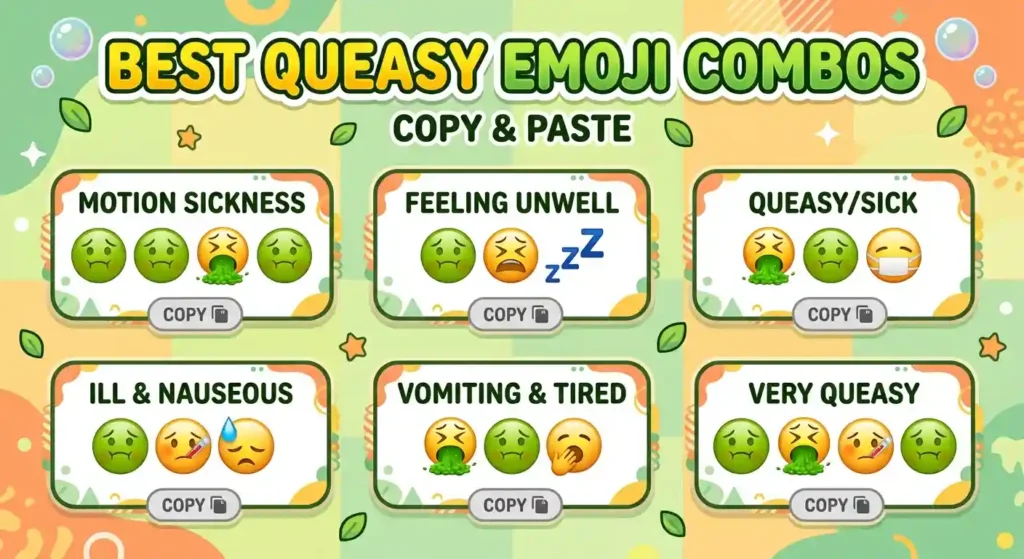
Romantic ❤️
1.🤢❤️, Use this jokingly when teasing about an overly sweet romantic moment.
2.❤️🤢, Use this for playful “too much sweetness” humor with someone close.
3.🤢🥴, Use this for a jokingly overwhelmed reaction to romantic flirting.
Cute 🥰
1.🤢🥰, Use this playfully when something is extremely cute but almost too much.
2.🥰🤢, Use this for exaggerated affection mixed with humorous embarrassment.
3.🤢😣, Use this when reacting dramatically to an overly cute situation.
Flirty 😉
1.🤢😉, Use this for teasing when playful flirting feels ridiculously bold.
2.😉🤢, Use this when jokingly pretending to be disgusted by someone’s flirting.
3.🤢🥴, Use this when flirting leaves you jokingly overwhelmed.
Missing Someone 💭
1.🤢😣, Use this when joking about feeling emotionally miserable while missing someone.
2.😰🤢, Use this for an exaggerated reaction to an especially difficult day apart.
3.🤢😵💫, Use this when missing someone has you feeling completely out of sorts.
Good Night 🌙
1.🤢😷, Use this when saying good night because you’re feeling sick.
2.🤢😣, Use this when ending the day while dealing with an uncomfortable feeling.
3.🤢😵💫, Use this after a long, exhausting, or dizzying day.
Trending Queasy Emoji in 2026
In 2026, 🤢 remains useful in casual digital communication because it communicates a strong physical or emotional reaction with very little text. It commonly appears alongside conversations about unusual food, unpleasant experiences, humorous reactions, sickness, and deliberately gross content.
The related 🤮 is often chosen when someone wants the reaction to feel more extreme. 🥴 can shift the message toward feeling woozy or awkward, while 😵💫 is useful when the situation is confusing or overwhelming rather than specifically disgusting.
These emojis can appear in WhatsApp messages, Instagram comments, TikTok reactions, Facebook posts, captions, and casual group chats. Their tone can shift quickly. A creator may use 🤢 for comedy, while someone messaging a friend may use it literally to describe nausea.
| Emoji | Why trending | Who uses it | Platform |
| 🤢 | Quick disgust reaction | Everyday users and creators | TikTok, Instagram, WhatsApp |
| 🤮 | Strong reaction | Casual social media users | TikTok, Instagram |
| 🥴 | Awkward or woozy humor | Friends and creators | TikTok, Instagram |
| 😵💫 | Overwhelmed reaction | Everyday chat users | WhatsApp, TikTok, Instagram |
Overall, emoji usage continues to evolve as people use familiar symbols in increasingly playful, ironic, and context-specific ways.
Queasy Emoji Meaning in Different Contexts
In a romantic conversation, 🤢 can be playful rather than genuinely negative. If someone sends an extremely cheesy compliment, a partner might jokingly answer with 🤢 to tease them. The surrounding conversation is what makes the joke understandable.
In friendship, the emoji is often more flexible. Friends may use it after discussing terrible food, an embarrassing story, or something they find disgusting. Because close friends usually understand one another’s humor, 🤢 can become a dramatic reaction rather than a serious criticism.
In a family conversation, it may be more literal. Someone could send “I think dinner did not agree with me 🤢.” Here, the emoji reinforces physical discomfort.
In professional or casual communication, caution is useful. With coworkers or unfamiliar contacts, 🤢 may appear harsher than intended. If the subject is genuinely unpleasant, adding explanatory words can prevent confusion.
In texting, 🤢 often works as a quick emotional shortcut. In social media comments, it may be humorous, exaggerated, or critical. In a caption, it can summarize an unpleasant experience without a long explanation.
For example, “Never trying that combination again 🤢” clearly communicates regret or disgust. Meanwhile, “This conversation is getting too cheesy 🤢❤️” changes the tone into playful teasing. The same emoji therefore does not carry a single fixed emotional message. Context, relationship, wording, and platform all matter.
How to Copy and Paste the Queasy Emoji
Copying 🤢 is simple. Select the emoji below, copy it, and paste it wherever you want:
🤢
You can paste the queasy emoji into WhatsApp messages, Instagram captions, TikTok comments, Facebook posts, Messenger chats, text messages, or other apps that support emojis.
On a phone, you can also open the emoji keyboard and search for the relevant expression. On computers, the available emoji picker may provide another way to find it. If you are copying from a website, remember that the visual appearance can change after you paste it because the destination device or application may use different emoji artwork.
FAQ
What is the most popular queasy emoji?
The most recognizable emoji for queasiness or disgust is 🤢. It is commonly used for nausea, feeling sick, or reacting to something unpleasant.
What does 🤢 mean when someone sends it?
It depends on the conversation. It can mean nausea, disgust, discomfort, or playful exaggeration. The meaning is not determined by the sender’s gender or by the emoji alone.
Why do emojis look different on iPhone vs Android?
Unicode provides the underlying emoji character, while companies create their own artwork. Therefore, Apple, Google, Samsung, and other platforms can display 🤢 with slightly different shapes, colors, and facial details.
Are queasy emojis used differently in other countries?
Emoji interpretation can vary with cultural and community context. However, 🤢 is broadly recognizable as an expression connected with nausea or disgust, while the specific humorous or social meaning can depend on the conversation.
Conclusion
The queasy emoji 🤢 is a simple way to communicate nausea, disgust, discomfort, or playful exaggeration.
Its meaning becomes clearer when you consider the words, relationship, and situation around it.
Use it thoughtfully, especially in public comments where playful reactions can be misunderstood.
When the context fits, 🤢 can say a lot without requiring many words.