

Sometimes a single gentle emoji can make a difficult message feel a little more human.
When someone experiences a loss, finding the right words can be surprisingly difficult. You may want to show sympathy without sounding cold, overly formal, or intrusive. That is where a condolences emoji can quietly add emotional warmth to a message. 🕊️ 🤍 🕯️
There is not one official emoji called the “condolences emoji.” Instead, people commonly use a small group of symbols to express sympathy, remembrance, comfort, prayer, and emotional support. The dove 🕊️, white heart 🤍, candle 🕯️, folded hands 🙏, and flowers 💐 are especially natural choices.
The right choice depends on your relationship with the person, the seriousness of the situation, the wording around the emoji, and sometimes cultural expectations. An emoji that feels comforting in one conversation may feel inappropriate in another. Unicode itself notes that emoji do not have one universal meaning and that interpretation can change with context, culture, and usage.
The right condolences emoji can say, “I am thinking of you,” when words simply do not feel enough. 🕊️
What Does the Condolence Emoji Mean?
The phrase condolences emoji usually refers to emojis used to express sympathy after someone’s death or during a difficult period of grief. There is no single universal symbol for condolences. Instead, people choose visual symbols that communicate peace, remembrance, prayer, love, sadness, or support.
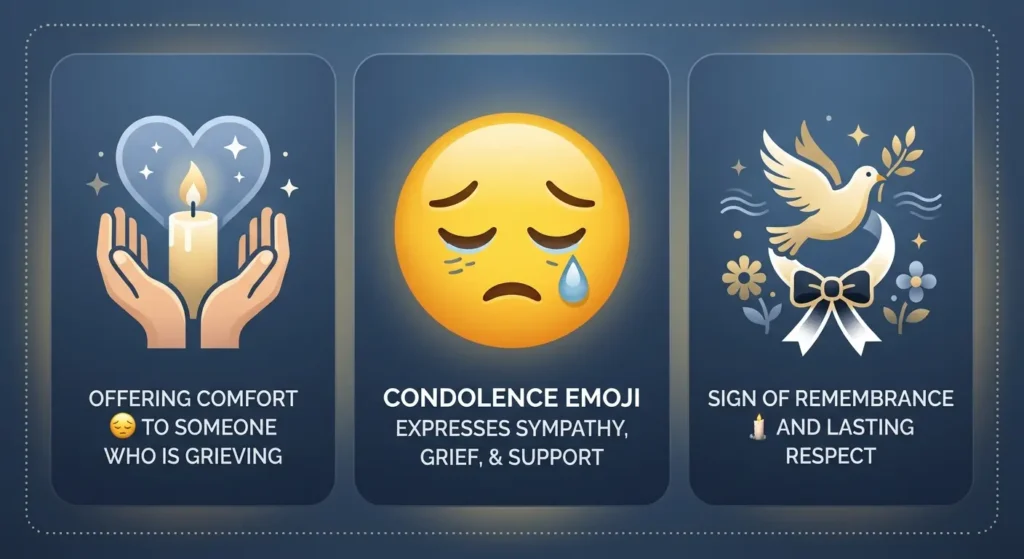
The dove 🕊️ is one of the gentlest choices. It can suggest peace, remembrance, comfort, or the idea of letting someone rest peacefully. The white heart 🤍 often adds quiet compassion and sincere emotional support. A candle 🕯️ can represent remembrance or honoring someone who has passed away. Folded hands 🙏 may communicate prayer, sympathy, or a heartfelt wish for strength. Flowers 💐 can symbolize respect, remembrance, and a thoughtful gesture.
Other choices can communicate sadness more directly. The pensive face 😔 may fit a personal message when you genuinely want to acknowledge someone’s pain. The broken heart 💔 can express grief, although it can sometimes feel more emotionally intense. A black heart 🖤 may communicate mourning or deep sadness in some conversations, but it can also have unrelated meanings depending on the context.
The meaning also changes according to the surrounding words. “I am so sorry for your loss 🕊️” feels respectful and gentle. “Thinking of you and your family 🤍” sounds supportive without being overly formal. By contrast, sending only an emoji with no message can sometimes feel too brief, especially after a serious loss.
Your relationship matters too. A close friend may appreciate a warmer combination such as 🫂🤍, while a coworker or acquaintance may be better served by a simple sentence followed by 🕊️. Context, wording, culture, and personal preference all influence interpretation. Unicode specifically explains that emoji meanings can vary by language, culture, and context rather than having one fixed interpretation.
| Emoji | Core meaning | Possible misread | Best used when |
| 🕊️ | Peace and remembrance | Could seem spiritual | Offering gentle sympathy |
| 🕯️ | Remembrance and honoring | May feel ceremonial | Memorial or remembrance messages |
| 🤍 | Quiet love and support | Can seem romantic in some contexts | Supporting someone emotionally |
| 🙏 | Prayer and sympathy | Can seem religious | When prayer or spiritual support fits |
| 💐 | Respect and remembrance | Can feel like a formal tribute | Condolence cards and messages |
| 😔 | Sadness and empathy | May focus heavily on sadness | Personal sympathy messages |
| 🖤 | Mourning and deep sadness | Can have other meanings | Serious grief-related conversations |
| 💔 | Emotional pain and grief | May feel intense | Close personal relationships |
| 🫂 | Comfort and emotional support | Less formal | Supporting a grieving friend |
| 🫶 | Care and heartfelt support | Can seem casual | Close friends or family |
🕊️ Dove
Meaning: Peace, remembrance, comfort, and a gentle expression of sympathy.
Example 1: I am so sorry for your loss 🕊️
Example 2: May they rest in peace 🕊️
🕯️ Candle
Meaning: Remembrance, honoring someone, reflection, and quiet tribute.
Example 1: Remembering them with love 🕯️
Example 2: Keeping your family in my thoughts 🕯️
🤍 White Heart
Meaning: Pure affection, compassion, care, and quiet emotional support.
Example 1: Sending you love and strength 🤍
Example 2: Thinking of you during this difficult time 🤍
🙏 Folded Hands
Meaning: Prayer, sympathy, respect, hope, or a heartfelt wish for strength.
Example 1: My thoughts and prayers are with you 🙏
Example 2: Wishing your family strength and peace 🙏
💐 Bouquet
Meaning: Respect, remembrance, sympathy, and a thoughtful tribute.
Example 1: Sending heartfelt condolences to your family 💐
Example 2: Remembering a beautiful life with love 💐
😔 Pensive Face
Meaning: Sadness, empathy, concern, and recognition of someone’s pain.
Example 1: I am deeply sorry to hear this 😔
Example 2: My heart goes out to you 😔
🖤 Black Heart
Meaning: Mourning, sorrow, emotional heaviness, or solidarity during grief.
Example 1: Thinking of you and your family 🖤
Example 2: Sending strength during this painful time 🖤
💔 Broken Heart
Meaning: Deep emotional pain, heartbreak, grief, or sorrow.
Example 1: I am heartbroken for you 💔
Example 2: There are no words for how sorry I am 💔
🫂 People Hugging
Meaning: Comfort, emotional closeness, support, and a symbolic hug.
Example 1: Sending you the biggest hug 🫂
Example 2: I wish I could be there to hug you 🫂
🫶 Heart Hands
Meaning: Care, love, emotional support, and heartfelt affection.
Example 1: Sending you so much love 🫶
Example 2: We are here for you always 🫶
How to Use Condolences Emoji the Right Way

WhatsApp 💬
WhatsApp is one of the most common places to send a condolences emoji because people often use it for personal conversations, family groups, and direct messages.
For a close friend, you could write, “I am so sorry. I am here for you 🕊️🤍.” For a family member, “Sending our love and prayers to everyone 🙏🤍” feels warm without becoming overly elaborate.
A status update may also include a simple remembrance message such as “Forever remembered 🕯️.” In a family group, however, it is usually better to include words rather than sending only emojis.
Instagram 📸
On Instagram, condolences emojis often appear in comments beneath memorial posts or messages about someone’s loss. A simple “So sorry for your loss 🕊️” can be more appropriate than a long public comment.
For a remembrance post, 🕯️, 🕊️, 🤍, and 💐 can work naturally. Keep public comments respectful because the grieving person’s audience may include relatives, coworkers, and acquaintances.
TikTok 🎵
TikTok can involve more casual language, but grief-related posts still deserve sensitivity. If someone shares a personal story about losing someone, a comment such as “Sending love and strength 🤍🫂” can show support without making the situation about yourself.
Avoid using playful or flirtatious emojis in a serious grief conversation, even if that style is normal in your everyday comments.
Facebook is often used for memorial posts, family announcements, and longer messages about someone who has passed away. A condolences emoji can accompany a thoughtful sentence such as “Keeping your family in my thoughts during this difficult time 🕯️.”
For professional contacts, coworkers, or acquaintances, understated choices such as 🕊️, 🤍, or 🕯️ are usually safer than emotionally intense combinations.
Do and Don’t
Do:
- Use an emoji to support your words, not replace them.
- Consider your relationship with the grieving person.
- Match the emoji with the seriousness of the message.
- Choose gentle symbols such as 🕊️, 🤍, or 🕯️ when uncertain.
- Remember that different people interpret emoji differently.
Don’t:
- Send a large string of unrelated emojis.
- Use playful emojis in a serious condolence message.
- Assume one emoji has exactly the same meaning for everyone.
- Make the message overly dramatic when you barely know the person.
- Use an emoji simply because it is visually attractive.
Why Do Condolences Emoji Look Different on iPhone and Android?
You may notice that the same condolences emoji looks slightly different on an iPhone, Android phone, Windows computer, or another device. That does not necessarily mean you are using a different emoji.
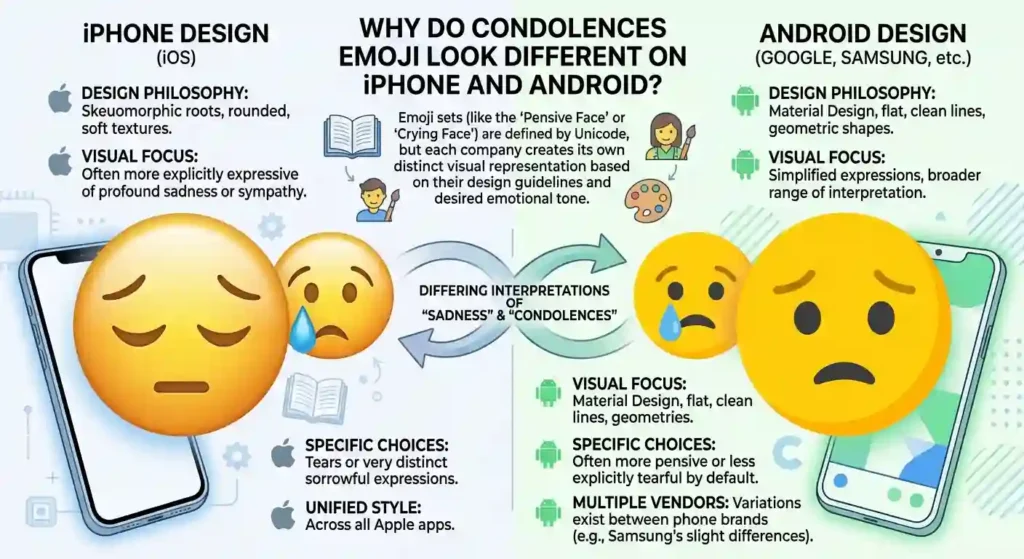
Unicode provides the underlying character standard, while individual companies and platforms create their own visual designs. Unicode explains that it does not control the color images used by vendors, and platforms can decide how supported emoji are rendered.
That is why the dove 🕊️ might have a somewhat different shape or shading depending on the device. The white heart 🤍 may also vary slightly in size, outline, or appearance.
The underlying Unicode character can still be the same even when the artwork differs. In practical terms, this means you should focus on the intended symbol rather than worrying that your recipient will see an identical design.
Platform differences can include:
- Shape of the symbol
- Color and shading
- Facial expressions where applicable
- Line thickness
- Overall visual style
- Size and spacing
Unicode’s documentation also notes that vendors periodically decide which characters to support and how those characters appear on their platforms.
So if your condolences emoji looks a little different from the one your friend sends, that is normal. The visual design may change while the underlying character remains the same.
Best Condolences Emoji Combos, Copy & Paste
For condolences, some of the requested styles people use for other emoji topics are not appropriate for a grieving conversation. The combinations below therefore focus on respectful, comforting situations while keeping the same copy-and-paste idea.
Romantic ❤️
1.👉 🤍🫂, Use this when offering emotional support to a grieving partner.
2.👉 🕊️🤍, Use this for a gentle message of love and remembrance.
3.👉 🕯️🤍🫶, Use this when honoring someone while supporting someone close to you.
Cute 🥰
For a condolence message, “cute” should be understood as gentle and affectionate rather than playful.
1.👉 🫂🤍, Use this as a soft symbolic hug for a close friend.
2.👉 💐🤍, Use this for a warm remembrance message.
3.👉 🕊️🫶, Use this when expressing gentle care and support.
Flirty 😉
Flirty combinations are generally not appropriate for condolences. If this category appears in a personal message, keep it completely non-flirtatious and supportive.
1.👉 🤍🫂, Use this instead of a playful emoji when comforting someone you care about.
2.👉 🕊️🫶, Use this for heartfelt emotional support.
3.👉 🕯️🤍, Use this when the conversation centers on remembrance.
Missing Someone 💭
1.👉 🕊️🤍, Use this when saying you miss someone who has passed away.
2.👉 🕯️💔, Use this when acknowledging deep grief and remembrance.
3.👉 💐🤍, Use this for a thoughtful memorial message.
Good Night 🌙
Good-night combinations can be appropriate when comforting someone at the end of a difficult day.
1.👉 🌙🤍, Use this to wish someone a peaceful night.
2.👉 🌙🫂, Use this when sending comfort before they sleep.
3.👉 🌙🕯️, Use this for a quiet remembrance message.
Trending Condolences Emoji in 2026
In 2026, condolences emoji usage continues to favor symbols that communicate emotion without requiring a long explanation. Rather than treating one emoji as an official trend leader, it is more useful to look at how familiar symbols work in everyday digital communication.

The dove 🕊️ remains a natural choice for peace and remembrance. The white heart 🤍 is useful when the sender wants to communicate warmth without making the message strongly romantic. The candle 🕯️ works particularly well in memorial contexts, while the folded hands 🙏 can express prayer or sincere sympathy when that tone fits the relationship.
These symbols commonly appear in WhatsApp messages, Instagram comments, Facebook memorial posts, TikTok comments, and private conversations. Their tone can shift depending on the words around them. Unicode also emphasizes that emoji meanings evolve and can be repurposed over time.
| Emoji | Why trending | Who uses it | Platform |
| 🕊️ | Gentle symbol of peace and remembrance | Friends, families, communities | WhatsApp, Instagram, Facebook |
| 🤍 | Quiet expression of love and support | Friends, family, younger users | WhatsApp, TikTok, Instagram |
| 🕯️ | Strong connection with remembrance | Families and memorial communities | Facebook, Instagram, WhatsApp |
| 🙏 | Familiar expression of prayer and sympathy | Friends, relatives, acquaintances | WhatsApp, Facebook, comments |
The larger trend is simple: people continue adapting familiar emoji to communicate tone, emotion, support, and intentional ambiguity alongside written language. Emoji are designed to augment communication rather than replace language completely.
Condolences Emoji Meaning in Different Contexts
The same emoji can feel different depending on where and how it appears.
In a romantic conversation, 🤍 or 🫂 may feel deeply personal. If someone’s partner is grieving, “I am right here with you 🤍🫂” can communicate closeness without needing a complicated explanation.
In friendship, 🕊️ and 🫂 can feel natural. A message such as “I am so sorry, my friend. Sending you a big hug 🫂” combines direct empathy with a visual expression of comfort.
In family conversations, 🙏, 🕯️, and 🤍 may fit naturally, especially when several relatives are sharing memories or offering support.
In professional communication, restraint matters. A coworker, manager, client, or acquaintance may appreciate “My sincere condolences to you and your family 🕊️” more than a long sequence of emotional symbols.
In texting, an emoji can soften an otherwise short message. “Thinking of you 🤍” feels warmer than simply “Thinking of you.”
In social media comments, brevity is often appropriate. “So sorry for your loss 🕊️” acknowledges the post without taking attention away from the grieving person.
In captions, 🕯️ and 🕊️ can help establish a quiet remembrance tone. A memorial caption may use one symbol rather than several, particularly when the accompanying words already express the emotion.
The key is not choosing the most emotional-looking emoji. It is choosing the symbol that matches the relationship, setting, and message.
How to Copy and Paste Condolences Emoji
If you want a simple condolences emoji to copy and paste, start with the dove:
🕊️
You can select the emoji, copy it, and paste it directly into WhatsApp, Instagram, TikTok, Facebook, Messenger, comments, captions, or text messages.
You can also copy these useful options:
🕊️ 🤍 🕯️ 🙏 💐 🫂
For a complete message, combine the emoji with words:
I am so sorry for your loss. 🕊️
Thinking of you and your family. 🤍
May their memory always be a blessing. 🕯️
Copy and paste emojis can look slightly different after you send them because the recipient’s device or platform may use different emoji artwork. The underlying character can still be the same.
FAQs
1. What is the most popular condolences emoji?
There is no single universally recognized “most popular” condolences emoji. 🕊️ is one of the most recognizable choices because it can suggest peace and remembrance. 🤍, 🕯️, 🙏, and 💐 are also commonly used depending on context.
2. What does 🕊️ mean when someone sends it?
When someone sends 🕊️ in a grief-related conversation, it can express peace, remembrance, sympathy, or a gentle acknowledgment of loss. Its exact meaning depends on the surrounding message and relationship rather than the sender’s gender or identity.
3. Why do condolences emojis look different on iPhone vs Android?
Emoji characters are standardized through Unicode, but companies create their own visual artwork for supported characters. As a result, the same 🕊️ or 🤍 can have slightly different shapes, colors, or styling across devices.
4. Are condolences emojis used differently in other countries?
They can be. Cultural, religious, community, and personal preferences can influence how people understand symbols such as 🙏, 🕊️, 🕯️, and 🤍. It is better to consider the recipient and situation than assume one interpretation works everywhere. Unicode likewise notes that emoji meanings can vary across language and culture.
Conclusion
A good condolences emoji should make a sympathy message feel more caring, not more . 🕊️ 🤍 and 🕯️ are gentle choices when you want to express remembrance, comfort, or support.
When in doubt, pair one respectful emoji with sincere words. In a difficult moment, thoughtful simplicity usually says the most.