One-line hook:
One little 😂 can turn an ordinary message into something genuinely funny.
Introduction
You send a funny message to a friend, they reply with 😂, and suddenly you know they actually laughed. But what does the laughing emoji iPhone version really mean, and does it always carry the same tone? Usually, 😂 communicates genuine laughter, amusement, or a reaction to something funny. Still, context matters. The same emoji can feel playful between friends, affectionate in a personal chat, or slightly sarcastic in a comment. On iPhone, Apple gives the emoji its own visual design, while the underlying Unicode character remains the same across compatible platforms. 😂 🤣 😭 and 😆 can also create slightly different emotional shades, even when people use them interchangeably. Whether you are texting on WhatsApp, replying on Instagram, commenting on TikTok, or sending a quick Facebook message, understanding the surrounding conversation helps you read the tone correctly.
Sometimes 😂 says “that was hilarious” without needing another word.
What Does Laughing Emoji iPhone Mean? 😂
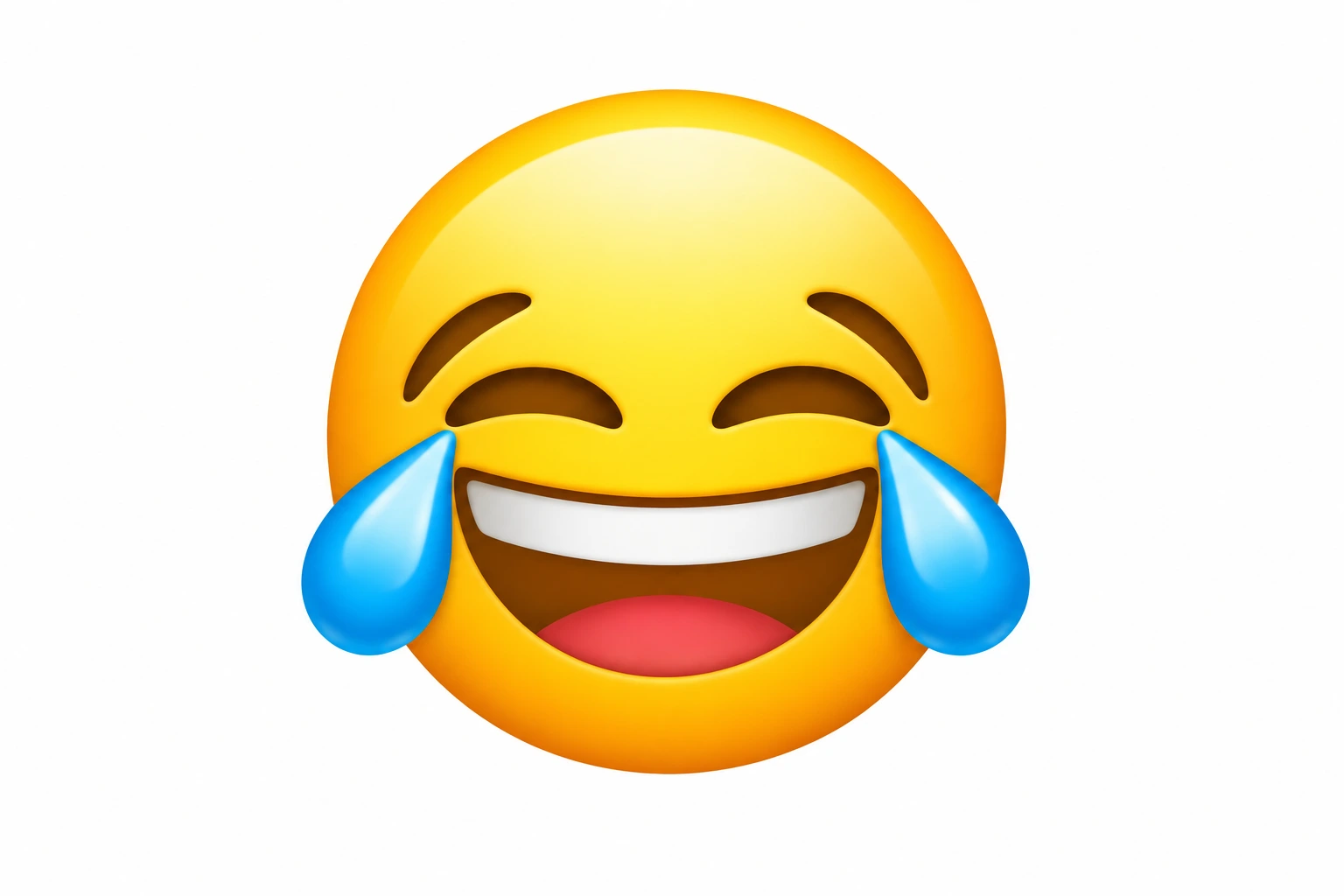
The laughing emoji iPhone users see, 😂, is commonly used to show strong amusement, laughter, or a reaction to something genuinely funny. Its official Unicode name is Face with Tears of Joy, which reflects the tears shown while laughing. In everyday messaging, however, people rarely think about the formal name. They simply use 😂 when words such as “LOL,” “I can’t stop laughing,” or “that’s hilarious” do not quite capture the reaction.

In texting, 😂 often makes a message feel lighter and friendlier. If a friend says, “I walked into the wrong classroom again 😂,” the emoji signals that the person is laughing at the situation. On WhatsApp, it can soften teasing and show that a comment is meant playfully rather than seriously. On Instagram and TikTok, 😂 frequently appears in comments reacting to funny videos, relatable situations, or unexpected moments.
Related emojis can add different shades. 🤣 generally suggests even stronger laughter, while 😆 can feel like a broad, energetic laugh. 😭 is sometimes used online to express being overwhelmed by laughter, although its literal meaning relates to crying. 😅 can suggest nervous or awkward laughter, while 🙂 can make a message calmer.
The relationship between sender and receiver also matters. A close friend sending 😂 after your joke is usually straightforward. A classmate or casual acquaintance might use it simply as a friendly reaction. In a professional conversation, the same emoji may feel more informal.
| Emoji | Core meaning | Possible misread | Best used when |
| 😂 | Strong amusement | Mocking laughter | Something is genuinely funny |
| 🤣 | Very strong laughter | Excessive reaction | Something is extremely funny |
| 😆 | Excited laughter | Overly energetic tone | Playful reactions |
| 😅 | Nervous or awkward laugh | Uncertainty | Embarrassing situations |
| 😭 | Intense emotional reaction | Literal sadness | Online humor or dramatic reactions |
| 🙂 | Friendly smile | Slightly distant tone | Simple, positive replies |
😂 Face with Tears of Joy
Meaning: Strong laughter and amusement.
Example 1: That ending was completely unexpected 😂
Example 2: I just remembered what happened yesterday 😂
🤣 Rolling on the Floor Laughing
Meaning: Extremely strong laughter or amusement.
Example 1: Your story gets funnier every time 🤣
Example 2: I cannot believe you actually did that 🤣
😆 Grinning Squinting Face
Meaning: Energetic, cheerful laughter.
Example 1: You really thought that would work 😆
Example 2: That was such a funny surprise 😆
😅 Grinning Face with Sweat
Meaning: Awkward, nervous, or relieved laughter.
Example 1: I almost sent that message to the wrong person 😅
Example 2: I completely forgot about the deadline 😅
😭 Loudly Crying Face
Meaning: Intense emotion, often exaggerated online for humor.
Example 1: This video is too funny 😭
Example 2: Why is this so relatable 😭
🙂 Slightly Smiling Face
Meaning: Mild friendliness or a simple positive tone.
Example 1: Sounds good to me 🙂
Example 2: Thanks for letting me know 🙂
😄 Grinning Face with Smiling Eyes
Meaning: Happy, open, and cheerful amusement.
Example 1: That made my day 😄
Example 2: You actually remembered! 😄
😁 Beaming Face with Smiling Eyes
Meaning: Excited happiness and a big smile.
Example 1: We finally finished it 😁
Example 2: I cannot wait for tomorrow 😁
😉 Winking Face
Meaning: Playfulness, teasing, or a light hint.
Example 1: You know what I mean 😉
Example 2: Maybe I planned it that way 😉
🥰 Smiling Face with Hearts
Meaning: Warm affection, appreciation, or fondness.
Example 1: That was really sweet 🥰
Example 2: You always make me smile 🥰
How to Use Laughing Emoji iPhone the Right Way
WhatsApp 💬
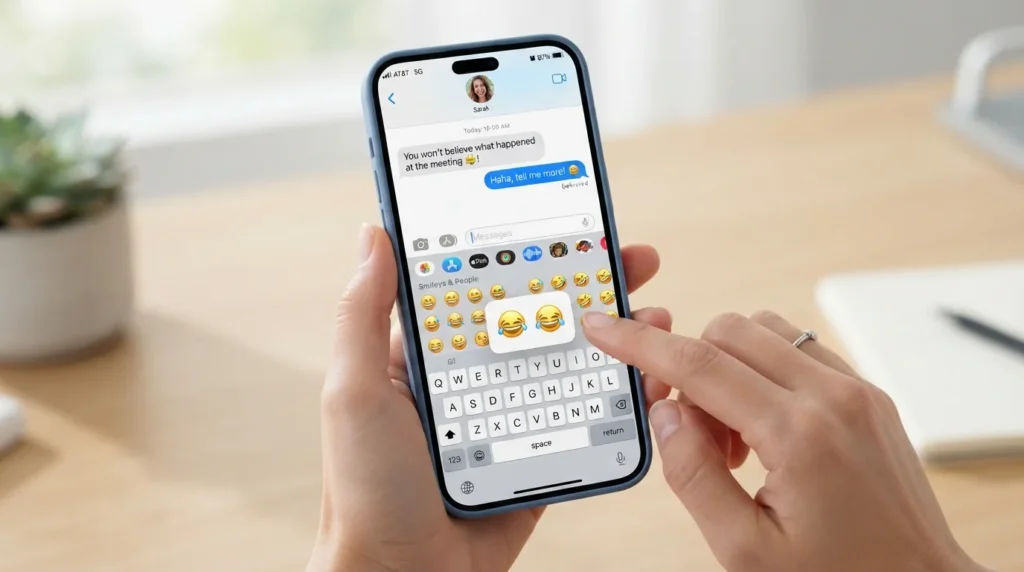
On WhatsApp, 😂 works naturally in personal chats, family conversations, and friendly group messages. It can follow a joke, funny memory, accidental mistake, or playful comment.
For example:
“I just realized I wore my shirt inside out 😂”
With friends, 😂 can make teasing feel less serious. In family chats, it can show amusement without needing a long response. It also works well in WhatsApp status updates when you are sharing something funny.
Instagram 📸
Instagram users commonly place 😂 in comments, captions, and reactions. A funny Reel might receive a simple “😂,” while a caption can use it to establish a playful tone.
For example:
“Me pretending I understand what is happening 😂”
In comments, context is especially important because a single emoji can be interpreted differently depending on the post.
TikTok 🎵
TikTok conversations often move quickly, and 😂 can work as a short reaction to humor, unexpected moments, or relatable content. It can appear in comments or captions without needing additional words.
For example:
“The ending got me 😂”
On Facebook, 😂 can appear in posts, comments, and Messenger chats. It works particularly well when responding to funny stories, memes, family jokes, or everyday situations.
Do’s and Don’ts
Do:
- Use 😂 when the message genuinely has a humorous tone.
- Consider your relationship with the receiver.
- Read the surrounding conversation.
- Match the emoji with the seriousness of the topic.
- Remember that device designs can look different.
Don’t:
- Assume everyone interprets 😂 identically.
- Use it randomly in serious conversations.
- Treat every laughing emoji as sarcasm.
- Combine large groups of unrelated emojis.
- Assume 😂 automatically has a romantic meaning.
Why Does Laughing Emoji iPhone Look Different on iPhone and Android?
The laughing emoji iPhone design may look different from the version displayed on Android, Windows, Samsung devices, or other platforms. This happens because Unicode standardizes the underlying emoji character, while individual technology companies create their own visual artwork for that character.
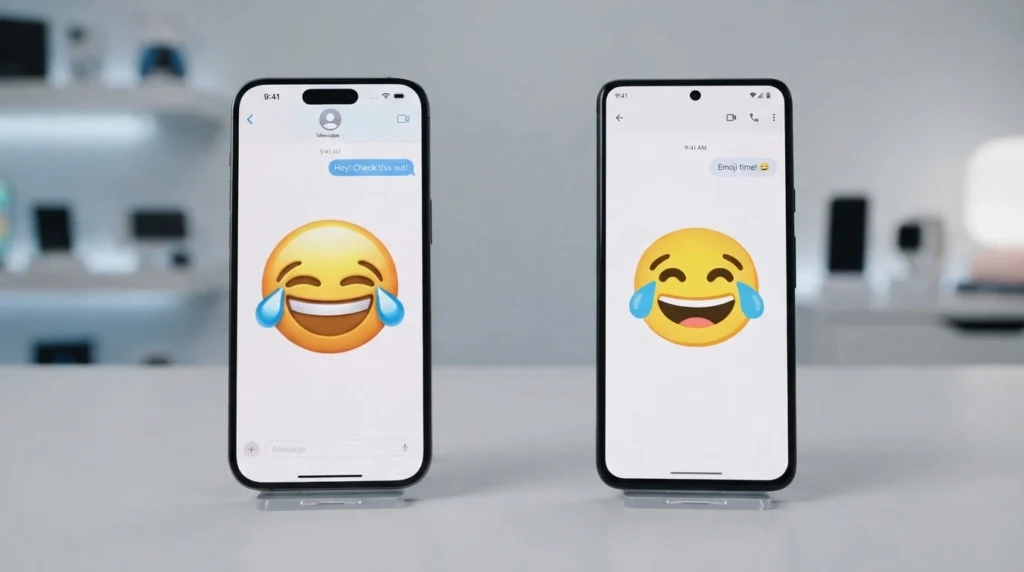
In other words, the character 😂 represents the same Unicode emoji, but Apple decides how it should look in its software. Google, Samsung, Microsoft, and other companies can use different artwork.
You might notice small differences in:
- Facial shape
- Eye design
- Tear placement
- Colors
- Expression
- Overall size and visual style
These differences do not normally mean that the sender chose a different emoji. Someone using an iPhone can send 😂 to someone using Android, and the receiver may simply see the Android version of the same character.
This is also why screenshots can sometimes make emoji meanings seem different. The visual design may influence your first impression, but the underlying character remains the same.
Best Laughing Emoji iPhone Combos: Copy & Paste
Romantic ❤️
1.👉 😂🥰 — Use this for a playful affectionate reaction.
2.👉 😉😂 — Use this when teasing someone you like.
3.👉 🥰😂 — Use this for warm laughter with affection.
Cute 🥰
1.👉 😂😄 — Use this for cheerful laughter.
2.👉 🥰😂 — Use this after something sweet and funny.
3.👉 😆🥰 — Use this for energetic but affectionate humor.
Flirty 😉
1.👉 😉😂 — Use this for playful teasing.
2.👉 😂😉 — Use this when joking with a hint of playfulness.
3.👉 🥰😉 — Use this for a warm, playful message.
Missing Someone 💭
1.👉 😂🥰 — Use this when remembering a funny moment together.
2.👉 😂😭 — Use this for dramatically missing someone’s humor.
3.👉 🥰😂 — Use this when recalling an amusing memory.
Good Night 🌙
1.👉 😂🥰 — Use this after ending the night with a funny conversation.
2.👉 😆🥰 — Use this for a cheerful good-night mood.
3.👉 😂😉 — Use this for a playful final message.
Trending Laughing Emoji iPhone in 2026
In 2026, 😂 remains a familiar part of casual digital communication because it is easy to understand and works in many situations. It commonly appears in messaging, social media comments, captions, and reactions.
🤣 is often chosen when someone wants to emphasize stronger laughter, while 😭 can appear in online humor when someone describes a reaction as emotionally overwhelming. 😆 can provide a more energetic alternative to a simple laughing response.
Different communities can also develop their own preferences. A TikTok comment may use 😂 differently from a private WhatsApp conversation, even when both reactions are responding to humor.
| Emoji | Why trending | Who uses it | Platform |
| 😂 | Simple, recognizable laughter | General users | WhatsApp, Instagram, TikTok |
| 🤣 | Stronger humorous reaction | Casual users | TikTok, Instagram, chats |
| 😭 | Dramatic online reaction | Social media users | TikTok, comments, messaging |
| 😆 | Energetic cheerful laughter | Friends and casual users | Messaging, social media |
Emoji usage continues to evolve because online communities constantly develop new ways to combine familiar symbols with humor, irony, and conversation styles.
Laughing Emoji iPhone Meaning in Different Contexts
In a romantic conversation, 😂 can make a message feel playful and relaxed. It does not automatically indicate attraction, but it can appear alongside affectionate messages when two people already have that kind of relationship.
In friendship, 😂 is especially straightforward. A friend may send it after a joke, funny memory, embarrassing story, or playful insult.
In family chats, it can react to funny photos, stories, or everyday situations. The meaning is usually easier to understand because participants know one another’s communication style.
In professional or casual communication, context becomes more important. A colleague might use 😂 in an informal team chat, but the same emoji could feel inappropriate in a serious announcement or sensitive discussion.
In texting, a single 😂 can serve as a complete response. On social media, however, it may function more like a public reaction to a post or video.
For example, compare:
“I forgot my keys again 😂”
This usually signals amusement about a personal mistake.
“You seriously said that 😂”
This may be playful disbelief or teasing.
“That meeting was three hours long 😂”
This could express humorous frustration.
The words around the emoji often tell you more than the emoji alone.
How to Copy and Paste Laughing Emoji iPhone
If you want to copy the primary laughing emoji, simply use this:
😂
On iPhone, select the emoji and choose Copy. You can then paste it into WhatsApp, Instagram, TikTok, Facebook, Messenger, text messages, comments, or captions.
You can also copy the emoji directly from this article and paste it wherever you want. The exact appearance may change when you send it to another device because each platform can display its own emoji artwork.
FAQs
1. What is the most popular laughing emoji iPhone?
😂 is one of the most recognizable laughing emojis and is widely used for humor and amusement. People commonly use it when something genuinely makes them laugh.
2. What does 😂 mean when someone sends it?
It usually indicates laughter or amusement, but the exact tone depends on the conversation. It can sometimes communicate teasing, playful disbelief, or humorous exaggeration.
3. Why do emojis look different on iPhone vs Android?
Unicode identifies the emoji character, while companies such as Apple and Google create their own visual designs. That is why the same emoji can have a different appearance across devices.
4. Are laughing emojis used differently in other countries?
Yes, interpretation can vary with language, culture, online communities, and personal communication habits. The surrounding message is often the best clue to the intended tone.
Conclusion
The laughing emoji iPhone, 😂, is a simple way to show genuine amusement, playful reactions, and humorous energy. Its meaning can shift with the conversation, relationship, and platform. 😂
Use it naturally, pay attention to context, and remember that the same emoji may look slightly different across devices.