Hook
You’ve seen the little red and orange squares in your emoji keyboard, but do you actually know what they say?
Introduction
You’re scrolling through your emoji keyboard looking for something fun to add to a chat, and you stumble on a row of small square symbols with Japanese characters inside them. They look official, maybe even important, but most people have no idea what they actually mean. That’s exactly why so many people search for japanese emoji meanings before using them. These aren’t random decorations. Each one, like 🈺 or 🈵, is based on a real Japanese word used on signs, storefronts, and paperwork across Japan. Context matters a lot here too, since the “correct” meaning of a symbol can shift depending on where you use it and who’s reading it. 🈶🈸 By the end of this guide, you’ll know exactly what these symbols say and how to use them naturally in your own messages.
Sometimes the smallest square symbol carries the biggest cultural story. 🈺
What Do Japanese Emoji Meanings Cover?
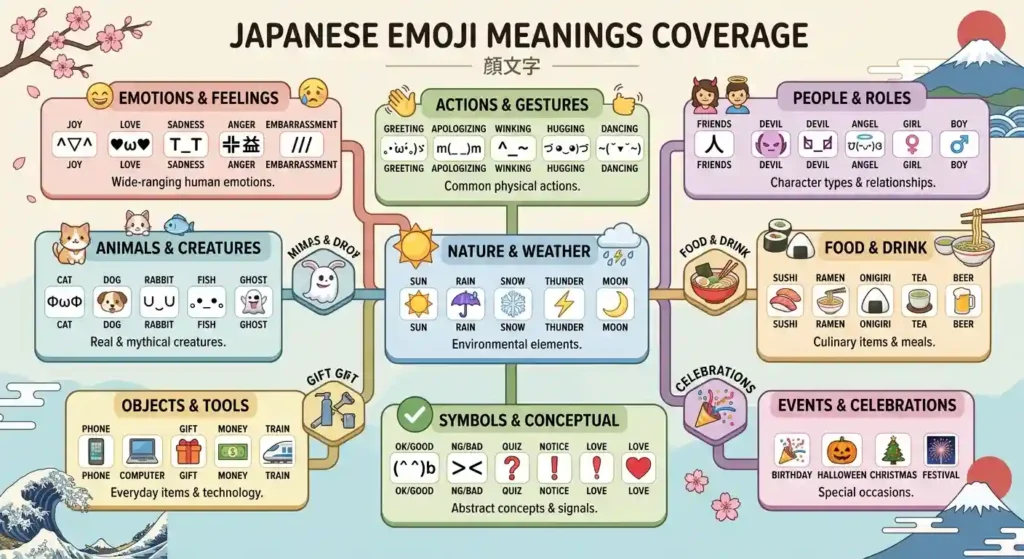
When people search for japanese emoji meanings, they’re usually talking about a specific set of Unicode symbols pulled directly from real signage used in Japan. Unlike heart or face emojis, these squares represent actual Japanese words, shortened into single characters and wrapped in colored backgrounds so they read clearly at a glance.
The basic meaning behind each one comes from its original real-world use. 🈺 for example comes from the Japanese character for “business,” and you’ll spot it on shop doors to show a store is open. 🈵 uses the character for “full,” commonly seen outside parking lots or fully booked venues. 🈳 flips that meaning entirely, showing “vacancy” instead.
Emotionally, these symbols carry a different weight than typical emojis. They don’t usually express feelings the way 😂 or ❤️ does. Instead, they add a playful, almost official-looking stamp to a message, which is part of why people enjoy using them outside their literal context.
In texting, 🈶 or 🈸 might get dropped into a casual conversation as a joke, almost like adding a fake bureaucratic seal of approval. On social media, they often show up in captions for humor or aesthetic reasons rather than their literal translation.
Context changes everything here. A friend sending 🈲 in a joking chat about food rules means something completely different than the same symbol used on an actual sign meaning “prohibited.” The relationship between sender and receiver, the platform, and the surrounding words all shape how a symbol like this lands. Nobody should assume a single fixed meaning applies every time.
Meaning Table
| Emoji | Core meaning | Possible misread | Best used when |
| 🈺 | Open for business | Random Asian text symbol | Announcing something is live or open |
| 🈵 | No vacancy, full | Confusing warning sign | Saying a place or schedule is full |
| 🈳 | Vacancy, available | Random square symbol | Showing something is open or free |
| 🈴 | Passing grade | Unclear approval mark | Congratulating someone on success |
| 🈶 | Not free of charge | Random stamp | Joking about paid services |
| 🈷️ | Monthly amount | Calendar confusion | Talking about monthly plans or bills |
| 🈸 | Application | Form or ticket symbol | Referring to applying for something |
| 🈹 | Discount | Sale sticker confusion | Sharing a deal or sale |
| 🈲 | Prohibited | Random ban symbol | Joking about rules or restrictions |
| ㊗️ | Congratulations | Random red seal | Celebrating an achievement |
Emoji Cards
🈺 Open for Business Meaning:
Signals that a shop, service, or idea is now live and ready to go.
Example 1: We’re finally live 🈺
Example 2: New menu just dropped, come check it out 🈺
🈵 No Vacancy Meaning:
Represents something being completely full, with no room left.
Example 1: My schedule this week is 🈵
Example 2: That restaurant is always 🈵
🈳 Vacancy Meaning:
Shows availability or open space somewhere.
Example 1: Good news, we have a spot 🈳
Example 2: My weekend is wide open 🈳
🈴 Passing Grade Meaning:
Used to show approval or that something met the standard.
Example 1: You passed the interview 🈴
Example 2: Nailed the exam 🈴
🈶 Not Free of Charge Meaning:
Playfully signals that something comes with a cost attached.
Example 1: Advice is free, snacks are 🈶
Example 2: Hugs are free, coffee is 🈶
🈷️ Monthly Amount Meaning:
References a recurring monthly cost or plan.
Example 1: Rent is due, the 🈷️ struggle is real
Example 2: New gym membership, hello 🈷️ fees
🈸 Application Meaning:
Represents applying, requesting, or submitting something formally.
Example 1: Just sent in my 🈸
Example 2: Application season is here 🈸
🈹 Discount Meaning:
Marks a sale, deal, or reduced price.
Example 1: Everything’s 🈹 this weekend
Example 2: Found this jacket on 🈹
🈲 Prohibited Meaning:
Signals are not allowed, often used jokingly among friends.
Example 1: Pineapple on pizza is 🈲 in this house
Example 2: No spoilers 🈲
㊗️ Congratulations Meaning:
A celebratory seal used to mark good news or achievements.
Example 1: You got the job, ㊗️
Example 2: Happy anniversary ㊗️
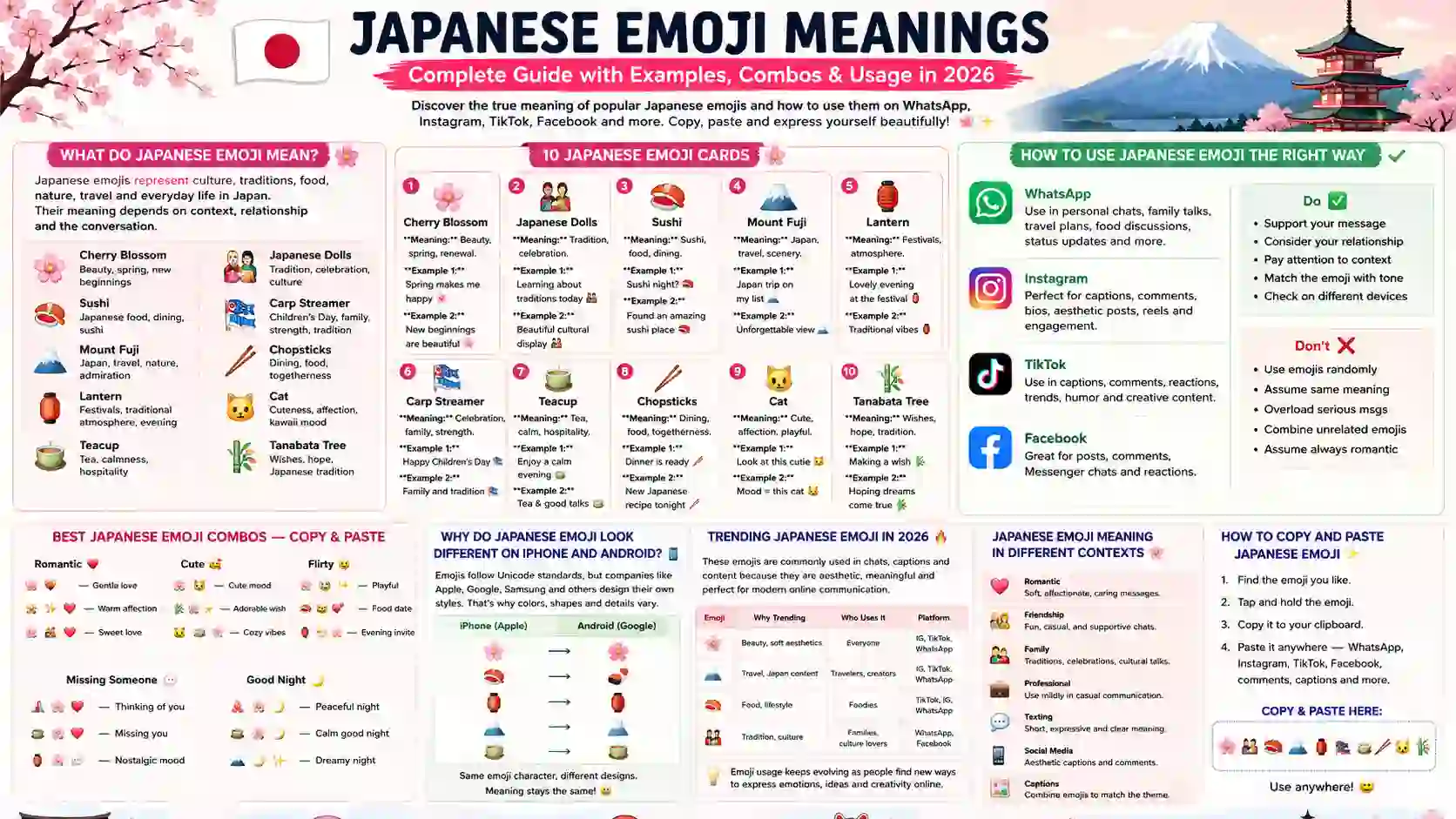
How to Use Japanese Emoji Meanings the Right Way
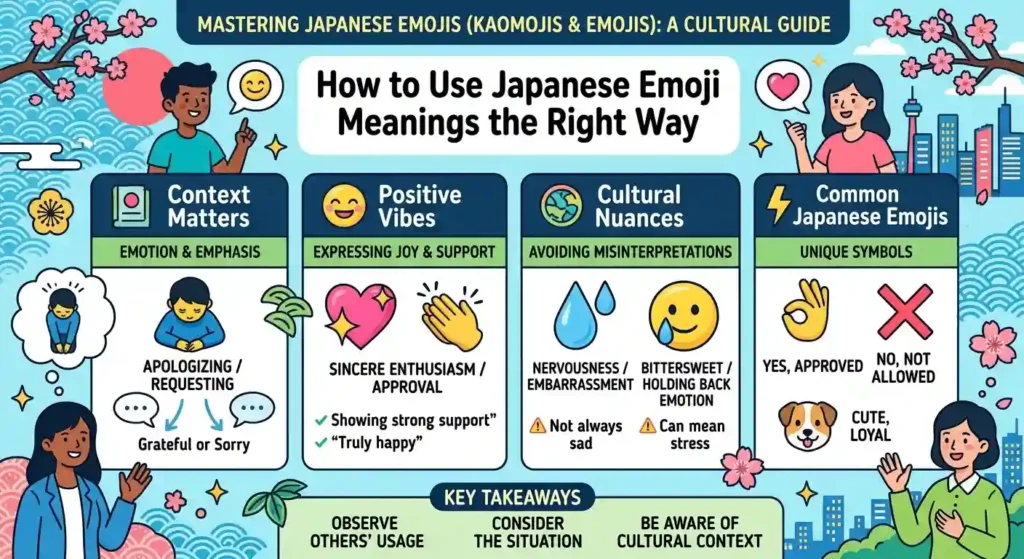
WhatsApp 💬
In personal chats, these symbols work best as playful accents rather than the main message. Sending 🈺 to a close friend when you launch a small project feels casual and fun. In family group chats, ㊗️ fits naturally for birthdays or good news, since it reads instantly as a celebration symbol even without translation. For status updates, 🈳 can hint that you’re free or open to plans this weekend.
Instagram 📸
Captions and bios are where these symbols shine visually, since their bold colors stand out in a feed. A discount post for a small business might use 🈹 right next to the price. Aesthetic posts sometimes use 🈶 or 🈷️ purely for the graphic look rather than the literal meaning. In comments, 🈴 works as a quick way to show approval on someone’s post.
TikTok 🎵
On TikTok, these emojis often show up ironically. Someone joking about a “rule” in their house might caption a video with 🈲, playing on the “prohibited” meaning for comedic effect. Reaction comments sometimes use 🈵 humorously to say a video was “too much” or overwhelming in a good way. Trends built around Japanese aesthetics or Tokyo-style visuals frequently borrow this whole emoji set for atmosphere.
On Facebook, usage tends to be simpler. Posts announcing a business opening might use 🈺 directly. Comments sometimes use ㊗️ to congratulate a friend’s milestone post. In Messenger, these symbols pop up occasionally as a quick, stylish reaction rather than a full sentence.
Dos and Don’ts
Do:
- Use these emojis to add a visual accent, not as your entire message.
- Think about whether your audience will recognize the symbol’s tone.
- Pay attention to the surrounding words for context.
- Match the symbol’s energy to your message, playful or straightforward.
- Check how the symbol renders before sending it in a formal context.
Don’t:
- Use these emojis assuming everyone knows their literal translation.
- Overload a serious message with multiple square symbols.
- Combine unrelated emoji families with this set without a clear reason.
- Assume 🈲 or 🈵 always carries a negative tone, since context often flips it.
- Use them as a substitute for actual Japanese text in formal writing.
Why Do Japanese Emoji Meanings Look Different on iPhone and Android?
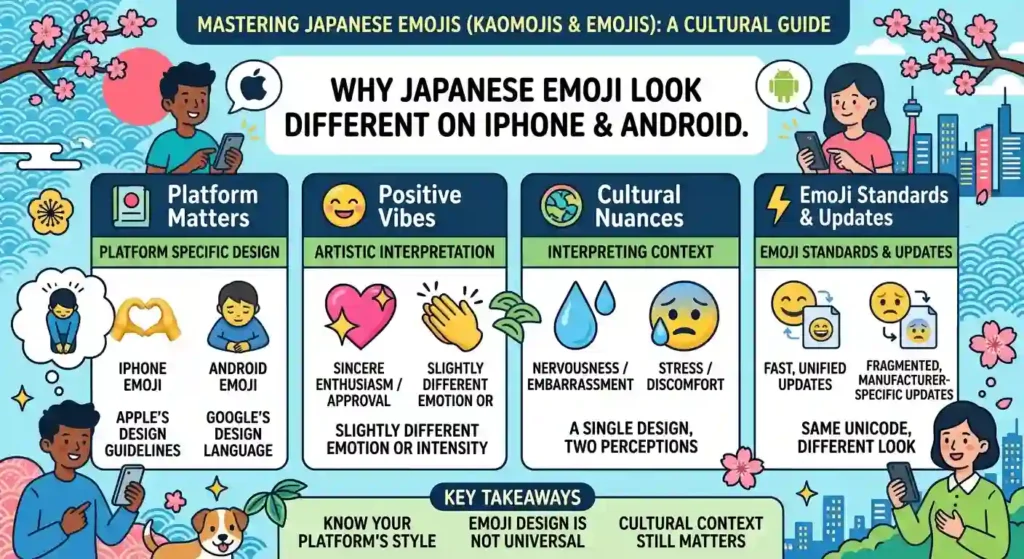
All emojis, including this Japanese symbol set, are built on a shared Unicode standard. That standard defines what each character means and which code point it uses, but it doesn’t control exactly how it looks. Companies like Apple, Google, Samsung, and Microsoft each design their own visual version of every emoji.
Because of this, 🈺 might appear as a slightly different shade of orange on an iPhone compared to a Samsung Galaxy phone. The character stroke style, background shape, and even size can differ slightly across platforms. The underlying meaning and Unicode character stay exactly the same, though.
Neither version is more “correct” than the other. If you send 🈶 from an Android phone to someone using an iPhone, they’ll see Apple’s rendering, not yours, but the meaning transfers perfectly since both devices point to the same Unicode symbol underneath.
Best Japanese Emoji Meanings Combos: Copy and Paste
Romantic ❤️
👉 ㊗️❤️ — Use this for celebrating a relationship milestone.
👉 🈳❤️ — Use this to hint you’re free for a date night.
👉 🈶❤️ — Use this jokingly when love comes with conditions.
Cute 🥰
👉 🈴🥰 — Use this to celebrate a small win together.
👉 🈺🥰 — Use this when announcing something exciting to a friend.
👉 🈹🥰 — Use this when sharing a fun deal you found.
Flirty 😉
👉 🈲😉 — Use this to playfully tease someone about rules.
👉 🈵😉 — Use this to say your heart is “full” for someone.
👉 🈸😉 — Use this to joke about “applying” for someone’s attention.
Missing Someone 💭
👉 🈳💭 — Use this to say there’s a space only they can fill.
👉 🈷️💭 — Use this when counting down the days each month.
👉 ㊗️💭 — Use this when celebrating a memory of them.
Good Night 🌙
👉 🈵🌙 — Use this when your day was completely full.
👉 🈳🌙 — Use this when your night is finally quiet and open.
👉 🈴🌙 — Use this to celebrate finishing the day well.
Trending Japanese Emoji Meanings in 2026
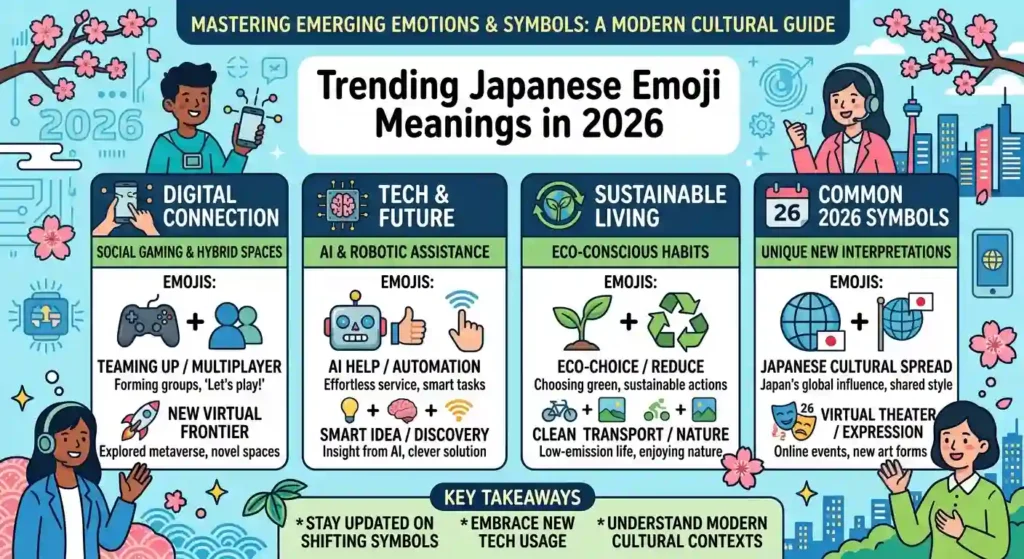
A handful of these symbols keep resurfacing in casual online conversation, particularly 🈺, 🈲, and ㊗️. Creators making Japan-themed or Tokyo aesthetic content commonly use 🈺 in captions to signal something new is available, tying the visual straight into the storefront meaning it originally came from.
🈲 is frequently used in a joking, rule-setting way, especially in comment sections reacting to unpopular opinions. ㊗️ shows up often in celebratory posts, from small personal wins to bigger community announcements, since its bold red seal reads as festive even to people unfamiliar with Japanese.
🈳 also appears often in scheduling-related posts, where people playfully mark themselves as “available” using the symbol instead of typing it out.
| Emoji | Why trending | Who uses it | Platform |
| 🈺 | Signals something new is live | Small business owners, creators | Instagram, TikTok |
| 🈲 | Playful rule-setting humor | Casual commenters, meme accounts | TikTok, Facebook |
| ㊗️ | Bold celebratory visual | Friends, family, community pages | WhatsApp, Instagram |
| 🈳 | Quick way to show availability | Everyday users | WhatsApp, TikTok |
Emoji usage across platforms continues to shift as trends and aesthetics change, and this square symbol set is likely to keep appearing in new, creative contexts over time.
Japanese Emoji Meanings in Different Contexts
In romantic conversations, a symbol like 🈳 can playfully suggest emotional availability rather than its literal meaning. Among friends, 🈲 usually reads as a joke about house rules or shared inside jokes rather than an actual restriction.
Family chats tend to use ㊗️ closer to its true meaning, celebrating birthdays, graduations, or good news. In more casual or professional settings, 🈸 might appear when someone mentions applying for a job or program, blending the literal meaning with everyday conversation.
On social media captions, these symbols often lean stylistic, chosen for their bold color and shape rather than deep meaning. In comments, they tend to react quickly to whatever the post is about, adjusting tone based on the community using them.
How to Copy and Paste Japanese Emoji Meanings
Copying these symbols is simple once you know where to look. Here’s a clean copy-paste line to start with:
🈺 🈵 🈳 🈴 🈶 🈷️ 🈸 🈹 🈲 ㊗️
To use them, simply select the emoji you want, copy it, and paste it directly into WhatsApp, Instagram captions or comments, TikTok captions, or any messaging app. Most phone keyboards also let you search these symbols directly if you type related words like “open” or “full” into your emoji search bar.
FAQ
1. What is the most popular Japanese emoji meaning?
🈺, meaning “open for business,” is one of the most recognized since it’s commonly seen on real storefronts and easily understood even out of context.
2. What does 🈲 mean when someone sends it?
It typically signals something is “not allowed,” but context usually determines whether it’s a serious warning or a lighthearted joke rather than any gendered assumption.
3. Why do emojis look different on iPhone vs Android?
Unicode defines the meaning and character, but each company designs its own visual style, which is why the same symbol can look slightly different across devices.
4. Are Japanese emoji meanings used differently in other countries?
Yes, cultural familiarity with the original Japanese signage can shape how quickly someone recognizes the symbol, though the general playful or stylistic use tends to carry across many online communities.
Conclusion
These small square symbols carry real meaning rooted in everyday Japanese signage, even when they’re used playfully online. Understanding their original context makes it easier to use them thoughtfully in chats, captions, and comments. Next time you spot 🈺 or ㊗️ on your keyboard, you’ll know exactly what story it’s telling. 🈶