One-line Hook
You can send a smile without typing a single word, but the type of smile matters. 😊
Introduction
You type “That’s great!” and then pause for a second. Should you add 😀, 😄, 😊, or simply 🙂? They all look happy, yet each one can give your message a slightly different feeling.
That is why people search for happy emoji faces when they want to understand which smiling face fits a conversation. Some happy emoji faces feel energetic and excited, while others are gentle, polite, playful, or quietly content. A laughing face can make a message feel much more humorous, while a simple smile may work better when you want to sound friendly without being overly enthusiastic.
The meaning also depends on the situation. A happy face in a WhatsApp chat with a close friend may feel completely different from the same emoji in a work conversation. On Instagram or TikTok, it may add personality to a caption or comment. Your relationship with the person, the words around the emoji, and even the platform can influence how it is understood. Similar smiley faces are widely recognized as positive expressions, but their emotional intensity can vary.
So, if you are choosing between happy emoji faces, the best choice is not always the biggest smile. It is the face that matches the feeling you actually want to communicate.
Standout Italicized Snippet
Sometimes the smallest smile can make an ordinary message feel warmer. 😊
What Does Emoji Faces Happy Mean?
The phrase emoji faces happy generally refers to smiling and cheerful facial emojis used to communicate happiness, friendliness, amusement, excitement, warmth, or positive reactions. There is no single emoji that owns the entire idea of happiness. Instead, several faces express different versions of a good mood.
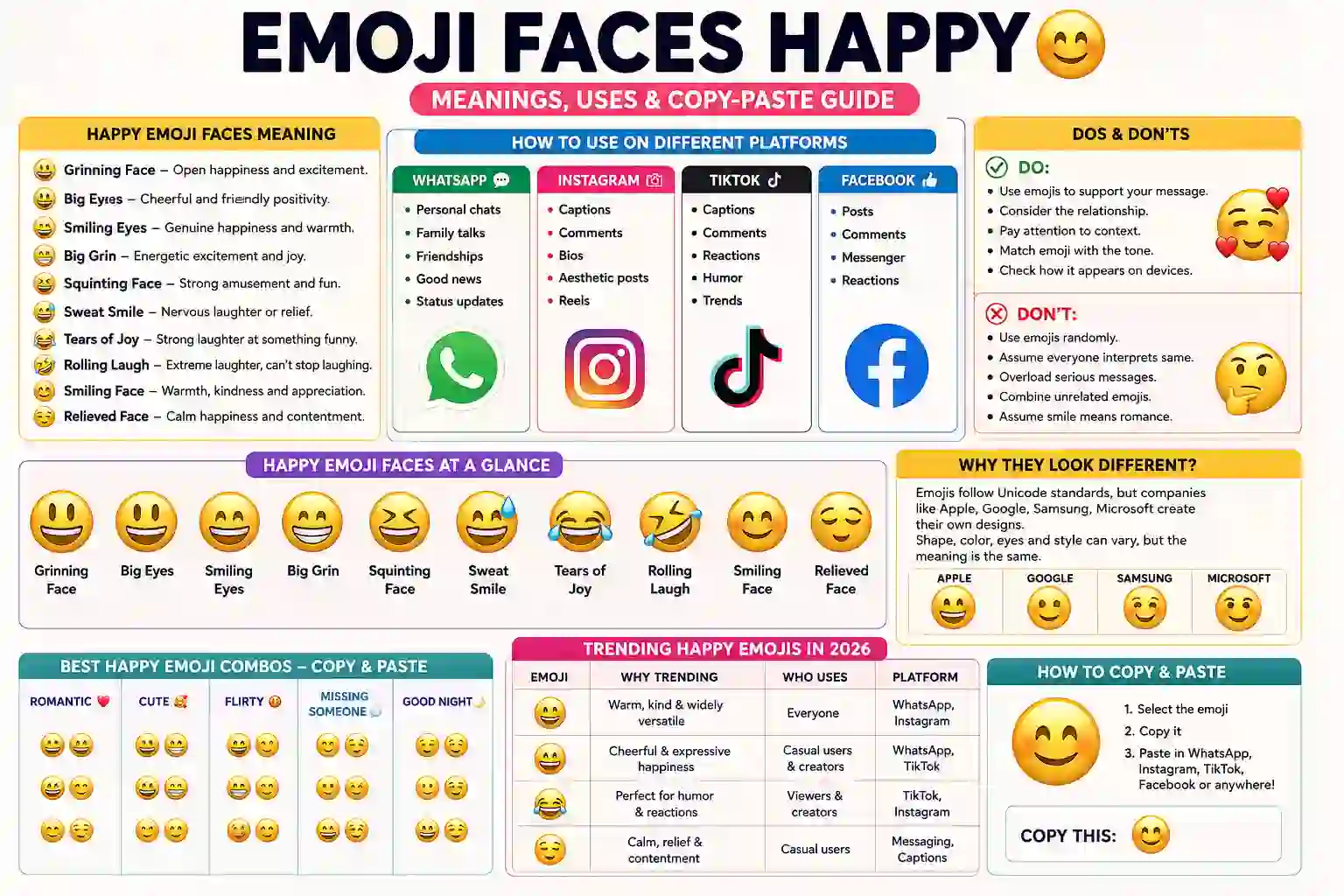
😀 is one of the clearest choices when you want an open, cheerful reaction. It can communicate genuine happiness, approval, or excitement. 😃 has a similarly positive feeling but can look a little more expressive. 😄 often feels especially cheerful because of its smiling eyes, making it useful when something genuinely makes you happy.
😁 adds a broad grin and can feel enthusiastic, playful, or extremely pleased. 😆 and 😂 move further toward laughter, so they are better when the message is genuinely funny. 🤣 is even more intense and is commonly used when something is extremely amusing.
Then there are softer happy emoji faces. 😊 often feels warm, kind, appreciative, or pleasantly shy. 🙂 can be simple and friendly, although its interpretation can depend strongly on the surrounding message. 😌 tends to communicate calm happiness, relief, satisfaction, or emotional comfort. 🙃 is more complicated because the upside-down smile can combine friendliness with irony, awkwardness, or playful frustration.
This distinction matters in texting. If someone tells you, “I finally passed my exam!” then 😄 can sound genuinely celebratory. If someone says, “Thanks for helping me today,” 😊 may feel more natural because it adds warmth without making the response overly energetic.
On Instagram and TikTok, happy faces often appear in comments and captions to reinforce a positive reaction. In a casual conversation, several smiling faces can also become part of someone’s personal texting style.
Context remains the deciding factor. The same emoji can sound sincere, playful, restrained, sarcastic, or awkward depending on the words, relationship, timing, and platform. Recent emoji explanations likewise emphasize that facial details and context can change how a smile is perceived.
Meaning Table
| Emoji | Core meaning | Possible misread | Best used when |
| 😀 | Open happiness | Overly enthusiastic | Good news and cheerful reactions |
| 😃 | Cheerful positivity | Excessive excitement | Friendly conversations |
| 😄 | Genuine happiness | Very energetic | Celebrating something |
| 😁 | Big grin | Too intense | Excitement or playful joy |
| 😆 | Laughing happiness | Childish tone | Funny situations |
| 😅 | Nervous laughter or relief | Awkwardness | Embarrassing or relieved moments |
| 😂 | Strong laughter | Casual tone | Something genuinely funny |
| 🤣 | Intense laughter | Overreaction | Very funny moments |
| 😊 | Warm happiness | Shyness | Appreciation and kindness |
| 🙂 | Simple friendliness | Hidden irritation | Polite casual messages |
| 🙃 | Playful irony | Confusion | Sarcasm or awkward humor |
| 😌 | Calm contentment | Emotional distance | Relief and quiet happiness |
Exactly 10 Emoji Cards
😀 Grinning Face
Meaning: Open happiness, cheerfulness, and positive excitement.
Example 1: We finally finished the project 😀
Example 2: That sounds like great news 😀
😃 Grinning Face with Big Eyes
Meaning: Bright happiness, friendliness, and enthusiastic positivity.
Example 1: I can’t wait for tomorrow 😃
Example 2: You actually remembered! 😃
😄 Grinning Face with Smiling Eyes
Meaning: Genuine happiness, warmth, and cheerful excitement.
Example 1: I’m so happy for you 😄
Example 2: This made my whole day 😄
😁 Beaming Face with Smiling Eyes
Meaning: A broad, energetic grin showing strong happiness or excitement.
Example 1: I got the tickets! 😁
Example 2: Look what I finally bought 😁
😆 Grinning Squinting Face
Meaning: Strong amusement, laughter, and playful happiness.
Example 1: You really said that? 😆
Example 2: I can’t stop laughing at this 😆
😅 Grinning Face with Sweat
Meaning: Nervous laughter, relief, or happiness mixed with awkwardness.
Example 1: I almost missed the deadline 😅
Example 2: That was way too close 😅
😂 Face with Tears of Joy
Meaning: Strong amusement or laughter at something genuinely funny.
Example 1: That video was hilarious 😂
Example 2: You always make me laugh 😂
🤣 Rolling on the Floor Laughing
Meaning: Extremely strong amusement or uncontrollable laughter.
Example 1: That joke was too good 🤣
Example 2: I cannot believe you actually did that 🤣
😊 Smiling Face with Smiling Eyes
Meaning: Gentle happiness, warmth, gratitude, and friendly affection.
Example 1: Thank you for being so kind 😊
Example 2: I’m really glad you came 😊
😌 Relieved Face
Meaning: Calm happiness, relief, comfort, or peaceful satisfaction.
Example 1: Everything worked out in the end 😌
Example 2: Finally, I can relax 😌
How to Use Emoji Faces Happy the Right Way
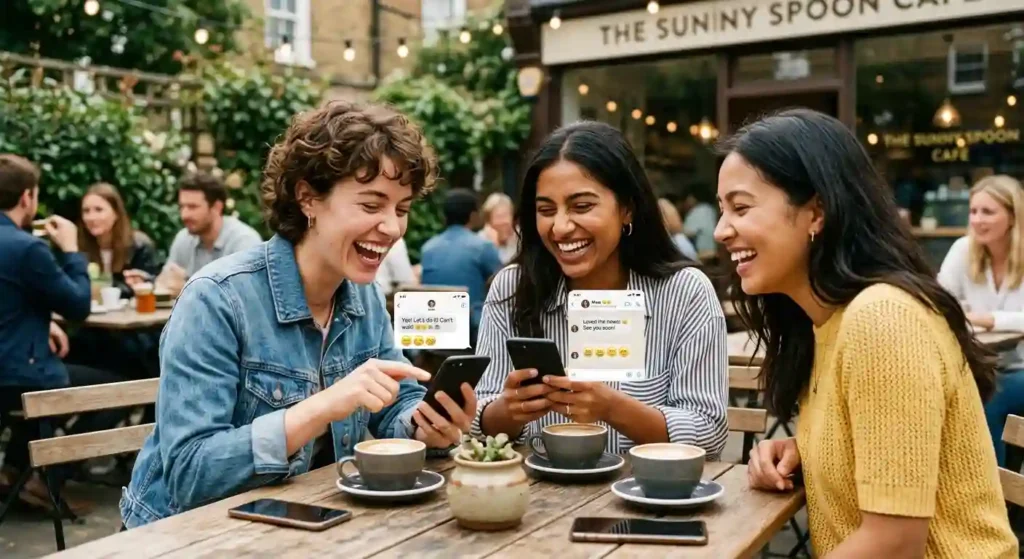
Happy emoji faces work best when they support the emotion already present in your words. Think of them as tone markers rather than automatic translations. The same sentence can feel energetic with 😄, gentle with 😊, or calm with 😌.
WhatsApp 💬
In personal WhatsApp chats, happy faces are useful for good news, encouragement, appreciation, jokes, and everyday friendliness. If a friend says, “I got the job!” then 😄 or 😁 can make your congratulations feel enthusiastic.
Family conversations often work well with simpler faces. “Dinner was amazing 😊” sounds warm and appreciative. A message such as “Made it home safely 😌” communicates relief and calm.
Happy emoji faces can also work in WhatsApp status updates. A short line such as “Good day today 😄” gives a positive feeling without needing a long explanation.
Instagram 📸
Instagram users commonly place smiling faces in captions, comments, and casual reactions. A creator might use 😄 after sharing exciting news, while 😊 can make a supportive comment feel warmer.
For aesthetic or personal posts, softer faces can sometimes fit better than an extremely expressive grin. The goal is to match the visual mood of the post rather than simply adding the happiest-looking emoji available.
TikTok 🎵
On TikTok, happy faces can signal amusement, approval, excitement, or playful reactions. 😂 and 🤣 are especially natural when reacting to genuinely funny content, while 😆 can suit a playful comment.
Context matters even more in short-form content because viewers may interpret an emoji together with a video, caption, sound, and comments.
Facebook posts and comments often use happy faces to congratulate people, react to good news, or make casual conversations feel friendlier. Messenger conversations can use the same faces as ordinary texting.
The strongest approach across every platform is simple: choose the face that matches your actual emotional intensity.
Dos and Don’ts
Do:
- Use emojis to support your message 😊.
- Consider your relationship with the receiver.
- Pay attention to the conversation context.
- Match the emoji with the emotional tone.
- Check how an emoji may appear on different devices.
Don’t:
- Use happy faces randomly.
- Assume everyone interprets them identically.
- Overload a serious message with laughter faces.
- Combine unrelated emojis without purpose.
- Assume a smile automatically means romantic interest.
A simple 😊 can communicate warmth without necessarily communicating romance. Likewise, 😂 usually signals laughter, but the exact strength of that reaction depends on the conversation.
Why Do Emoji Faces Look Different on iPhone and Android?
If you send 😀 from an iPhone to an Android phone, you may notice that the face does not look exactly the same. That does not necessarily mean you sent a different emoji.
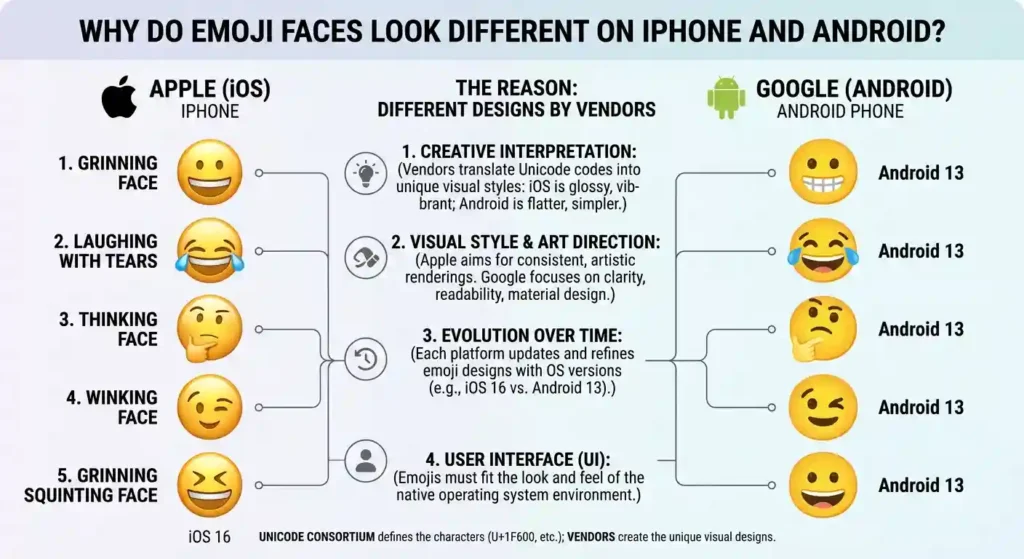
Emojis are standardized through Unicode, which gives characters their underlying identity. However, companies such as Apple, Google, Samsung, and Microsoft can create their own visual artwork for those characters. As a result, the same emoji can have differences in shape, color, facial details, proportions, or overall style.
A smile may look slightly wider on one device. The eyes may appear different. The face may seem more expressive on one platform and simpler on another. Size and rendering can also vary between apps.
This is particularly important with emotional faces because tiny visual details can influence how people perceive them. A face with a slightly different smile or eye shape may feel warmer, stronger, or more playful even though the underlying Unicode character is the same.
There is therefore no universal visual design that every device must copy. The important point is that the character remains recognizable across supported platforms.
For example, if you copy 😊 from a website and paste it into WhatsApp, Instagram, or another messaging app, the recipient may see the platform’s own version of 😊. The character is still the same, even if its artwork changes.
So if an emoji looks a little different on an iPhone, Android phone, Windows computer, or another device, that is usually a rendering difference rather than a change in what you selected.
Best Emoji Faces Happy Combos, Copy & Paste
Romantic ❤️
1.😊😄 — Use this for a warm, happy response to someone you care about.
2.😄😁 — Use this when you are genuinely excited to see someone.
3.😊😌 — Use this for gentle affection and comfortable happiness.
Cute 🥰
1.😊😄 — Use this for a sweet and cheerful reply.
2.😄😁 — Use this when something makes you especially happy.
3.😊🙂 — Use this for a simple, friendly, cute reaction.
Flirty 😉
1.😄😊 — Use this for playful warmth without making the message too intense.
2.😁😊 — Use this when you are smiling at someone’s attention.
3.🙃😊 — Use this for playful teasing with a light tone.
Missing Someone 💭
1.😊😌 — Use this when thinking about someone brings a calm, warm feeling.
2.🙂😊 — Use this for a gentle “thinking of you” message.
3.😄😊 — Use this when remembering someone makes you smile.
Good Night 🌙
1.😌😊 — Use this for a peaceful, warm good-night message.
2.😊🙂 — Use this for a simple friendly bedtime message.
3.😄😌 — Use this after a happy day before going to sleep.
Trending Emoji Faces Happy in 2026
Happy facial emojis remain common in casual digital communication because they can add emotional information without requiring another sentence. Different smiley faces also allow users to control the intensity of a reaction, from a quiet smile to strong laughter. Current emoji resources continue to group faces such as 🙂, 😊, 😄, and 😃 among standard smiling expressions and commonly used positive combinations.
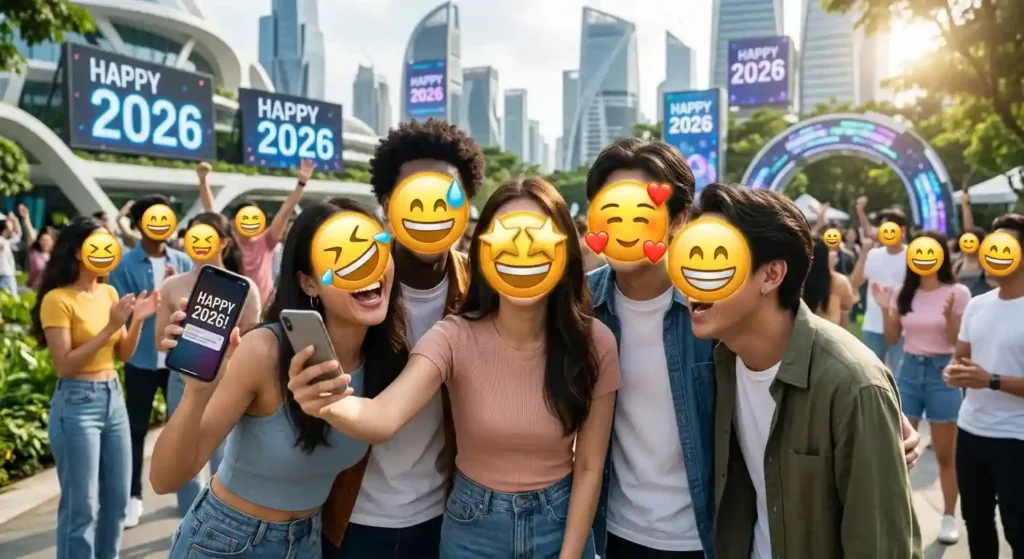
In 2026, the most useful distinction is not necessarily which face is supposedly “number one,” but how people choose among several similar expressions. 😄 often suits cheerful reactions, 😊 works well for warmth, 😂 communicates laughter, and 😌 fits calm or relieved moments.
Creators may use these faces in Instagram captions, TikTok comments, Facebook posts, and casual messaging. Everyday users use them in much the same way, especially when they want text to sound less flat.
| Emoji | Why trending | Who uses it | Platform |
| 😊 | Warm and versatile | Friends and everyday users | WhatsApp, Instagram |
| 😄 | Clearly cheerful | Casual communicators | WhatsApp, TikTok |
| 😂 | Strong humorous reaction | Viewers and creators | TikTok, Instagram |
| 😌 | Calm and positive | Casual users | Messaging, captions |
One useful observation is that emoji usage continues to evolve with online conversation, and people often adapt familiar faces to new conversational tones rather than following one permanent definition.
Emoji Faces Happy Meaning in Different Contexts
A happy face can communicate noticeably different things depending on who receives it and what surrounds it.
Romantic conversations
In romantic chats, 😊 may feel affectionate and emotionally warm. 😄 can show excitement, while 😌 can communicate comfort or peaceful closeness. None of these automatically means romance, however. The words and relationship provide the larger context.
Friendship
Friends often use 😄, 😆, 😂, and 🤣 casually. A funny story may receive 😂, while a silly inside joke may receive 😆. A simple 😊 can show appreciation without making the message overly emotional.
Family
Family conversations often benefit from straightforward positive faces. “See you tonight 😄” feels cheerful and natural. 😊 can soften a thank-you or supportive message.
Professional and casual communication
In professional settings, a restrained smile can sometimes be more appropriate than an intense laughing face. 😊 or 🙂 may work when the conversation is friendly and informal, although workplace norms vary.
Texting
Text messages have fewer visual and vocal cues than face-to-face conversations, so emojis can help clarify tone. Adding 😊 to a short thank-you can make it sound warmer.
Social media comments
Comments are often brief, so an emoji can communicate a reaction quickly. 😂 can indicate laughter, while 😄 can signal enthusiastic approval.
Captions
In captions, happy faces can reinforce the mood of a post without taking attention away from the main text. A single 😊 or 😄 can be enough.
The key is to consider the complete message instead of interpreting the emoji in isolation.
How to Copy and Paste Emoji Faces Happy
Copying a happy emoji is simple.
Copy this: 😊
Select the emoji, copy it, and paste it wherever you want to use it. You can paste it into WhatsApp messages, Instagram captions, TikTok comments, Facebook posts, Messenger chats, text messages, or other apps that support emojis.
You can also copy an entire combination, such as:
😄😊
On a phone, you can usually tap and hold an emoji or use the device’s emoji keyboard. On a computer, you can copy an emoji from a webpage or use the operating system’s emoji picker.
Remember that the recipient may see a slightly different design because their device or app may render the Unicode character using its own emoji artwork.
FAQs
What are the most popular emoji faces?
There is no single happy face that is universally the most popular for every situation. Common choices include 😊, 😄, 😀, and 😂, with each fitting different emotional tones.
What does 😊 mean when someone sends it?
😊 often communicates warmth, friendliness, appreciation, or gentle happiness. Its meaning depends on the conversation and relationship rather than the sender’s or receiver’s gender.
Why do emojis look different on iPhone vs Android?
Apple, Google, Samsung, Microsoft, and other platforms can use different artwork for the same Unicode emoji character. The appearance can therefore change while the underlying emoji remains the same.
Are emoji faces happily used differently in other countries?
Emoji interpretation can vary between communities and cultures, particularly when an expression has a less obvious emotional tone. It is safer to consider the surrounding words, relationship, and local communication style instead of assuming one universal interpretation.
Conclusion
Happy emoji faces give digital conversations extra emotional texture, from the energetic grin of 😄 to the gentle warmth of 😊 and the calm feeling of 😌.
The best choice depends on your words, relationship, platform, and intended tone. 😊
Choose the face that naturally matches what you mean, and your message will usually feel clearer, warmer, and more authentic.