Hook:
One small symbol can completely change the message attached to a rainbow flag.
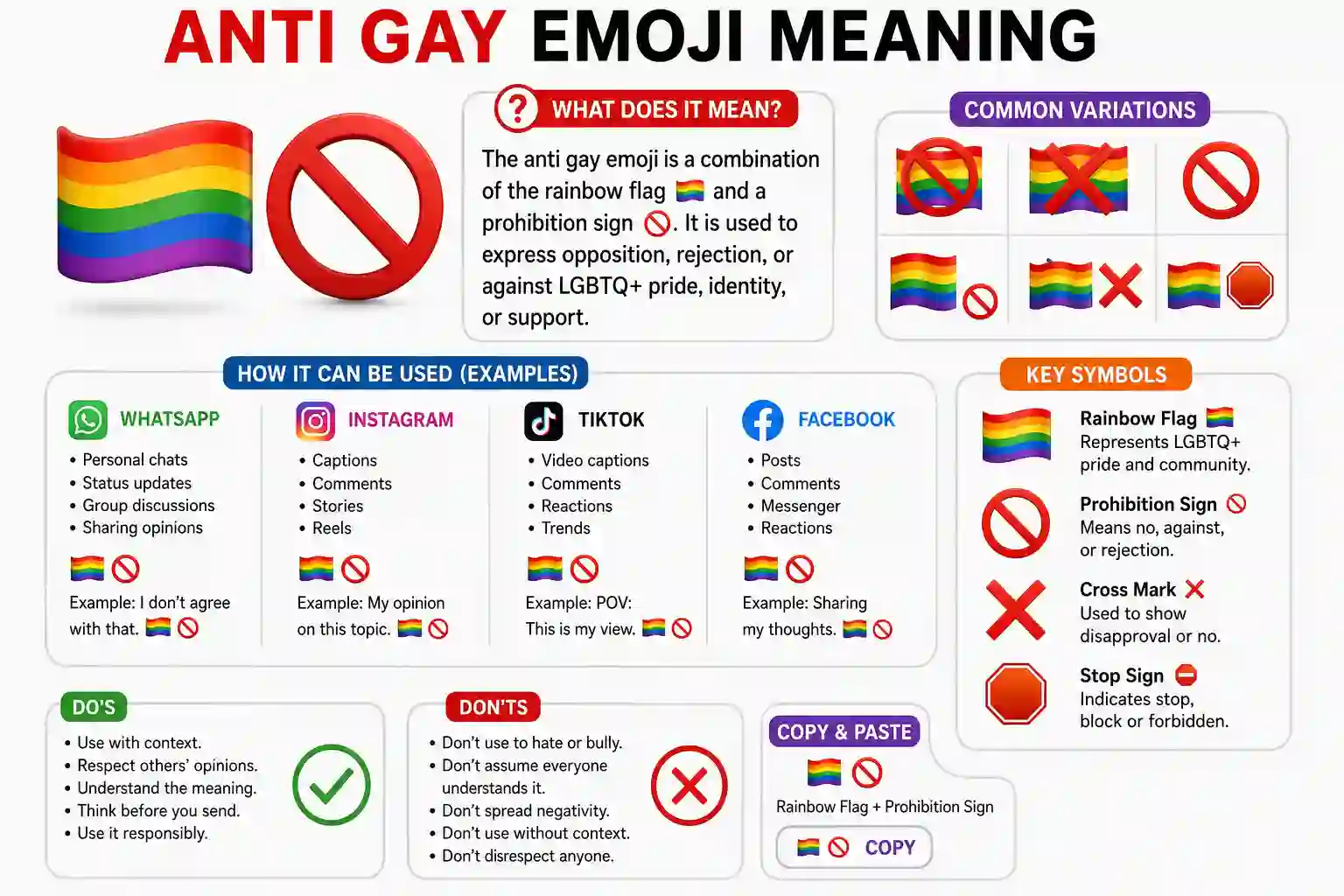
When people search for the anti gay emoji, they are usually looking for the meaning behind combinations such as 🏳️🌈🚫 or a rainbow flag displayed with a prohibition-style mark. It is important to understand that this is not an official standalone Unicode emoji with one standardized name or definition. The viral symbol that attracted attention online was created by combining existing characters, and its appearance could vary between devices.
In a message, the combination can be interpreted as opposition to LGBTQ+ identities, Pride, or LGBTQ+ inclusion. However, context matters. Someone might use it seriously, critically, ironically, or while discussing the history of the symbol. A person discussing the emoji itself may use it without expressing the viewpoint represented by the combination.
The surrounding words, relationship between the people chatting, platform, and community can all affect interpretation. That is why it is better to understand the symbol before assuming what the sender intended. 🏳️🌈🚫
Sometimes the meaning comes less from one emoji and more from the symbols placed together.
What Does Anti Gay Emoji Mean?
The phrase anti gay emoji generally describes an emoji or symbol combination intended to communicate opposition to gay people, LGBTQ+ identities, Pride, or LGBTQ+ symbolism. One commonly discussed version combines the rainbow flag 🏳️🌈 with a prohibition or crossed-out mark. This combination is not an official standalone emoji. It is constructed from existing Unicode characters or symbols.
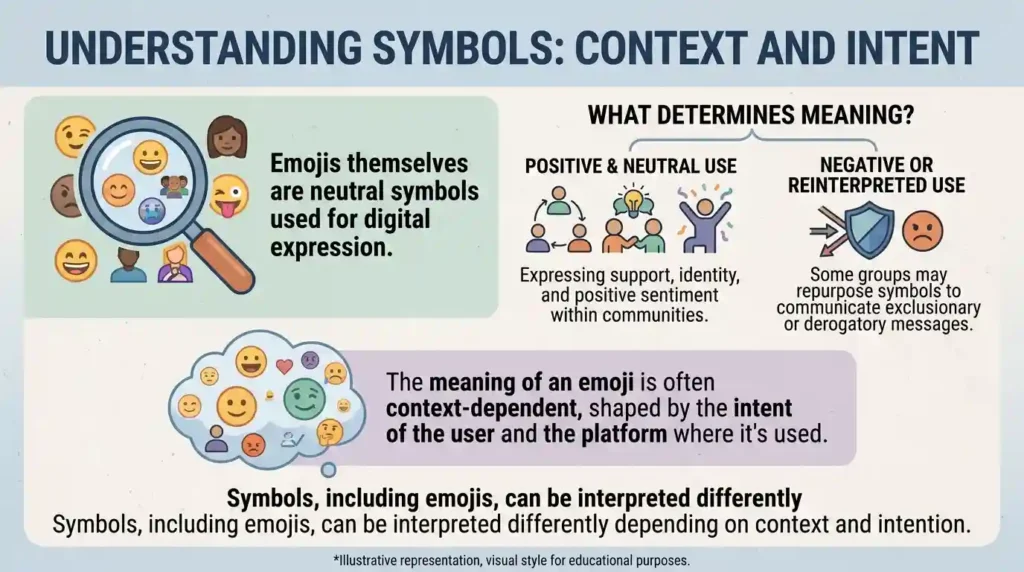
The rainbow flag is widely associated with LGBTQ+ Pride, while 🚫, ❌, or similar prohibition symbols can communicate ideas such as no, prohibited, against, or rejection. When these ideas are visually combined, the resulting message can therefore be read as rejecting or opposing LGBTQ+ symbolism.
In texting, interpretation depends heavily on the surrounding message. Someone might send 🏳️🌈🚫 as an expression of prejudice, while another person might quote it while discussing anti-LGBTQ+ rhetoric. An academic, journalist, moderator, or activist could also display the combination while explaining harmful online symbolism.
On Instagram, TikTok, Facebook, or WhatsApp, the same combination can therefore have very different purposes. A caption surrounding the symbols may completely change the intended meaning.
It is also worth avoiding assumptions about the sender. The symbols themselves cannot reliably tell you someone’s identity, beliefs, or motivation. Look at the words around them and the conversation as a whole.
Meaning Table
| Emoji or symbol | Core meaning | Possible misread | Best used when |
| 🏳️🌈 | LGBTQ+ Pride or identity | May be interpreted simply as colorful or supportive | LGBTQ+ related discussion |
| 🚫 | No, prohibited, rejected | Can sound confrontational | Clear prohibition |
| ❌ | No, wrong, rejection | May sound harsher than intended | Marking something as incorrect |
| ⛔ | Stop or prohibited | Can appear unusually forceful | Warnings or restrictions |
| 🙅 | No or rejection | May feel personal | Clearly expressing refusal |
| 🛑 | Stop | May sound urgent | Strong warning |
| ⚠️ | Caution or warning | Can imply danger | Highlighting a concern |
| 🏳️ | Flag | May be read literally | Flag-related contexts |
| 🏳️⚧️ | Transgender Pride | Can be confused with other Pride symbols | Transgender-related discussion |
| 🫷 | Stop or hold back | Meaning varies by context | Informal refusal or boundary |
Emoji Cards
🏳️🌈 Rainbow Flag
Meaning: LGBTQ+ Pride, community, identity, or support.
Example 1: Pride Month is here 🏳️🌈
Example 2: The post is about LGBTQ+ history 🏳️🌈
🚫 Prohibited
Meaning: No, forbidden, blocked, or not allowed.
Example 1: Smoking is 🚫 here.
Example 2: Outside food 🚫
❌ Cross Mark
Meaning: No, incorrect, rejected, or crossed out.
Example 1: That answer is ❌
Example 2: This option is ❌ for me.
⛔ No Entry
Meaning: Stop, restricted access, or prohibition.
Example 1: Entry is ⛔
Example 2: Do not continue ⛔
🙅 Person Gesturing No
Meaning: Refusal, disagreement, or saying no.
Example 1: Not today 🙅
Example 2: That plan is a no 🙅
🛑 Stop Sign
Meaning: A strong request to stop or pause.
Example 1: Stop right there 🛑
Example 2: Time to pause 🛑
⚠️ Warning
Meaning: Caution, concern, or something requiring attention.
Example 1: Be careful with this ⚠️
Example 2: Content warning ⚠️
🏳️ White Flag
Meaning: A flag symbol that can represent surrender, peace, or a literal flag.
Example 1: The white flag appeared 🏳️
Example 2: A symbol of peace 🏳️
🏳️⚧️ Transgender Flag
Meaning: Transgender Pride, identity, community, or support.
Example 1: Transgender awareness matters 🏳️⚧️
Example 2: The event celebrates Pride 🏳️⚧️
🫷 Hand with Fingers Splayed
Meaning: Stop, wait, hold on, or create a boundary.
Example 1: Wait a second 🫷
Example 2: Please stop 🫷
How to Use Anti Gay Emoji the Right Way

The most responsible way to use this symbol is descriptively rather than as a way to target people. If you are discussing the symbol itself, its history, moderation, or online communication, context can make your purpose clear.
WhatsApp 💬
In personal chats, a rainbow flag combined with a prohibition symbol can easily be interpreted as hostility toward LGBTQ+ people. If you are discussing the symbol rather than expressing opposition, add words that explain your meaning.
For example:
“I’m talking about the viral anti-Pride symbol 🏳️🌈🚫, not supporting it.”
Family conversations require even more attention to context because short emoji combinations can be misunderstood without facial expressions or tone of voice.
Instagram 📸
On Instagram, symbols can appear in captions, comments, bios, Stories, and Reels. A combination involving 🏳️🌈 and 🚫 may be interpreted differently depending on the accompanying caption.
If your post is educational, make that purpose obvious. For example, an article discussing the history of online symbols can show the combination while clearly explaining what it represents.
TikTok 🎵
TikTok comments often depend on trends, irony, memes, and rapidly changing community language. That makes ambiguous emoji combinations especially easy to misunderstand.
If the symbol appears in a discussion, look at the video, caption, and surrounding comments before deciding what the person means.
On Facebook, the combination may appear in posts, comments, Messenger conversations, or shared educational material. The safest interpretation comes from reading the full message rather than treating the symbol as a complete statement.
Dos and Don’ts
Do:
- Consider the surrounding words.
- Think about who will receive the message.
- Explain your intent when discussing controversial symbols.
- Remember that emoji interpretation depends on context.
- Check how symbols render on different devices.
Don’t:
- Assume a symbol automatically reveals someone’s identity.
- Use a symbol to harass or target someone.
- Treat an unofficial combination as an official Unicode emoji.
- Assume every person interprets it identically.
- Use ambiguous symbols in serious conversations without context.
Why Do Anti Gay Emoji Look Different on iPhone and Android?
The anti gay emoji can look different because the combination is not a single official emoji with one standardized artwork. Unicode defines characters and sequences, while platforms such as Apple, Google, Samsung, and Microsoft can create their own visual designs.
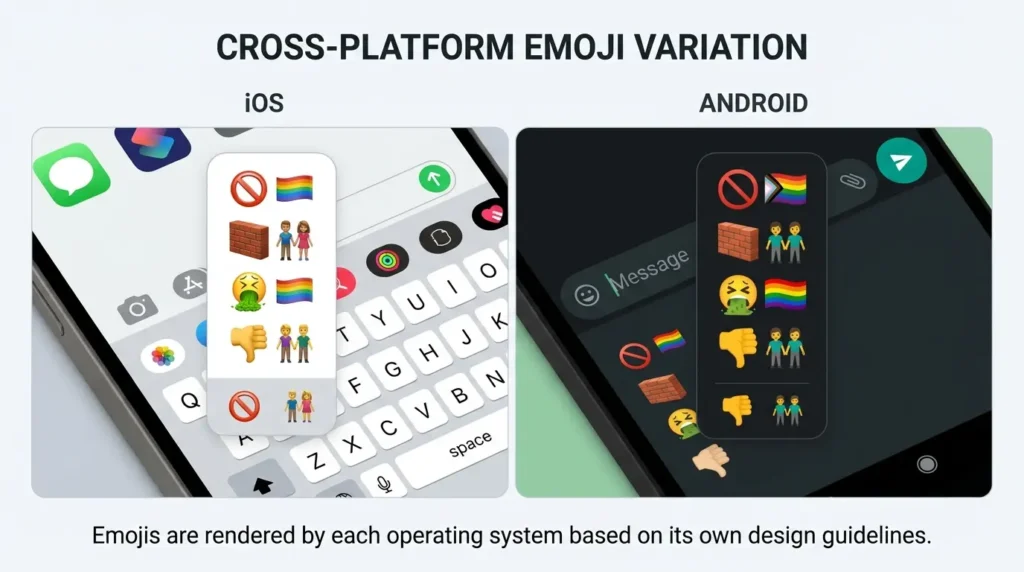
This distinction is especially important for emoji combinations. A sequence that appears visually combined on one device may appear as separate characters on another. The viral anti-Pride symbol discussed in 2019 was particularly notable because the prohibition-style mark could be rendered differently depending on the system.
For example, one device might visually place a prohibition mark over or alongside 🏳️🌈, while another might simply display 🏳️🌈 and 🚫 next to each other.
That does not necessarily mean one device is showing the “correct” emoji and another is wrong. It means the underlying characters or sequence are being rendered according to the platform’s supported design.
You may also notice differences in:
- Shape
- Color
- Size
- Spacing
- Symbol placement
- Whether a sequence combines visually
This is one reason screenshots of unusual emoji combinations can sometimes look surprising when viewed on another phone.
Best Anti Gay Emoji Combos, Copy & Paste
These combinations are presented for recognition, discussion, and contextual understanding, not as recommendations for targeting LGBTQ+ people. Because the keyword refers to a negative or hostile meaning, the examples below should be interpreted according to their surrounding text.
Romantic ❤️
1.🏳️🌈🚫❤️ , can imply rejection of LGBTQ+ relationships.
2.❌🏳️🌈❤️ , can visually frame opposition to a Pride-related romantic topic.3
3.🙅🏳️🌈❤️ , can represent refusal in a discussion about LGBTQ+ relationships.
Cute 🥰
1.🏳️🌈🚫🥰 , may be used while discussing an anti-Pride meme or symbol.
2.❌🏳️🌈🥰 , can indicate rejection in an ironic or quoted context.
3.🏳️🌈🙅🥰 , may represent a refusal involving a Pride-related topic.
Flirty 😉
1.🏳️🌈🚫😉 , can be interpreted as rejecting a Pride-related suggestion.
2.🙅🏳️🌈😉 , may communicate refusal, depending on the surrounding message.
3.❌🏳️🌈😉 , can suggest rejection of the topic, but tone depends on context.
Missing Someone 💭
1.🏳️🌈🚫💭 , may appear when discussing rejection or opposition in a conversation.
2.❌🏳️🌈💭 , can indicate that a Pride-related idea is being rejected.
3.🙅🏳️🌈💭 , can communicate refusal connected to the topic.
Good Night 🌙
1.🏳️🌈🚫🌙 , may appear in a quoted or meme-based discussion.
2.❌🏳️🌈🌙 , can indicate rejection when the symbols are being discussed.
3.🙅🏳️🌈🌙 , can communicate “no” in a contextual conversation.
Trending Anti Gay Emoji in 2026
The term continues to appear mainly as a search and user-created combination rather than the name of a newly standardized emoji. Current emoji search pages list combinations involving 🏳️🌈, 🚫, ❌, and related symbols, while historical reporting confirms that the viral version was constructed from existing characters.
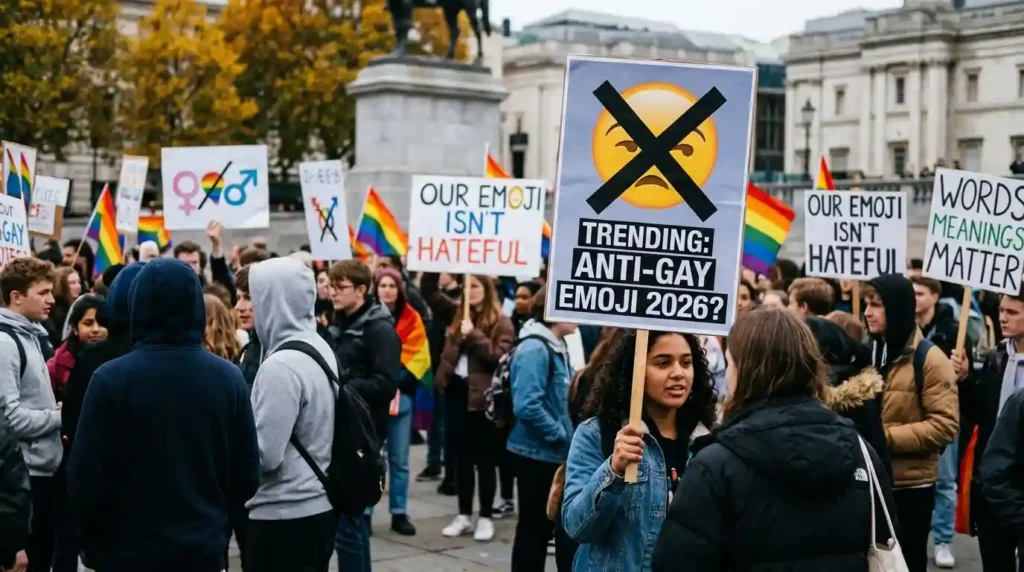
This distinction matters in 2026 because people often discover unusual emoji combinations through social media posts, memes, comments, and copy-paste websites. A combination may become recognizable within an online community without ever becoming an official Unicode emoji.
| Emoji | Why it appears | Who uses it | Platform |
| 🏳️🌈 | Pride and LGBTQ+ discussions | General users and communities | Instagram, TikTok, WhatsApp |
| 🚫 | Prohibition or rejection | Meme and discussion users | Social media, messaging |
| ❌ | Rejection or disagreement | General users | Comments, chats |
| 🙅 | Informal refusal | Casual users | TikTok, Instagram, WhatsApp |
The broader lesson is that online emoji usage changes through community habits, memes, combinations, and context rather than only through official emoji releases.
Anti Gay Emoji Meaning in Different Contexts
The same symbol combination can communicate different things depending on where it appears.
In a romantic conversation, 🏳️🌈🚫 could be interpreted as rejection of a same-sex relationship or Pride-related romantic topic. If someone is merely discussing the symbol, however, the meaning may be completely different.
In friendship, the combination might appear in a meme, joke, quoted message, or disagreement. The surrounding text is essential for understanding whether the sender is being serious or discussing the symbol itself.
In a family conversation, an unexplained combination can create confusion because recipients may not be familiar with internet symbolism.
In professional communication, it is generally better to use explicit words rather than relying on ambiguous symbols, especially when discussing sensitive subjects.
In texting, short combinations can carry strong emotional meanings because there is no voice or facial expression to provide additional context.
On social media, comments can be especially difficult to interpret because irony and community-specific humor are common. Look at the original post, replies, caption, and surrounding symbols before reaching a conclusion.
The key point is simple: an emoji combination can suggest an attitude, but context tells you how that attitude is actually being used.
How to Copy and Paste Anti Gay Emoji
There is no single official standalone “anti gay emoji” to copy in the same way you would copy a standard Unicode emoji.
For discussion or educational purposes, you can copy the commonly searched combination:
🏳️🌈🚫
Select the symbols, copy them, and paste them into supported apps such as WhatsApp, Instagram, TikTok, Facebook, or a text message.
Keep in mind that the appearance may change between platforms. Some devices may show the symbols separately rather than as a visually combined design. This is one reason a copied emoji sequence can look different from the screenshot where you originally found it.
FAQ
What is the most popular anti gay emoji?
There is no official standalone anti gay emoji. The combination most commonly associated with the term is a rainbow flag with a prohibition or rejection symbol, such as 🏳️🌈🚫.
What does 🏳️🌈🚫 mean when someone sends it?
It can communicate opposition to LGBTQ+ Pride or LGBTQ+ identities, but context matters. It may also appear while someone is discussing, quoting, criticizing, or explaining the symbol rather than endorsing its message.
Why do emojis look different on iPhone vs Android?
Unicode defines the underlying characters, while Apple, Google, Samsung, and other platforms design their own visual presentations. Emoji sequences can therefore look different across devices.
Are anti gay emojis used differently in other countries?
Interpretations can vary between communities and cultures. Online groups may also develop their own meanings, so it is better to consider the surrounding conversation instead of assuming one universal interpretation.
Conclusion
The anti gay emoji is generally a user-created symbol combination rather than an official standalone Unicode emoji. 🏳️🌈🚫
Its meaning can depend heavily on context, wording, platform, and community. Understanding the difference between an emoji’s visual construction and the message someone intends can prevent unnecessary misunderstandings.
When discussing sensitive symbols, clear language is usually more reliable than emojis alone.