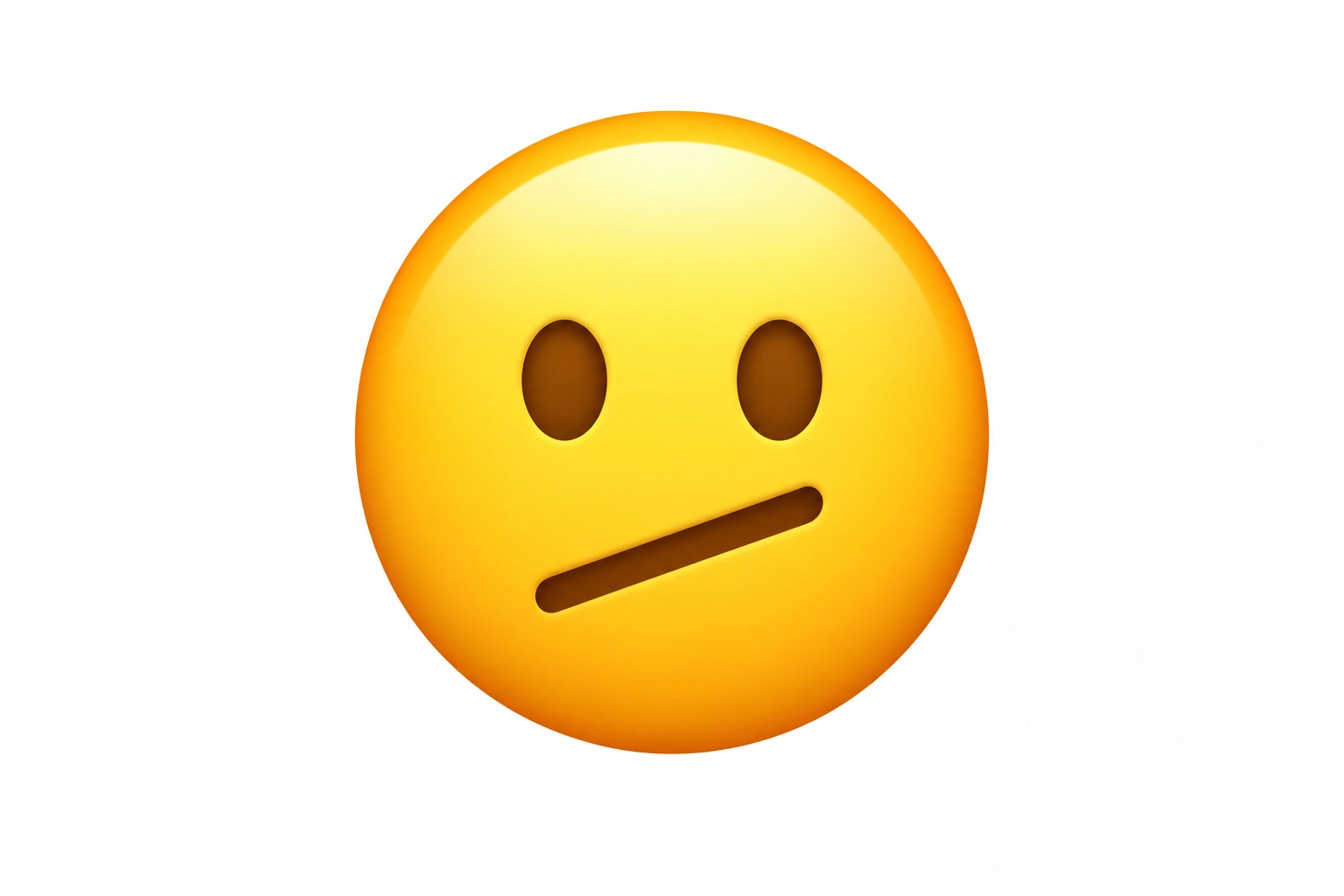
One-line Hook
One tiny sideways expression can say, “I’m not sure how I feel about this.” 🫤
If someone sends you 🫤, you might pause and wonder whether they are confused, uncomfortable, doubtful, or simply unimpressed. That is exactly why the sideways mouth emoji can be tricky to interpret. It is commonly associated with mixed feelings, uncertainty, awkwardness, hesitation, or a reaction that is somewhere between positive and negative. In texting, the surrounding words usually matter just as much as the emoji itself. 🫤
You may see it in a WhatsApp conversation after an unexpected message, in an Instagram comment when something feels questionable, or in a TikTok reply when someone does not quite know how to react. It can also soften a mildly awkward response without making the message sound overly serious. 😅
The meaning can change depending on your relationship with the sender, the conversation, and even the tone of the message. A friend may use 🫤 jokingly, while someone else may use it to show genuine discomfort or uncertainty.
The sideways mouth emoji is perfect for those “Well… I’m not sure about those moments. 🫤
What Does the Sideways Mouth Emoji Mean?
The 🫤 emoji is officially known as Face with Diagonal Mouth, but many people casually call it the sideways mouth emoji. Its basic idea is a facial expression that looks uncertain, uneasy, conflicted, or mildly uncomfortable. Unlike a clearly happy or sad face, 🫤 sits somewhere in the middle. That makes it especially useful when your feelings are difficult to put into words.

In texting, 🫤 can communicate “I don’t know,” “That feels weird,” “I’m not convinced,” or “This is awkward.” For example, someone might say, “You want me to call them right now? 🫤” The emoji adds hesitation without needing a long explanation.
It can also express skepticism. If a friend tells you, “I finished the entire project in ten minutes 🫤,” the emoji could suggest that you are doubtful or unconvinced. In a positive conversation, it may simply show uncertainty rather than negativity.
On social media, the emoji often works as a subtle reaction. An Instagram commenter might use 🫤 when a post leaves them unsure what to think. On TikTok, it can accompany an awkward, unexpected, or questionable moment. 😬 and 😐 can sometimes appear in similar situations, but they do not necessarily communicate exactly the same emotional nuance.
Context matters enormously. A romantic partner sending “Okay 🫤” may sound disappointed or hesitant, while a friend sending “That outfit is certainly a choice 🫤” may be joking. In family chats, it can show mild confusion. In professional communication, however, it may be better to use clear words because facial emojis can be interpreted differently.
Other nearby emojis include 😕 for confusion, 😐 for neutrality, 😬 for awkwardness, and 🤨 for skepticism. 😅 can make an awkward situation feel lighter, while 🙃 may suggest ironic frustration.
Meaning Table
| Emoji | Core meaning | Possible misread | Best used when |
| 🫤 | Mixed feelings, uncertainty | Anger or sadness | You feel unsure |
| 😕 | Confusion or concern | Disapproval | Something is unclear |
| 😐 | Neutral reaction | Coldness | You have little reaction |
| 😬 | Awkwardness or tension | Fear | A situation feels uncomfortable |
| 🤨 | Doubt or skepticism | Accusation | You question something |
| 🙃 | Irony or frustration | Happiness | You are being sarcastic |
| 😅 | Nervous or awkward humor | Genuine happiness | You want to soften awkwardness |
| 😶 | Speechlessness | Disinterest | You do not know what to say |
| 😑 | Annoyance or flatness | Simple neutrality | You are unimpressed |
| 🤔 | Thinking or uncertainty | Doubt | You are considering something |
Emoji Cards
🫤 Face with Diagonal Mouth
Meaning: Mixed feelings, hesitation, uncertainty, or mild discomfort.
Example 1: I’m not really sure about that 🫤
Example 2: This situation feels a little strange 🫤
😕 Confused Face
Meaning: Confusion, uncertainty, or concern.
Example 1: Wait, what just happened? 😕
Example 2: I don’t understand this part 😕
😐 Neutral Face
Meaning: A flat, neutral, or emotionally restrained reaction.
Example 1: Okay, noted 😐
Example 2: I honestly have no reaction 😐
😬 Grimacing Face
Meaning: Awkwardness, tension, embarrassment, or discomfort.
Example 1: That was painfully awkward 😬
Example 2: I accidentally sent it to the wrong person 😬
🤨 Face with Raised Eyebrow
Meaning: Doubt, suspicion, curiosity, or skepticism.
Example 1: Are you serious right now? 🤨
Example 2: I’m not sure I believe that 🤨
🙃 Upside-Down Face
Meaning: Irony, sarcasm, awkward humor, or hidden frustration.
Example 1: Everything is going perfectly 🙃
Example 2: Another Monday morning 🙃
😅 Grinning Face with Sweat
Meaning: Nervousness, relief, awkward humor, or embarrassment.
Example 1: I almost forgot the deadline 😅
Example 2: That could have gone badly 😅
😶 Face Without Mouth
Meaning: Speechlessness, silence, or not knowing what to say.
Example 1: I honestly have nothing to say 😶
Example 2: You really said that? 😶
😑 Expressionless Face
Meaning: Annoyance, boredom, impatience, or an unimpressed reaction.
Example 1: You did it again 😑
Example 2: I’m officially out of words 😑
🤔 Thinking Face
Meaning: Thinking, considering, questioning, or uncertainty.
Example 1: Let me think about it 🤔
Example 2: I’m not completely convinced 🤔
How to Use the Sideways Mouth Emoji the Right Way
The best way to use 🫤 is to let the surrounding message establish the situation. On WhatsApp 💬, it works naturally in personal chats when you want to express hesitation without sounding dramatically upset. With friends, “Are we really doing this? 🫤” can sound playful. In a family conversation, “So we’re leaving at 6 AM? 🫤” can communicate reluctance. It can also work in a status update when you want to hint at mixed feelings without explaining everything.
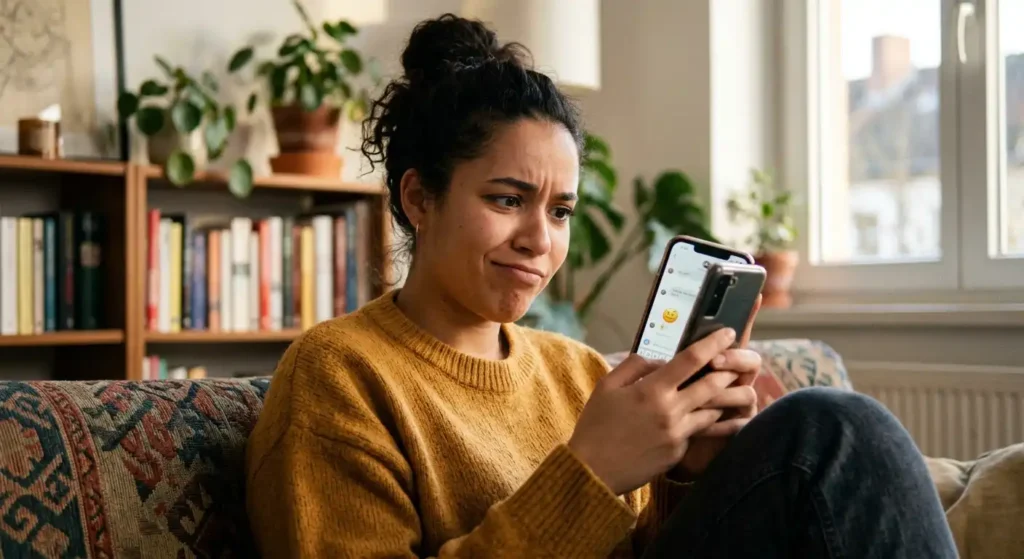
For emotional messages, wording is particularly important. “I guess that’s okay 🫤” can sound disappointed, while “I don’t know what to choose 🫤” sounds genuinely uncertain. The same emoji can therefore create different impressions.
On Instagram 📸, 🫤 can appear in captions, comments, reels, and casual replies. A creator might use it after describing an unexpectedly awkward situation. A commenter could respond with “Interesting choice 🫤” to express uncertainty or mild skepticism. In a bio, however, the emoji is less straightforward because there may be little context around it.
On TikTok, the emoji can work especially well with humor, unexpected moments, and reactions. A comment such as “He really thought that would work 🫤” gives the emoji a skeptical or unimpressed tone. It can also support irony when the video itself provides enough context.
On Facebook, 🫤 can appear in posts, comments, and Messenger conversations. Because Facebook includes many different age groups and communication styles, it is safest to judge the tone from the complete message rather than assuming everyone uses it identically.
The emoji is less suitable when you need precision. In a professional conversation, for example, “I’m uncertain about this approach” is clearer than simply sending 🫤. The emoji works best when the recipient already understands your conversational style.
Do
- Use 🫤 when your feelings are mixed or uncertain.
- Let the written message provide context.
- Consider your relationship with the recipient.
- Match the emoji to the emotional tone.
- Remember that different devices may render it differently.
Don’t
- Assume 🫤 automatically means sadness.
- Use it as a substitute for an important explanation.
- Add several unrelated emojis just to make a message more expressive.
- Assume everyone will interpret it exactly as you intended.
- Treat every use as romantic or negative.
Why Does the Sideways Mouth Emoji Look Different on iPhone and Android?
You may notice that 🫤 does not look exactly the same on an iPhone, Android phone, Windows computer, or another device. That is normal. Emojis are based on Unicode standards, which provide a common character system so devices and applications can recognize the same emoji. However, Unicode does not require every company to draw that character in exactly the same way.
Apple, Google, Samsung, Microsoft, and other technology companies can create their own emoji artwork. As a result, the sideways mouth emoji may have slightly different proportions, shading, line details, or facial appearance depending on the platform. The overall concept remains connected to the same Unicode character.
The difference can occasionally affect how an expression feels. A face that looks slightly more serious on one platform may appear softer or more neutral on another. This is one reason emoji interpretation should focus on the conversation rather than the artwork alone.
The size can also change. An emoji displayed inside a messaging app may look different from the same character shown on a website, social platform, or desktop application. Fonts, operating systems, app designs, and rendering systems can all influence its appearance.
For example, if you send 🫤 from an iPhone to an Android user, they receive the same underlying emoji character, but their device may display its own version. Neither design is necessarily the “correct” visual version. They are different graphical interpretations of the same standardized character.
This matters when discussing emoji meanings because people sometimes think a slightly different appearance represents a different emoji. Usually, it does not. If the Unicode character is the same, the visual design can vary while the underlying character remains unchanged.
So if your sideways mouth emoji looks a little different from a friend’s screenshot, there is usually no reason to worry. It is simply the way that platform renders the emoji.
Best Sideways Mouth Emoji Combos, Copy & Paste
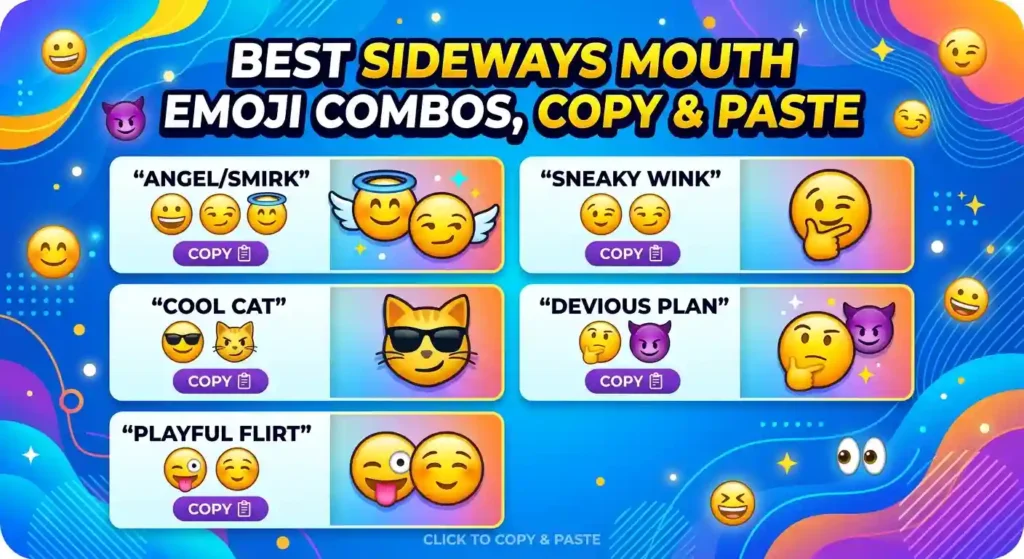
Romantic ❤️
1.👉 🫤❤️, Use this when affection is mixed with uncertainty.
2.👉 🫤💕, Use this for a hesitant but caring message.
3.👉 ❤️🫤, Use this when you care but are unsure about the situation.
Cute 🥰
1.👉 🫤🥰, Use this for playful uncertainty with affection.
2.👉 🥰🫤, Use this when something is cute but slightly confusing.
3.👉 🫤😊, Use this for a soft, lighthearted reaction.
Flirty 😉
1.👉 🫤😉, Use this when teasing someone while acting uncertain.
2.👉 😉🫤, Use this for playful doubt in a flirtatious chat.
3.👉 🫤😏, Use this when uncertainty has a teasing edge.
Missing Someone 💭
1.👉 🫤💭, Use this when you are thinking about someone with mixed feelings.
2.👉 💭🫤, Use this for a reflective or uncertain mood.
3.👉 🫤💭❤️, Use this when missing someone feels emotionally complicated.
Good Night 🌙
1.👉 🫤🌙, Use this for a slightly uncertain good-night mood.
2.👉 🌙🫤, Use this when ending the conversation feels bittersweet.
3.👉 🫤🌙❤️, Use this for a caring but emotionally mixed good-night message.
Trending Sideways Mouth Emoji in 2026
In 2026, 🫤 fits naturally into the broader style of online communication where people use emojis as quick emotional reactions rather than simple decorations. Its appeal comes from its ambiguity. It can express uncertainty, awkwardness, skepticism, or a feeling that does not fit neatly into “happy” or “sad.”
On WhatsApp, people can use it in casual conversations when a situation feels questionable or uncomfortable. On Instagram and TikTok, it can work as a reaction to unusual posts, unexpected situations, or humorous moments. In comments, its meaning is often shaped by the text immediately before it.
The emoji can also be useful for creators because it communicates a reaction without requiring a long sentence. A short caption followed by 🫤 may suggest that something did not go as planned. At the same time, another user might use it simply because they cannot decide whether something is funny, strange, or concerning.
| Emoji | Why trending | Who uses it | Platform |
| 🫤 | Expresses mixed reactions | Casual users and creators | WhatsApp, TikTok |
| 😬 | Captures awkward moments | Social media users | TikTok, Instagram |
| 🤨 | Shows doubt quickly | Commenters and friends | Instagram, Facebook |
| 🙃 | Works well with irony | Casual communicators | TikTok, WhatsApp |
The important point is that online emoji usage keeps evolving. People frequently adapt familiar symbols to new jokes, conversational habits, memes, and social situations, so the surrounding message remains essential.
Sideways Mouth Emoji Meaning in Different Contexts
In a romantic conversation, 🫤 can suggest uncertainty, disappointment, or hesitation. If someone says, “You forgot our plans 🫤,” the emoji may make the disappointment visible without making the message extremely harsh. It can also be playful when both people regularly tease each other.
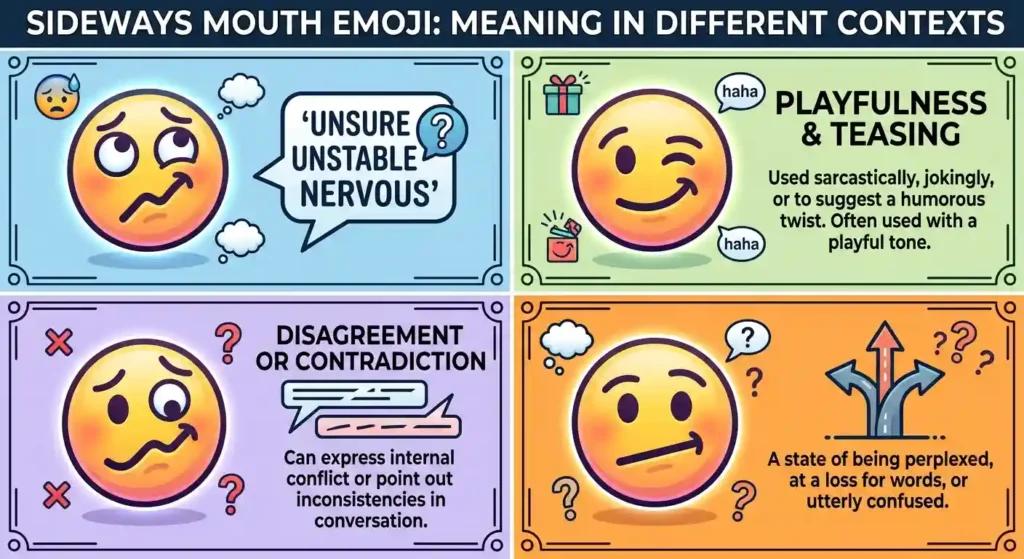
Between friends, it is often much lighter. “You’re seriously ordering that? 🫤” could simply be friendly teasing. The relationship gives the recipient information that the emoji alone cannot provide.
In a family chat, 🫤 may express reluctance or mild confusion. “We’re having dinner at 5 PM? 🫤” is a simple example. The sender may not be angry at all, just surprised by the timing.
In professional or casual communication, context becomes even more important. Among coworkers who frequently use emojis, 🫤 might communicate uncertainty about a suggestion. In a formal workplace message, however, clear language is usually preferable.
In texting, the emoji can function almost like a facial reaction. “I guess so 🫤” feels different from “I guess so.” It adds emotional information while leaving the exact feeling open to interpretation.
In social media comments, 🫤 can be humorous, skeptical, or mildly critical. A comment such as “That explanation 🫤” could indicate that the viewer is not convinced. The same character might also be used affectionately if the post is clearly joking.
For captions, it can create a deliberately uncertain mood. “Well, that happened 🫤” leaves room for readers to interpret the situation. That ambiguity is part of its usefulness.
Ultimately, the sender’s intention, the recipient’s expectations, and the surrounding words all work together. There is no single interpretation that applies to every conversation.
How to Copy and Paste the Sideways Mouth Emoji
If you simply need the sideways mouth emoji, copy it here:
🫤
On a phone or computer, select the emoji, copy it, and paste it wherever you need it. You can use it in WhatsApp messages, Instagram captions and comments, TikTok captions and replies, Facebook posts, Messenger chats, or other apps that support Unicode emojis.
If you are unsure whether the emoji will display correctly, send a quick test message first. Most modern devices support it, although its visual design may differ from one platform to another.
FAQs
1. What is the most popular sideways mouth emoji?
The primary sideways mouth emoji is 🫤, officially known as Face with Diagonal Mouth. It is commonly used to show uncertainty, mixed feelings, awkwardness, or hesitation.
2. What does 🫤 mean when someone sends it?
It depends on the conversation. The sender may be uncertain, uncomfortable, skeptical, disappointed, or simply reacting to something awkward. The meaning should not be assumed based on gender or stereotypes.
3. Why do emojis look different on iPhone vs Android?
Apple and Android-related platforms can use different artwork for Unicode emojis. The character remains the same even though its shape, details, or expression may look slightly different.
4. Are sideways mouth emojis used differently in other countries?
Emoji interpretation can vary with language, culture, online communities, and personal communication habits. However, it is better to consider the specific conversation rather than assuming one universal cultural meaning.
Conclusion
The sideways mouth emoji 🫤 is useful when your reaction is somewhere between certainty and uncertainty. Its meaning can shift from awkwardness to skepticism, hesitation, or mixed feelings depending on the conversation.
Use it with context, especially when the message could be interpreted in more than one way. A little thought behind your emoji choice can make digital conversations feel much clearer and more natural. 🫤