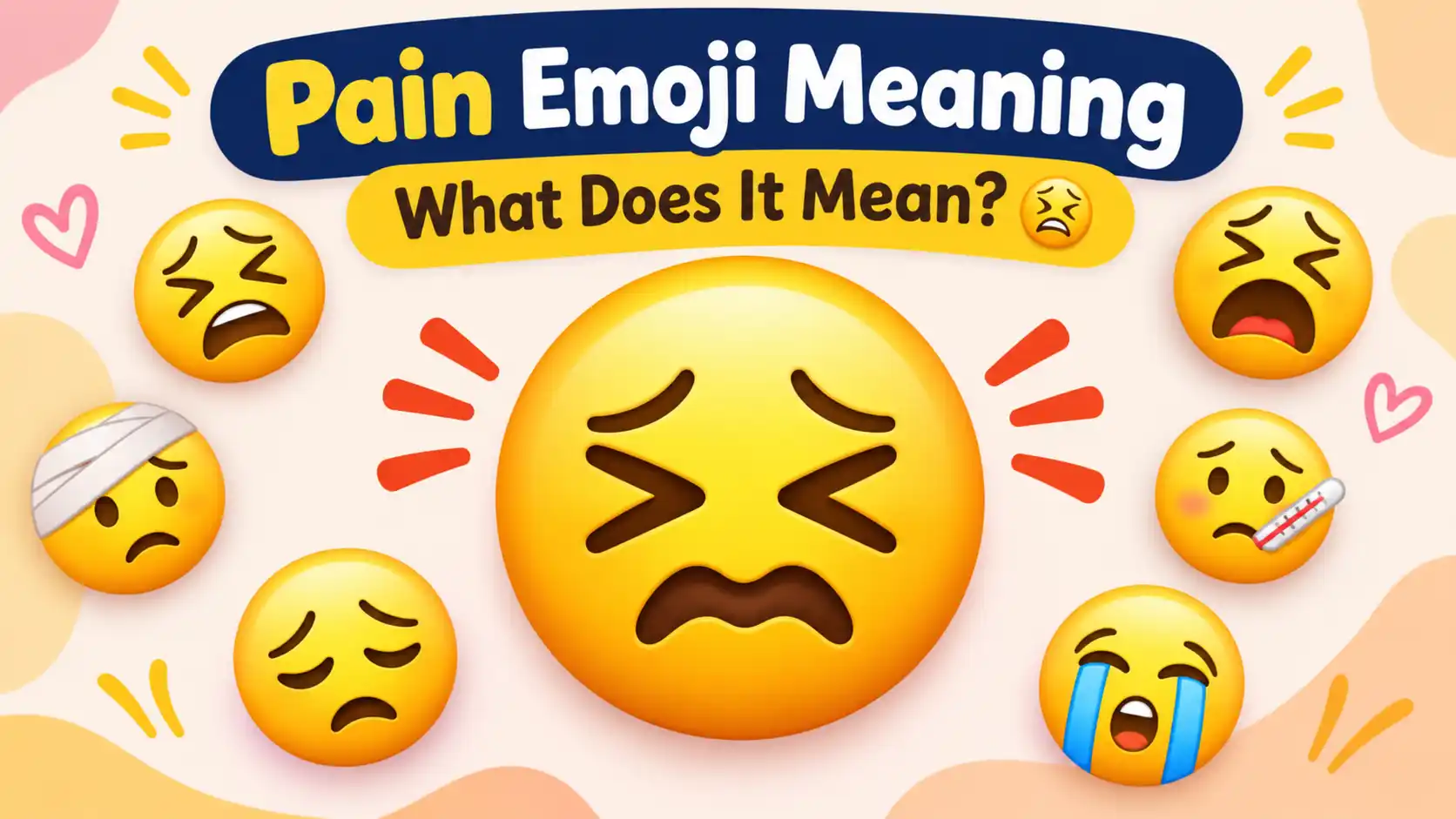
One tiny emoji can show a level of discomfort that words sometimes struggle to explain.
Have you ever had a terrible headache, experienced an exhausting day, or felt so frustrated that you could not find the right words? That’s when a pain emoji can come in handy. 😣 It helps express physical discomfort, emotional hurt, frustration, exhaustion, and difficult moments in everyday digital conversations.
The most commonly recognized pain-related face is 😣, known as the Persevering Face. However, other emojis, such as 😖 and 😫, can also communicate different levels of distress. Some people use them when they feel physically unwell, while others add them to messages about heartbreak, stressful situations, or uncomfortable experiences.
Whether you see one on WhatsApp, Instagram, TikTok, or Facebook, its meaning depends on the conversation. Understanding the differences can help you choose the right expression and avoid sending the wrong message.
Sometimes a single painful expression says more than an entire paragraph. 😣
What Does the Pain Emoji Mean? 😣
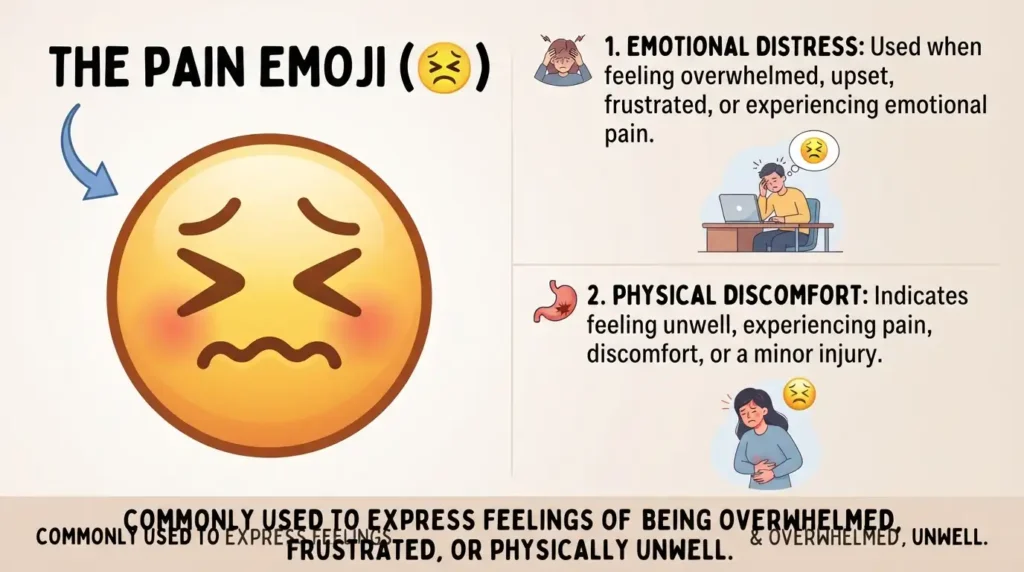
The pain emoji usually represents discomfort, suffering, frustration, or an unpleasant experience. The most common choice is 😣, officially called the Persevering Face. Its tightly closed eyes, furrowed eyebrows, and tense mouth create an expression that looks like someone is struggling through something difficult.
Although people often associate it with physical pain, its meaning is not limited to injuries or illness. It can also communicate emotional discomfort, embarrassment, disappointment, and mental exhaustion.
Here are five closely related expressions that help communicate different feelings:
- 😣 Persevering Face: Shows someone trying to tolerate pain, discomfort, or a difficult situation. For example, “My back hurts so much today 😣.”
- 😖 Confounded Face: Expresses intense frustration, distress, or feeling overwhelmed. It works well when something goes terribly wrong.
- 😫 Tired Face: Often represents extreme exhaustion, discomfort, or being completely fed up with something.
- 😩 Weary Face: Communicates emotional or physical fatigue, disappointment, and the feeling of having had enough.
- 🤕 Face with Head-Bandage: Usually represents an injury, headache, accident, or someone recovering from physical harm.
In texting, the pain emoji can make a message sound more emotional. Saying “I have been working all day” communicates information, while “I have been working all day 😫” adds a clear sense of exhaustion.
On social media, it can also appear in funny posts, relatable memes, and comments about uncomfortable experiences. Someone might use 😖 after making an embarrassing mistake or 😣 when describing a difficult workout.
Its interpretation can change with the relationship between the sender and receiver. A close friend may understand it as playful complaining, while a family member might interpret it as a genuine sign that something is wrong. In a romantic conversation, it can express missing someone or feeling emotionally hurt.
The surrounding words matter more than the symbol alone. A pain emoji does not automatically indicate a medical problem, serious suffering, or romantic disappointment. It simply adds an emotional expression to the message.
Pain Emoji Meaning Table
| Emoji | Core meaning | Possible misread | Best used when |
| 😣 | Pain and struggle | Ordinary sadness | Something feels difficult |
| 😖 | Frustration and distress | Anger | You feel overwhelmed |
| 😫 | Extreme exhaustion | Physical illness | You are completely tired |
| 😩 | Weariness and disappointment | Dramatic sadness | You have had enough |
| 🤕 | Injury or physical pain | General sadness | Someone is hurt |
| 🤒 | Feeling sick | Tiredness | You are unwell |
| 😢 | Emotional sadness | Physical discomfort | Something has upset you |
| 😭 | Intense crying or distress | Always genuine sadness | You feel overwhelmed |
| 😓 | Stress and discomfort | Sweating from heat | You are under pressure |
| 😵💫 | Dizziness and confusion | Ordinary tiredness | You feel disoriented |
10 Pain Emoji Cards
😣 Persevering Face
Meaning: Discomfort, struggle, and trying to tolerate something painful.
Example 1: My headache is getting worse 😣
Example 2: This workout is harder than I expected 😣
😖 Confounded Face
Meaning: Intense frustration, distress, and emotional discomfort.
Example 1: I cannot believe that happened again 😖
Example 2: Everything is going wrong today 😖
😫 Tired Face
Meaning: Extreme exhaustion, discomfort, and feeling completely drained.
Example 1: I have three more assignments to finish 😫
Example 2: That was the longest day ever 😫
😩 Weary Face
Meaning: Feeling fed up, disappointed, or emotionally exhausted.
Example 1: Why does this keep happening to me? 😩
Example 2: I just need a little break 😩
🤕 Face with Head-Bandage
Meaning: Physical injury, headaches, or recovering from an accident.
Example 1: I bumped my head this morning 🤕
Example 2: Still recovering from yesterday’s accident 🤕
🤒 Face with Thermometer
Meaning: Illness, fever, and feeling physically unwell.
Example 1: I think I am catching a cold 🤒
Example 2: Staying home today because I feel sick 🤒
😢 Crying Face
Meaning: Sadness, disappointment, and emotional hurt.
Example 1: I really miss those days 😢
Example 2: That news made me so sad 😢
😭 Loudly Crying Face
Meaning: Intense sadness, emotional overwhelm, or exaggerated reactions.
Example 1: I cannot handle this anymore 😭
Example 2: That ending broke my heart 😭
😓 Downcast Face with Sweat
Meaning: Stress, nervousness, pressure, and uncomfortable situations.
Example 1: I barely finished the exam on time 😓
Example 2: That was an awkward conversation 😓
😵💫 Face with Spiral Eyes
Meaning: Dizziness, confusion, mental overload, or feeling disoriented.
Example 1: I have too much work to do today 😵💫
Example 2: I cannot understand this complicated question 😵💫
How to Use the Pain Emoji the Right Way
The pain emoji can make everyday messages feel more expressive. However, the best way to use it depends on the platform, audience, and situation.
WhatsApp 💬
On WhatsApp, pain-related emojis work naturally in personal chats, family groups, and conversations with friends.
You can use 😣 to tell someone that you have a headache, 😫 to describe a tiring day, or 🤒 to let family members know you are feeling sick.
Examples:
- I barely slept last night 😣
- Work was exhausting today 😫
- I am not feeling well, so I will rest 🤒
- I really miss you today 😢
These expressions can make short messages feel more personal. They are also useful in WhatsApp status updates when you want to share your mood without writing a long explanation.
For example, a status saying “One of those difficult days 😩” communicates frustration without revealing every detail.
Instagram 📸
Instagram users often include pain emojis in captions, comments, reels, and relatable posts.
For example, someone sharing a picture after a difficult workout might write, “My legs are officially done 😫.” A creator posting about a stressful experience might use 😖 to express frustration.
You can also use them in comments:
- This is too relatable 😭
- I felt that 😩
- That must have hurt 😣
For aesthetic or personal posts, choose an expression that matches the overall mood. Avoid adding several different pain emojis when one communicates your message clearly.
TikTok 🎵
TikTok is a natural place for exaggerated emotional reactions and humorous situations.
Pain-related emojis can appear in video captions, comment sections, memes, and reaction posts.
Examples include:
- Me after one hour at the gym 😫
- When the alarm rings after five minutes of sleep 😭
- That awkward moment was painful 😖
They can also add humor to videos about everyday struggles. However, the same emoji can communicate genuine distress when the video discusses a serious experience.
On Facebook, these emojis work well in personal posts, comments, Messenger conversations, and shared memes.
You might use 🤕 when updating friends about an injury or 😓 when describing a stressful day at work.
Examples:
- Recovering slowly after a difficult week 😣
- Today has been exhausting 😩
- Sending love to everyone having a hard day 😢
The key is to match your emoji with the message instead of using it as a random decoration.
Dos and Don’ts of Using Pain Emojis
Pain emojis are simple, but choosing the wrong expression can sometimes change how your message sounds.
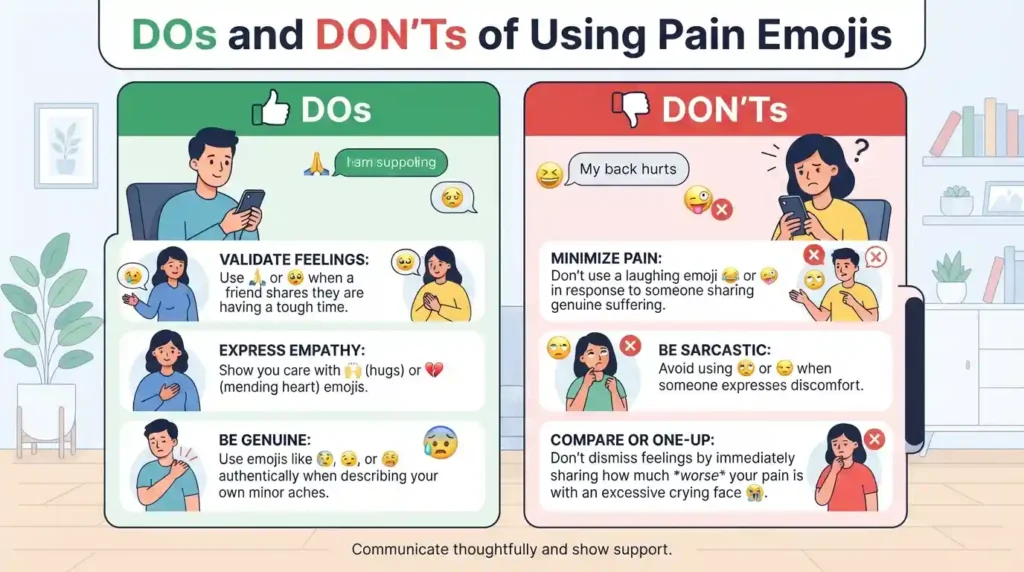
Do:
- Use 😣 when describing discomfort or a difficult experience.
- Choose 🤕 or 🤒 when discussing an injury or illness.
- Consider your relationship with the person receiving your message.
- Match the emoji with the emotional tone of your words.
- Remember that different devices may display slightly different designs.
Don’t:
- Use pain emojis randomly without considering their meaning.
- Assume everyone interprets them in exactly the same way.
- Overload a serious health-related message with dramatic expressions.
- Combine unrelated emojis just to make a message look colorful.
- Assume that 😢 or 😭 always indicates a romantic problem.
A little thought can make your emoji choices much clearer and more meaningful.
Why Do Pain Emojis Look Different on iPhone and Android?
Have you ever noticed that the same pain emoji looks slightly different on an iPhone and an Android phone? That happens because emojis have standardized digital identities, but their visual designs can vary between platforms.
The Unicode Consortium maintains the Unicode Standard, which assigns standardized characters and code points to emojis. Companies such as Apple, Google, Samsung, and Microsoft create their own artwork to display these characters on their devices and operating systems.
For example, 😣 represents the same Persevering Face character across supported platforms. However, Apple’s version may have slightly different shading, facial proportions, or expression details compared with Google’s or Samsung’s version.
Some differences you might notice include:
- Shape: The eyes, eyebrows, and mouth may have slightly different proportions.
- Color: Skin tones, facial shading, and background details can vary.
- Expression: One design might look more dramatic or uncomfortable than another.
- Size: Emojis can appear larger or smaller depending on the application.
- Style: Some platforms use more detailed artwork, while others prefer a simpler appearance.
These differences do not automatically mean that an emoji has changed its official meaning.
The underlying character remains the same when the same Unicode emoji is supported. However, older software may display an unsupported character as a blank box or another placeholder.
So, if your friend sends 😖 from an iPhone and you view it on Android, you may notice a small visual difference. The intended expression is still the same.
Best Pain Emoji Combos: Copy & Paste
Combining pain-related emojis can help express more specific feelings. Whether you are talking about missing someone, feeling exhausted, or reacting to a difficult day, these combinations are easy to copy and use.
Romantic ❤️
- 😢😭: Use this when you genuinely miss someone special.
- 😣😢: Share this when you feel emotionally hurt.
- 😩😭: Express how difficult being apart feels.
Cute 🥰
- 😣😢: Use this for a gentle, emotional reaction.
- 😫😩: Show exaggerated tiredness in a playful conversation.
- 😭😢: Share an emotional reaction to something touching.
Flirty 😉
- 😣😩: Use this when playfully complaining about someone’s teasing.
- 😫😭: React dramatically when someone leaves you waiting.
- 😖😣: Show playful frustration during a fun conversation.
Missing Someone 💭
- 😢😭: Express how much you miss someone.
- 😩😢: Share a feeling of emotional longing.
- 😣😢: Use this when missing someone makes you feel down.
Good Night 🌙
- 😫😩: Show that you are completely exhausted before bed.
- 😣😢: Express that you have had a difficult day.
- 😭😩: Use this for a dramatic, tired goodnight message.
Trending Pain Emojis in 2026
Pain-related expressions continue to appear in everyday digital conversations because they help people communicate feelings quickly. From humorous TikTok videos to personal WhatsApp messages, these emojis make reactions easier to understand.
Some expressions are especially useful in casual online communication.
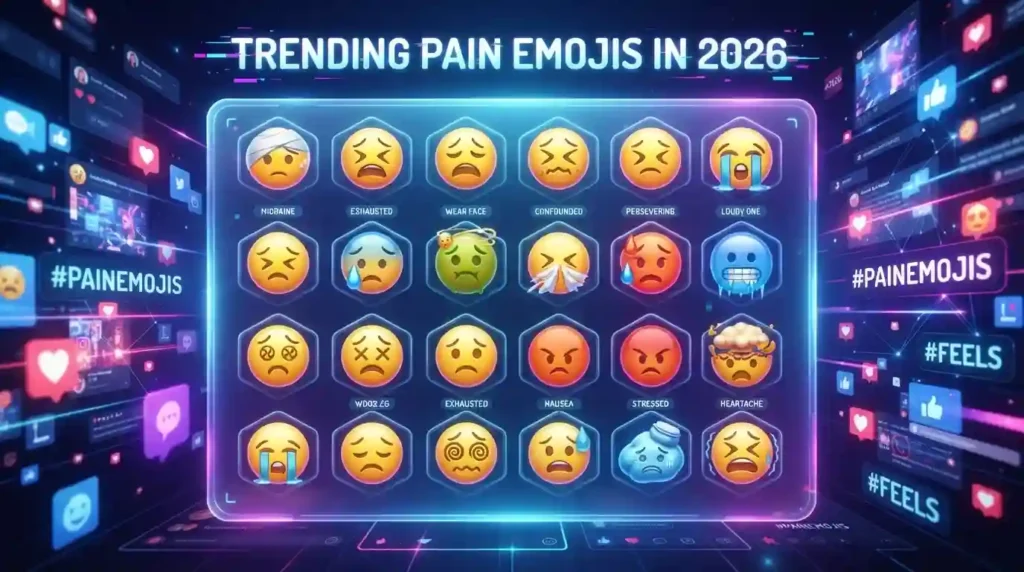
😣 Persevering Face is commonly used when people describe difficult experiences, physical discomfort, or challenging situations. It can appear in fitness posts, personal updates, and conversations about stressful days.
😫 Tired Face frequently appears in captions and comments about work, studying, busy schedules, and everyday exhaustion. Creators also use it in relatable videos about being tired.
😭 Loudly Crying Face is popular in exaggerated online reactions. People may use it to express genuine sadness, but it can also represent laughter, embarrassment, or an overwhelming situation.
😵💫 Face with Spiral Eyes works well when someone feels confused or mentally overloaded. It often appears in conversations about complicated tasks, busy routines, and unexpected situations.
| Emoji | Why trending | Who uses it | Platform |
| 😣 | Relatable struggles and discomfort | Everyday users | WhatsApp, Instagram |
| 😫 | Work and study exhaustion | Students and workers | TikTok, Facebook |
| 😭 | Dramatic emotional reactions | Creators and commenters | TikTok, Instagram |
| 😵💫 | Confusion and mental overload | Students and online users | WhatsApp, TikTok |
These emojis are useful because their expressions are easy to recognize, even when the surrounding message is short.
Creators often add them to captions, while everyday users include them in comments and private chats. Their tone can shift from serious to humorous depending on the words and content around them.
Ultimately, emoji usage continues to evolve as online communities develop new ways to express familiar emotions.
Pain Emoji Meaning in Different Contexts
The same pain emoji can communicate different feelings depending on who sends it, why they send it, and what the conversation is about.
Here are some common situations where interpretation can change.
Romantic Conversations
When someone uses 😣 or 😢 in a romantic conversation, they might be expressing emotional discomfort, missing their partner, or feeling disappointed.
For example:
“I wish you were here 😢”
However, it does not automatically mean heartbreak. The surrounding conversation provides the important details.
Friendship
Friends frequently use 😫 and 😭 to exaggerate everyday problems.
For example:
“You finished the entire project without telling me? 😭”
In this situation, the expression might communicate playful disappointment rather than genuine sadness.
Family Conversations
In family chats, 🤒 and 🤕 can be practical ways to communicate illness or injury.
For example:
“I am staying home today because I have a fever 🤒”
These expressions can help family members understand the situation quickly.
Professional and Casual Communication
In workplace conversations, 😓 might communicate pressure or nervousness after a demanding task.
For example:
“That presentation was more difficult than expected 😓”
However, consider your workplace culture before using emotional emojis in formal messages.
Texting
In private messages, the pain emoji often adds emotional detail to short sentences.
For example:
“I have been awake all night 😫”
The emoji makes the sender’s exhaustion easier to understand.
Social Media Comments
Comments often use 😭, 😖, and 😩 as reactions to videos, memes, and relatable experiences.
A person might comment “I cannot stop laughing 😭” even though the emoji traditionally represents crying.
Captions
For captions, pain emojis can help communicate a mood without lengthy explanations.
For example:
“Surviving another busy week 😣”
The most important thing is to understand the context instead of assuming every sender intends the same emotion.
How to Copy and Paste the Pain Emoji
Copying and pasting a pain emoji is simple. You do not need a special application or complicated settings.
Copy the primary pain emoji here:
<escape>😣</escape>
You can also copy other related expressions:
<escape>😖 😫 😩 🤕 🤒 😢 😭 😓 😵💫</escape>
Follow these simple steps:
- Select the emoji you want to use.
- Right-click and choose Copy, or use your device’s copy shortcut.
- Open WhatsApp, Instagram, TikTok, Facebook, or your messaging application.
- Tap the message box, caption field, or comment section.
- Paste the emoji and send or publish your message.
On most smartphones, you can also find these expressions directly through the emoji keyboard. Search for words such as “pain,” “tired,” “sick,” or “sad” to find suitable options.
The emoji may look slightly different after pasting, depending on the device and application, but its underlying character remains the same.
Frequently Asked Questions
1. What is the most popular pain emoji?
😣, the Persevering Face, is one of the most recognizable choices for expressing discomfort and struggle. 😫 and 😖 are also common alternatives for exhaustion and frustration.
2. What does 😣 mean when someone sends it?
It usually communicates discomfort, difficulty, or trying to tolerate an unpleasant situation. The meaning depends on the conversation and the sender’s intention, not their gender.
3. Why do pain emojis look different on iPhone vs Android?
Apple and Android manufacturers use different emoji artwork. Unicode standardizes the underlying character, but each platform can display its own visual design.
4. Are pain emojis used differently in other countries?
Yes, personal habits, cultural communication styles, and online communities can influence how people interpret emojis. However, meanings are not identical for everyone within a country, so context is always important.
Conclusion
The pain emoji is a useful way to express discomfort, frustration, exhaustion, and emotional struggles in everyday conversations. 😣
Choosing between related expressions like 😖, 😫, and 🤕 helps make your messages more accurate and meaningful.
Pay attention to the situation, consider the person receiving your message, and let the right emoji express what words cannot. ❤️