5. One-Line Hook
One small symbol can express equality, agreement, or a mathematical idea without typing a long explanation.
6. Introduction
You are chatting with a friend about splitting a bill, comparing two prices, or explaining that two things have the same value. Instead of writing a whole sentence, you might reach for the equal emoji 🟰. It is a simple symbol, but it can make a message clearer and easier to understand.
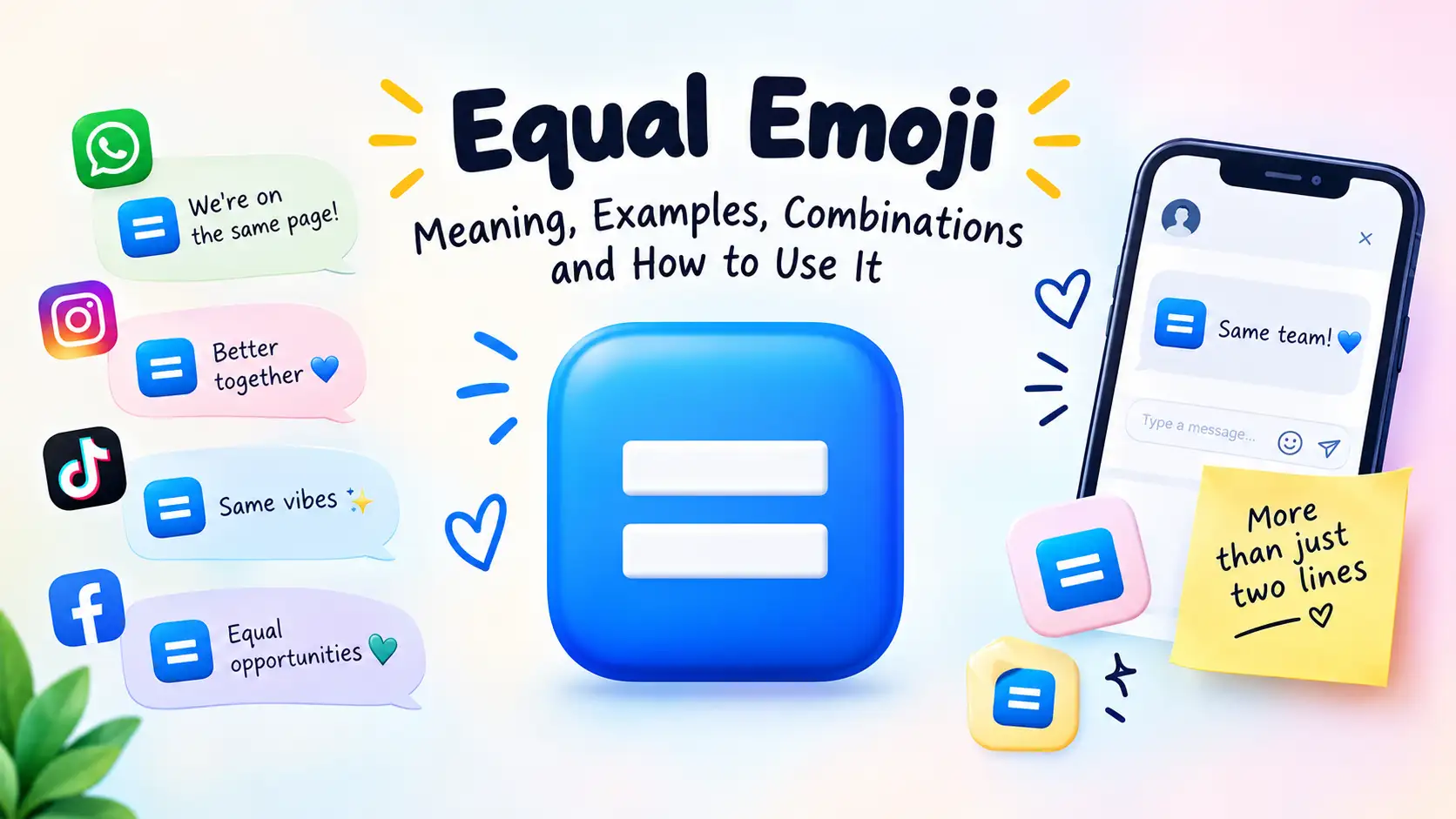
The equal emoji represents the idea of equality, sameness, or equivalent value. It is especially useful in math-related conversations, educational posts, comparisons, and online discussions where people want to show that two things match. Depending on the conversation, it can also suggest agreement or that two sides are balanced.
People search for the equal emoji meaning because they want to understand what the symbol communicates in texting, how it differs from other mathematical symbols, and where it fits naturally on social media. Its meaning usually depends on the surrounding words. A mathematical explanation is different from a casual message about two equally good choices.
In this guide, you will learn how to use 🟰, explore related symbols, discover practical combinations, and copy the emoji for WhatsApp, Instagram, TikTok, and other platforms.
7. Standout Snippet
Sometimes, one simple symbol is enough to show that two things are equal. 🟰
8. What Does the Equal Emoji Mean? 🟰
The equal emoji 🟰 is a symbol associated with equality, equivalence, and matching values. Its most straightforward use is mathematical: it communicates that the value on one side of an equation is the same as the value on the other side. For example, 5 + 5 🟰 10 shows a simple mathematical relationship in a message.
In everyday conversations, people can use the symbol to emphasize that two things are comparable or have the same value. Someone discussing two products might write, “Same quality 🟰 same value,” to make a point about their comparison. In this case, the symbol acts as a visual shortcut rather than a formal mathematical statement.
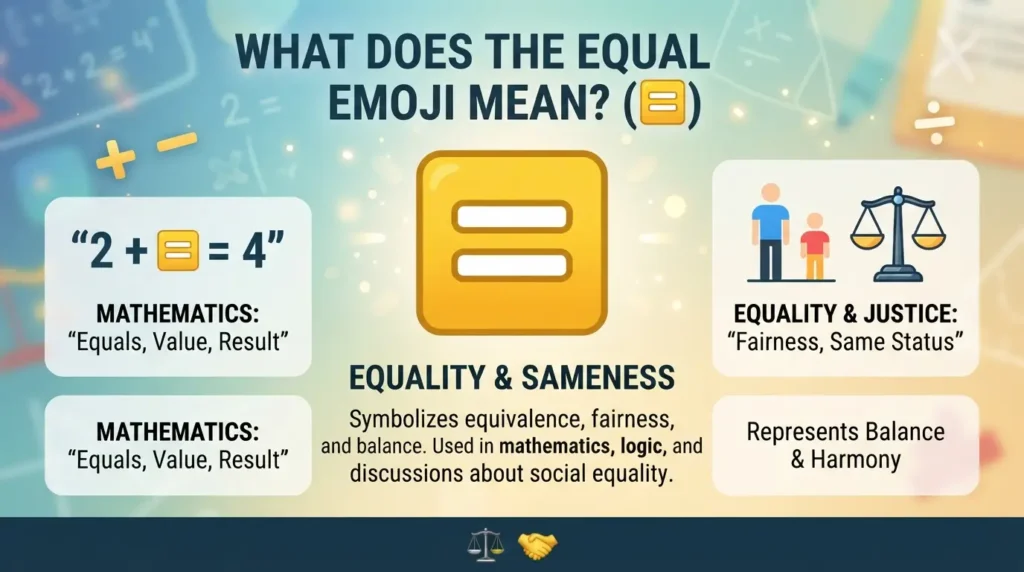
The equal emoji can also appear in educational content, quizzes, tutorials, and social media graphics. Teachers, students, and creators may use it to make equations more noticeable or organize information in a visually clear way.
A few related symbols can help express more specific ideas:
- 🟰 Equal sign: Indicates equality or equivalent values.
- ➕ Plus sign: Represents addition or something being added.
- ➖ Minus sign: Represents subtraction or a reduction.
- ✖️ Multiplication sign: Indicates multiplication or a mathematical operation.
- ➗ Division sign: Represents division or splitting something into parts.
- ⚖️ Balance scales: Can suggest fairness, balance, or weighing two sides of an issue.
Although these symbols can appear together in a math-related conversation, they do not all mean the same thing. The equal emoji is specifically connected to equality, while the others communicate different operations or ideas.
In texting, 🟰 may communicate that two options are equivalent, but it does not automatically mean that two people are identical or that a relationship is fair. A message such as “We both deserve respect 🟰” uses the symbol to emphasize a point about equal treatment.
Context matters. A student solving a problem, a shopper comparing prices, and a creator discussing fairness may all use the symbol differently. The words around it determine whether the message is mathematical, practical, or symbolic.
Equal Emoji Meaning Table
| Emoji | Core meaning | Possible misread | Best used when |
| 🟰 | Equality or equivalent value | A decorative symbol | Showing matching values |
| ⚖️ | Balance or fairness | A legal-only symbol | Discussing equal treatment |
| ➕ | Addition or increase | A positive mood only | Adding numbers or items |
| ➖ | Subtraction or reduction | Negativity in every case | Showing a decrease |
| ✖️ | Multiplication or an X mark | A wrong answer only | Mathematical calculations |
| ➗ | Division | A general separator | Showing division |
| ≠ | Not equal | Confused with equality | Showing a difference |
| ≤ | Less than or equal to | Confused with a plain equal sign | Comparing values |
| ≥ | Greater than or equal to | Confused with a plain equal sign | Comparing values |
| 🔢 | Numbers or numerical information | A mathematical operation | Introducing number-based content |
10 Equal and Related Symbol Cards
🟰 Equal Sign
Meaning: Equality, sameness, or equivalent values.
Example 1: Two answers match 🟰
Example 2: Same price, same value 🟰
⚖️ Balance Scales
Meaning: Fairness, balance, or weighing different sides.
Example 1: Everyone deserves fair treatment ⚖️
Example 2: Finding balance matters ⚖️
➕ Plus Sign
Meaning: Addition, an increase, or something extra.
Example 1: Add five more points ➕
Example 2: One more reason to smile ➕
➖ Minus Sign
Meaning: Subtraction, a decrease, or something removed.
Example 1: Ten minus three ➖
Example 2: Less stress, more focus ➖
✖️ Multiplication Sign
Meaning: Multiplication or a mathematical operation.
Example 1: Three times four ✖️
Example 2: Let’s solve this calculation ✖️
➗ Division Sign
Meaning: Division or splitting a value into parts.
Example 1: Divide the total by two ➗
Example 2: Let’s split the amount equally ➗
≠ Not Equal Sign
Meaning: A difference between two values or things.
Example 1: Different prices, different offers ≠
Example 2: Popularity does not equal quality ≠
≤ Less Than or Equal To
Meaning: A value is smaller than or equal to another value.
Example 1: Keep the score at five or below ≤
Example 2: The limit is ten ≤
≥ Greater Than or Equal To
Meaning: A value is greater than or equal to another value.
Example 1: The minimum score is eight ≥
Example 2: We need at least five answers ≥
🔢 Input Numbers
Meaning: Numbers, counting, or number-related information.
Example 1: Check the numbers before submitting 🔢
Example 2: Time for a quick math challenge 🔢
9. How to Use the Equal Emoji the Right Way
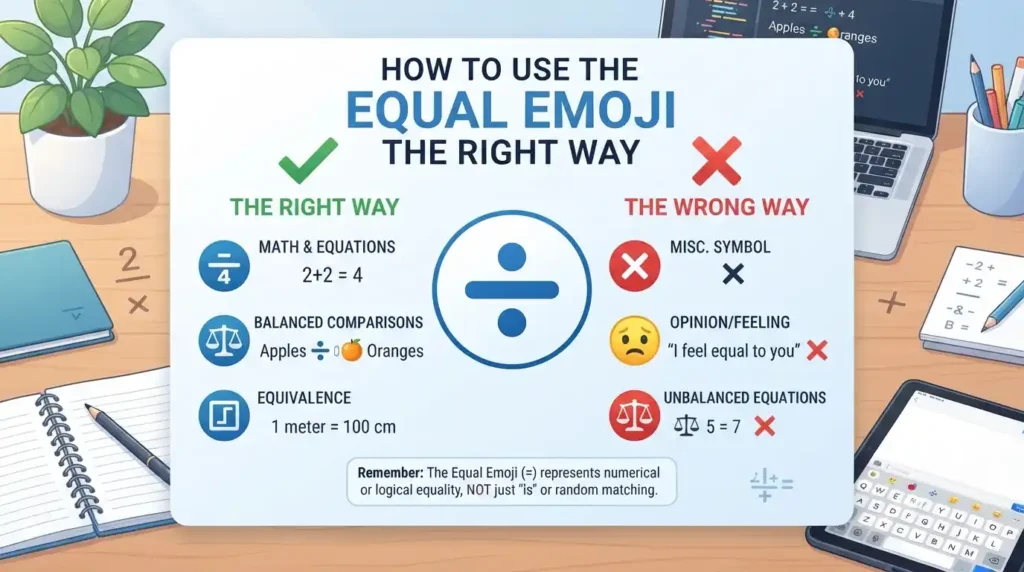
The equal emoji 🟰 works best when you want to communicate a direct comparison, show equivalent values, or make a mathematical point easier to notice. Because it has a specific visual meaning, it is usually most effective when paired with words, numbers, or another symbol that explains the comparison.
WhatsApp 💬
In personal chats, use 🟰 when discussing shared expenses, comparing options, or helping someone understand a calculation. For example, if you and a friend are splitting a restaurant bill, you might write, “We each pay the same amount 🟰.” The wording makes the intended meaning clear.
It can also work in family group chats when discussing budgets, shopping totals, schoolwork, or other practical matters. If someone asks whether two prices are identical, the equal emoji can reinforce your answer. Avoid sending it alone when the recipient may not understand what you are comparing.
For a status update, you could write, “Fair effort 🟰 fair opportunity.” This uses equality symbolically, although a full sentence may be more appropriate for a serious topic.
Instagram 📸
Instagram emojis often add visual structure to captions and comments. The equal emoji can help organize educational posts, comparison graphics, number-based tutorials, and informative Reels.
For example, a creator might caption a post, “Clear goals 🟰 better planning.” This is a stylized comparison, not a mathematical formula. Another creator could use 🟰 in a study tip showing that two different expressions have the same result.
In a comment, the symbol may emphasize that two options are equivalent. In a bio, it is generally more useful for an account focused on education, mathematics, or comparisons than for a personal profile with no related theme.
TikTok 🎵
On TikTok, 🟰 can support short tutorials, educational videos, quizzes, and comparison-based content. A creator explaining a simple calculation might display the symbol on screen to make the result easy to follow.
It can also appear in humorous comparisons, such as “More practice 🟰 more confidence.” Here, the symbol expresses an intended relationship rather than a guaranteed outcome.
In comments, it may reinforce a point about two similar situations. However, a viewer should not assume that every use is a serious mathematical statement. Some creators use symbols informally to make captions shorter or more visually distinctive.
On Facebook, the equal emoji can appear in educational posts, community discussions, comments, and Messenger conversations. It may help someone explain a calculation, compare two offers, or make a point about equal treatment.
For example, a person discussing a shared household expense might write, “Same contribution 🟰 same responsibility.” In a mathematics group, the symbol can support a worked example. In a general discussion, adding a short explanation is helpful when the topic is sensitive or complicated.
Across all four platforms, the basic principle is the same: use 🟰 where equality or equivalence is relevant, and let the surrounding text explain exactly what you mean.
Do’s and Don’ts
Do:
- Use 🟰 to make a comparison easier to follow.
- Include numbers or words when precision matters.
- Consider whether the recipient understands the context.
- Use ⚖️ when you mean fairness or balance rather than a mathematical equality.
- Check how symbols display on different devices.
Don’t:
- Assume 🟰 automatically communicates romantic interest.
- Use it as a substitute for a complete explanation in a complicated discussion.
- Confuse equality with inequality symbols such as ≠.
- Add unrelated symbols just to decorate a message.
- Assume that two things are mathematically equal merely because they look similar.
10. Why Does the Equal Emoji Look Different on iPhone and Android?
The equal emoji 🟰 may look slightly different depending on the phone, computer, app, or operating system you use. You might notice differences in the thickness of the lines, spacing, proportions, or overall visual style. These differences are usually related to how each platform displays emoji characters.
Emoji characters are standardized through Unicode, an international system that assigns codes to characters used in digital text. Unicode helps devices recognize the same underlying character, but it does not require every company to draw that character in exactly the same way.
Companies such as Apple, Google, Samsung, and Microsoft can create their own emoji artwork. As a result, the same emoji may have a slightly different appearance on an iPhone, an Android phone, or a desktop computer.
For the equal emoji, these differences are generally less dramatic than those seen in expressive facial emojis. The equal sign is a simple geometric symbol, so its appearance tends to remain recognizable across devices.
Here are some differences you might notice:
- Shape: The horizontal lines may appear thicker or thinner.
- Color: The symbol may have different styling depending on the platform.
- Size: It can appear larger or smaller relative to nearby text.
- Style: Some systems may render it with a more emoji-like appearance, while others display a simpler symbol.
- App support: An older app or operating system may not display a newer character correctly.
For example, you could send 🟰 from an iPhone to a friend using Android. Your friend may see a slightly different design, but the underlying character is intended to represent the same symbol.
If the character appears as an empty box or an unexpected placeholder, the receiving device or app may not support that character properly. Updating the software can sometimes resolve the issue.
There is no single platform design that is automatically the correct visual version. The important distinction is between the character itself and the artwork used to display it.
11. Best Equal Emoji Combos: Copy and Paste
The equal emoji is more practical than decorative, so the best combinations usually involve numbers, comparisons, or a clear message about equivalence. You can also use it in playful captions, but the combination should still make sense to the reader.
The following combinations use the established group of related symbols. Copy any line that fits your message.
Romantic ❤️
These combinations work for lighthearted messages about mutual effort or shared values. They are creative expressions rather than established romantic emoji meanings.
- 🟰⚖️: Use this when talking about fairness and mutual respect in a relationship.
- 🟰➕: Use this to suggest that two people bring something positive to a partnership.
- 🟰≠: Use this for a playful comparison between two different personalities.
Cute 🥰
These options are suitable for friendly captions, playful comparisons, and casual conversations.
- 🟰🔢: Use this for a number-based puzzle or a simple math challenge.
- ➕🟰: Use this when presenting an addition problem and its result.
- 🟰⚖️: Use this to represent a balanced arrangement or equal contributions.
Flirty 😉
For a playful tone, pair the equal sign with a short sentence. The symbols alone do not automatically communicate flirtation.
- 🟰➕: Use this with a caption about someone adding something good to your day.
- ⚖️🟰: Use this for a lighthearted message about matching effort.
- 🟰≠: Use this when teasing someone about how different you are despite having things in common.
Missing Someone 💭
These combinations can support reflective messages about distance, similarities, and shared experiences.
- 🟰⚖️: Use this to say that both people deserve equal effort.
- 🟰➖: Use this in a creative caption about reducing distance or closing a gap, with explanatory text.
- 🔢🟰: Use this when referring to a shared date, memorable number, or matching result.
Good Night 🌙
These options suit simple end-of-day posts, especially when the text explains the intended message.
- 🟰⚖️: Use this with a message about finding balance after a busy day.
- ➖🟰: Use this in a playful post about subtracting the day’s worries and settling down.
- 🟰➕: Use this with a caption about adding up the day’s good moments.
A quick tip: The equal sign is not a traditional love or good-night symbol. These combinations are creative ways to use it, so a few explanatory words will make your message clearer. If you want a strictly mathematical combination, use 🟰 alongside numbers or arithmetic symbols instead.
12. Trending Equal Emoji in 2026
The equal emoji 🟰 has a practical role in digital communication, particularly where numbers, explanations, and comparisons are involved. However, it is important to distinguish useful everyday applications from verified popularity rankings. Without reliable, current usage data, it would be misleading to claim that this emoji is among the most popular emojis of 2026.
Its usefulness comes from its ability to communicate a relationship between values in a compact format. Students can use it in study notes, teachers can include it in educational content, and creators can add it to short tutorials where space is limited.
On social media, symbols are often incorporated into visual explanations, captions, and short-form videos. The equal sign can make a relationship between two ideas easier to scan, particularly when the accompanying text provides enough context.
For example, an educational creator might use 2 + 3 🟰 5 in a short lesson. A personal finance account could write, “Same cost 🟰 same budget impact,” when comparing two options with equivalent prices. In both cases, the symbol supports the message instead of replacing the explanation.
The related symbols ⚖️, ➕, and ≠ can also help creators express different relationships. A discussion about fairness may use ⚖️, while a comparison showing that two values differ may use ≠. Choosing the appropriate symbol makes the content easier to understand.
| Emoji | Why it is useful | Who uses it | Platform |
| 🟰 | Shows equality or matching values | Students and educators | Messaging and educational posts |
| ⚖️ | Suggests balance or fairness | Community creators and commentators | Facebook and Instagram |
| ➕ | Represents addition or an increase | Students and general users | TikTok and messaging |
| ≠ | Highlights differences | Educators and comparison creators | Instagram and online discussions |
These are practical examples of usage, not a verified ranking of current trends. The frequency of individual emoji characters can vary by audience, subject, and platform.
As digital communication evolves, simple symbols continue to be adapted for new contexts, making surrounding words increasingly important for clear interpretation.
13. Equal Emoji Meaning in Different Contexts
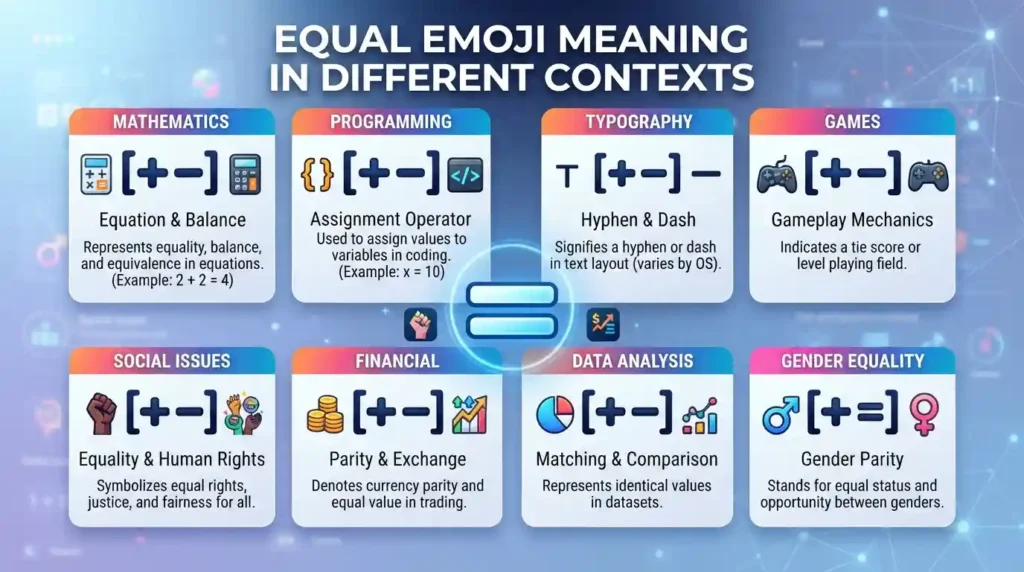
The equal emoji 🟰 does not always communicate a formal mathematical equation. People can also use it as shorthand for matching values, similar situations, or a relationship between two ideas. Understanding the context helps you decide what a sender intends.
Romantic conversations
In a romantic conversation, the symbol might suggest mutual effort, shared expectations, or equal treatment. For example, someone could write, “Respect 🟰 trust,” to emphasize a personal belief about relationships.
This is a creative use, not a universally recognized romantic meaning. If someone sends 🟰 without any explanation, there is no reliable reason to assume they are flirting or expressing affection.
Friendship
Friends might use the symbol when comparing interests, sharing expenses, or pointing out similarities.
Example: “Our taste in movies 🟰 identical.”
The message is casual and playful. If the comparison is not obvious, adding a few words makes the meaning easier to understand.
Family conversations
Family members can use 🟰 for calculations, shared responsibilities, or household planning. For example, “Your contribution 🟰 my contribution” makes the idea of equal contributions visible.
When discussing important financial or family decisions, however, use clear wording rather than relying on a symbol alone.
Professional and casual communication
In professional messages, the equal sign is most appropriate when discussing calculations, equivalent results, or comparisons. It may be useful in educational material, spreadsheets, presentations, and informal work chats.
For example, “Both options have the same cost 🟰” communicates a straightforward comparison.
For formal documents, use standard mathematical notation or complete sentences where accuracy matters. The emoji version is better suited to informal communication.
Texting
In texting, 🟰 can shorten a simple explanation or emphasize that two things match.
Example: “Same answer 🟰 we got it right.”
The wording tells the recipient how to interpret the symbol. Without that context, the message could seem incomplete.
Social media comments
A comment such as “Effort 🟰 results” may express a creator’s opinion about the relationship between work and outcomes. It is a rhetorical comparison, not necessarily a mathematical fact.
Similarly, ≠ can highlight a difference, while ⚖️ may suggest fairness. Choose the symbol that matches your intended message.
Captions
For captions, the equal emoji can create a compact visual statement.
Examples:
- “Simple ingredients 🟰 a great meal.”
- “Practice 🟰 progress.”
- “Clear communication 🟰 fewer misunderstandings.”
These examples use the symbol informally. The relationship expressed in each caption is an idea or opinion, not a guarantee that one thing always produces another.
Ultimately, the surrounding words, the relationship between the people communicating, and the subject of the conversation matter more than the symbol by itself.
14. How to Copy and Paste the Equal Emoji
Copying the equal emoji is simple. You do not need to install a special keyboard or download an additional application.
Copy-paste equal emoji:
🟰
Equal emoji
Copy Equal Emoji
Follow these steps:
- Select the 🟰 symbol above, or use the copy button.
- Copy the selected character.
- Open WhatsApp, Instagram, TikTok, Facebook, or your preferred messaging app.
- Tap the text field where you want to use it.
- Paste the symbol and send your message or publish your caption.
You can also copy related symbols when you need them:
🟰
Equal
Copy
≠
Not equal
Copy
⚖️
Balance scales
Copy
➕
Plus
Copy
If the equal emoji does not display correctly after pasting, check whether your device and application support the character. You can also use the ordinary equals sign (=) when you need a simple text alternative.
15. Frequently Asked Questions
1. What is the most popular equal emoji?
The main emoji associated with this keyword is 🟰, the equal sign. It represents equality or equivalent values, especially in mathematical and comparison-based messages. There is no verified popularity ranking specific to this emoji here.
2. What does 🟰 mean when someone sends it?
It usually indicates equality, matching values, or a comparison. The intended meaning depends on the accompanying words and the conversation, rather than the sender’s gender or relationship status.
3. Why do emojis look different on iPhone vs Android?
Apple and Android-related platforms can use different artwork to display the same Unicode character. This can affect the symbol’s appearance, but it does not necessarily change its underlying meaning.
4. Are equal emojis used differently in other countries?
The mathematical meaning of an equal sign is broadly recognizable, but informal interpretations can vary across communities and online settings. Consider the surrounding message instead of assuming that everyone uses the symbol in precisely the same way.
16. Conclusion
The equal emoji 🟰 is a useful way to express equality, matching values, and comparisons in everyday digital communication. Use it for calculations, educational content, captions, or informal messages where the meaning is clear. When the subject is complicated, add words to explain your point. A little context makes your message easier to understand. 🟰