One-line Hook
One tiny picture can change the entire feeling of a message.
Introduction
You send a quick “thank you 😊,” add a heart ❤️ to a message, or react with 😂 instead of typing a whole sentence. Suddenly, the conversation feels warmer, funnier, or more emotional. That is why people search for emoji pictures meaning when they are unsure what a particular symbol is trying to say.
Emoji pictures are visual symbols used to add emotion, tone, reaction, or personality to digital conversations. Their meaning can be straightforward, but it can also shift depending on the words around them, the relationship between two people, and the platform being used. A smile may feel friendly in one conversation and slightly sarcastic in another. A heart can express affection, appreciation, support, or romance. 💕✨
This guide explains common emoji meanings, how people use emoji pictures in texting and social media, and how context can change their interpretation.
Standout Snippet
The best emoji is not always the most obvious one, but the one that fits the feeling behind your words. 💫
What Does Emoji Pictures Mean?
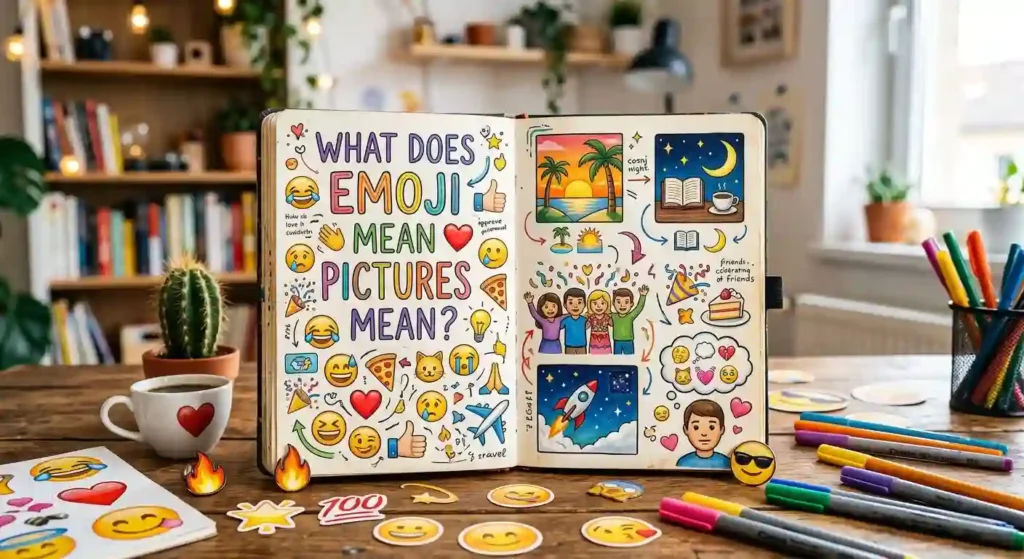
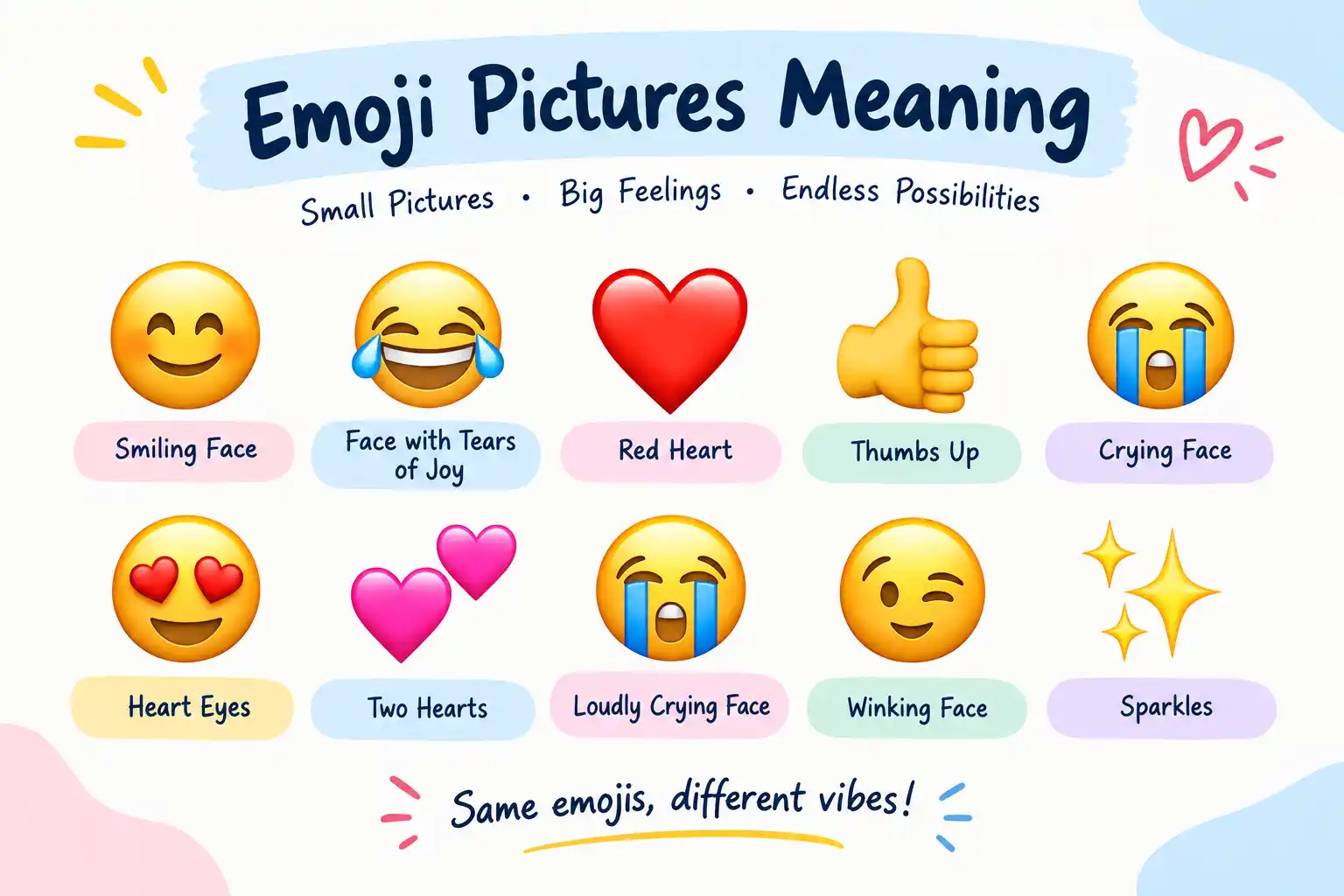
When people search for emoji pictures meaning, they are usually trying to understand what visual symbols communicate in digital conversations. Emojis can represent emotions, reactions, objects, ideas, affection, humor, celebration, or simple emphasis. Common examples include 😊 for a warm or friendly feeling, 😂 for strong amusement, ❤️ for love or affection, 👍 for approval, 😢 for sadness, and 😍 for admiration or strong liking.
The important point is that an emoji does not always have one fixed interpretation. Emoji meaning in texting depends heavily on context. “Thanks 😊” usually feels warmer than a plain “Thanks,” while “Okay 👍” may simply confirm that someone understands. In a romantic conversation, ❤️ can feel intimate, while the same symbol between friends may simply show care or appreciation.
Social media adds another layer. On Instagram, emojis can make captions feel more expressive or visually appealing. On TikTok, they may strengthen a joke, reaction, or playful comment. WhatsApp users often rely on emoji pictures to soften everyday messages or communicate feelings quickly.
Platform design matters too. Apple, Google, Samsung, and Microsoft may display the same Unicode emoji with different artwork. The picture can therefore look slightly different while representing the same underlying character.
Ultimately, the safest way to understand an emoji is to read it together with the surrounding message. 😊 ❤️ 😂 👍 😍 and 💕 can all communicate different shades of emotion, but the sender’s words, relationship, and tone provide the real context.
| Emoji | Core meaning | Possible misread | Best used when |
| 😊 | Warmth or friendliness | Forced politeness | Friendly messages |
| 😂 | Strong laughter | Mocking someone | Funny moments |
| ❤️ | Love or affection | Romantic interest | Caring messages |
| 👍 | Approval or agreement | Dismissiveness | Confirming something |
| 😢 | Sadness | Dramatic reaction | Emotional situations |
| 😍 | Admiration | Romantic attraction | Compliments |
| 💕 | Affection or sweetness | Romantic intent | Warm conversations |
| 😭 | Intense emotion | Overreaction | Sad or funny moments |
| 😉 | Playfulness | Flirting | Teasing messages |
| ✨ | Emphasis or excitement | Pure decoration | Highlights and captions |
Emoji Cards
😊 Smiling Face
Meaning: Warmth, friendliness, happiness, or gentle positivity.
Example 1: That sounds great 😊
Example 2: Thanks for checking on me 😊
😂 Face with Tears of Joy
Meaning: Strong amusement or laughter.
Example 1: That video was hilarious 😂
Example 2: I can’t stop laughing at this 😂
❤️ Red Heart
Meaning: Love, affection, care, or emotional appreciation.
Example 1: Thank you for always being there ❤️
Example 2: Have a beautiful day ❤️
👍 Thumbs Up
Meaning: Agreement, approval, confirmation, or acknowledgment.
Example 1: I’ll meet you at eight 👍
Example 2: That plan works for me 👍
😢 Crying Face
Meaning: Sadness, disappointment, or emotional pain.
Example 1: I really miss those days 😢
Example 2: That ending made me sad 😢
😍 Heart Eyes
Meaning: Strong admiration, delight, or affection.
Example 1: You look amazing 😍
Example 2: This dessert looks incredible 😍
💕 Two Hearts
Meaning: Sweet affection, warmth, or loving feelings.
Example 1: Sending you lots of love 💕
Example 2: That was such a sweet surprise 💕
😭 Loudly Crying Face
Meaning: Intense sadness or exaggerated emotional reaction.
Example 1: I can’t believe the show is over 😭
Example 2: That was way too funny 😭
😉 Winking Face
Meaning: Playfulness, teasing, humor, or possible flirtation.
Example 1: You know what I mean 😉
Example 2: Maybe I’ll tell you later 😉
✨ Sparkles
Meaning: Emphasis, excitement, freshness, or a magical touch.
Example 1: New week, fresh energy ✨
Example 2: Your idea is brilliant ✨
How to Use Emoji Pictures Meaning the Right Way
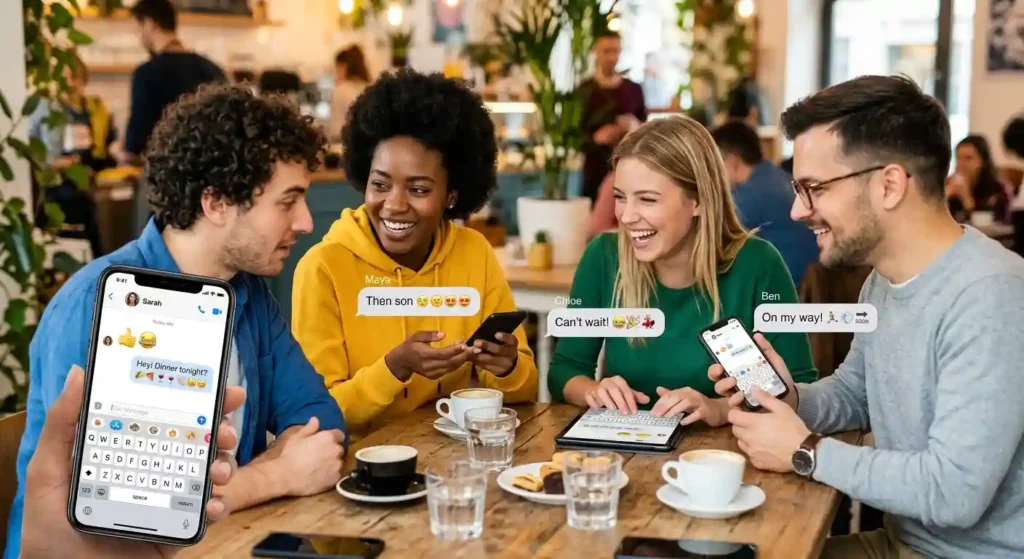
Using emoji pictures effectively is less about memorizing definitions and more about matching the symbol to your message. Think of an emoji as a tone marker. It can make a short sentence feel warmer, show that something is a joke, or make an emotional statement easier to understand. The same principle applies across WhatsApp emojis, Instagram emojis, TikTok comments, Facebook posts, and ordinary text messages.
WhatsApp 💬
In personal chats, emojis can make everyday messages feel less formal. A simple “See you soon 😊” sounds warmer than the same sentence without an emoji. Family conversations can use hearts or smiles to express affection, while friends may use laughing or winking faces to reinforce jokes. Emojis also work naturally in WhatsApp status updates, especially when a short phrase needs extra personality.
Instagram 📸
Instagram emojis are especially common in captions, comments, bios, and Reels. A creator might use ✨ to emphasize a new look or idea, while a heart can express appreciation toward followers. In comments, an emoji can sometimes communicate a reaction more naturally than a full sentence. Still, the surrounding caption should make the intended tone clear.
TikTok 🎵
TikTok comments often use emojis for humor, surprise, excitement, teasing, or emotional reactions. A laughing face can reinforce a joke, while a wink can make a playful comment feel less serious. Because short-form content moves quickly, emojis can help communicate an immediate reaction without adding much text.
Facebook posts and Messenger conversations use emojis for congratulations, sympathy, humor, affection, agreement, and everyday reactions. They can make a personal post feel more expressive, but a serious announcement usually benefits from restrained emoji use.
The best approach is simple: choose the emoji that supports what you already mean. Do not rely on the picture alone when the message could easily be misunderstood. Context remains more important than any dictionary-style definition.
Why Do Emoji Pictures Meaning Look Different on iPhone and Android?
If you send an emoji from an iPhone to an Android phone and notice that the picture looks different, nothing is necessarily wrong. Emojis are standardized as characters through Unicode, but the visual artwork used to represent those characters is created by individual technology companies and operating systems.
Apple has its own emoji artwork, while Google, Samsung, Microsoft, and other platforms may use different designs. This means the same emoji character can have differences in facial expression, shape, proportions, colors, details, or overall style. The underlying Unicode character remains the important part. The artwork is simply the platform’s visual interpretation.
For example, a smiling face may look slightly more rounded on one device and somewhat different on another. A heart may have a different appearance or rendering style. These differences do not automatically mean that the emoji has a different meaning.
This matters when researching emoji pictures meaning because people sometimes judge an emoji based entirely on how it looks on their own phone. Someone using an iPhone may see a particular expression one way, while a friend using Samsung or Google software sees a subtly different version. Usually, both are still displaying the same standardized emoji character.
Font support, operating system versions, and app behavior can also influence how emoji pictures appear. Older software may display some newer characters differently or fail to support them fully.
So, if an emoji looks different on iPhone and Android, focus first on the character being sent rather than the exact artwork. There is not necessarily a single visually “correct” design. Unicode provides the standard character, while platforms create their own visual presentation.
Understanding this can prevent unnecessary confusion, especially when someone interprets an emoji based on a visual detail that appears differently on another device.
Best Emoji Pictures Meaning Combos, Copy & Paste
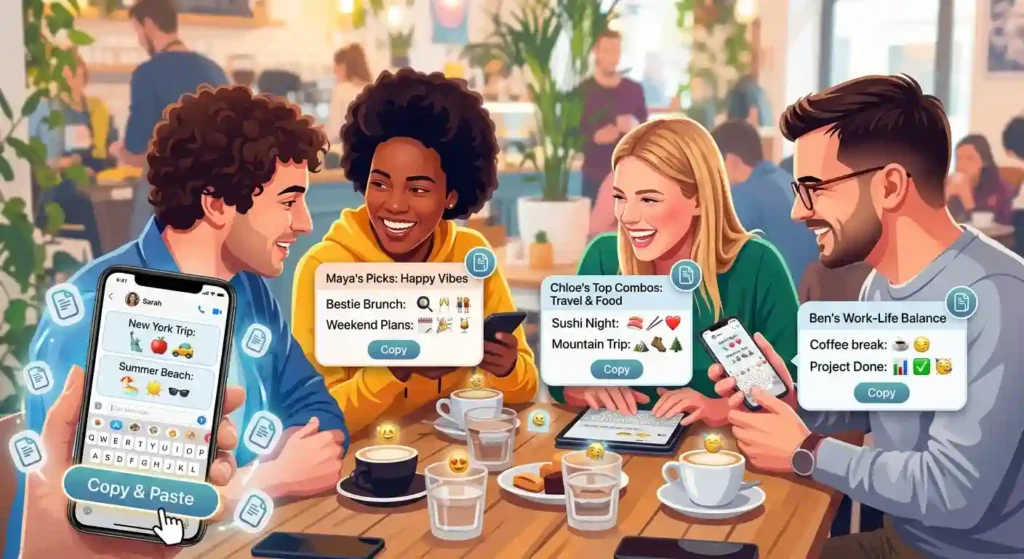
Emoji combinations can communicate a complete mood with only a few symbols. The key is keeping combinations understandable and relevant to the message.
Romantic ❤️
1.👉 ❤️💕 — Use this for a simple affectionate message.
2.👉 😍❤️ — Use this when complimenting someone you adore.
3.👉 ❤️✨ — Use this for a warm, affectionate caption or message.
Cute 🥰
1.👉 😊💕 — Use this for a sweet thank-you.
2.👉 😍✨ — Use this for something adorable or beautiful.
3.👉 💕😊 — Use this to make a friendly message feel extra warm.
Flirty 😉
1.👉 😉❤️ — Use this for playful affection.
2.👉 😍😉 — Use this when giving a teasing compliment.
3.👉 😉✨ — Use this for a light, playful message.
Missing Someone 💭
1.👉 😢❤️ — Use this when saying you miss someone.
2.👉 😭💕 — Use this for a stronger emotional message.
3.👉 ❤️😢 — Use this when expressing heartfelt longing.
Good Night 🌙
1.👉 ❤️😊 — Use this for a warm good-night message.
2.👉 💕✨ — Use this for a sweet nighttime wish.
3.👉 😉❤️ — Use this for a playful good-night message.
Trending Emoji Pictures Meaning in 2026
In 2026, emoji use continues to reflect the fast, informal nature of digital communication. Rather than replacing words completely, emoji pictures are commonly used to add emotional cues to short messages, captions, comments, and reactions. Their popularity is closely connected to how quickly people communicate online.
The smiley 😊 remains useful when someone wants a friendly or positive tone without making a message feel overly enthusiastic. The heart ❤️ works across many situations, from affection and appreciation to supportive comments. Laughing reactions such as 😂 are natural in humorous conversations, while ✨ is often used to highlight something exciting, attractive, fresh, or aesthetically pleasing.
On WhatsApp, these symbols commonly appear in personal chats and statuses. Instagram captions and comments use emojis to add personality and visual emphasis. TikTok users often use them as quick reactions to videos, jokes, or relatable moments. Facebook users may combine them with posts and comments to express support, amusement, affection, or acknowledgment.
| Emoji | Why trending | Who uses it | Platform |
| 😊 | Friendly emotional tone | Everyday users | WhatsApp, Instagram |
| ❤️ | Affection and support | Friends, couples, families | All major platforms |
| 😂 | Quick humorous reaction | Casual users and creators | TikTok, Instagram |
| ✨ | Emphasis and visual style | Creators and everyday users | Instagram, TikTok |
These patterns should not be treated as an official ranking. Emoji popularity changes with conversations, communities, trends, and individual preferences. The broader observation is that emoji usage keeps evolving alongside digital communication, with familiar symbols gaining new shades of meaning depending on how people use them.
Emoji Pictures Meaning in Different Contexts
The meaning of an emoji can change significantly depending on who sends it, what was said before it, and where the conversation happens. This is one of the most important things to understand about emoji meanings in chat.
In a romantic conversation, a heart can communicate affection, closeness, appreciation, or love. If the same heart appears in a conversation between close friends, it may simply show care or support. Family members may use affectionate emoji pictures in everyday messages without intending anything romantic.
Friendship also creates its own context. A laughing emoji after an obviously funny story usually reinforces the humor. A wink may suggest teasing between people who already understand each other’s communication style. Without that shared context, the same symbol could be interpreted differently.
Professional and casual communication should be treated differently too. In a relaxed workplace chat, a smile can make a message feel approachable. In a formal email or sensitive business conversation, excessive emojis may make the message feel less appropriate.
Social media comments are another interesting case. A heart under a photograph can mean appreciation rather than romantic interest. Sparkles can highlight an attractive detail, exciting announcement, or aesthetic presentation.
Texting often depends on the surrounding words. Compare “Good job 😊” with simply “Good job.” The first feels warmer. Similarly, “Really? 😂” can signal that the sender finds something amusing rather than seriously questioning it.
The safest rule is to interpret emoji pictures alongside the complete message. Avoid assuming intent based only on one symbol. Relationship, wording, platform, culture, and shared communication habits can all influence the final meaning.
How to Copy and Paste Emoji Pictures Meaning
Copying an emoji is simple. On a phone or computer, select the emoji character, copy it, and paste it wherever you want to use it. You can place emoji pictures in WhatsApp messages, Instagram captions, TikTok comments, Facebook posts, Messenger conversations, text messages, or other apps that support emojis.
For example, here is a clean copy-paste line:
😊 ❤️ 😂 👍 😍 💕 😭 😉 ✨
On most devices, you can also open the emoji keyboard and select a symbol directly instead of copying it from another website. On Windows, macOS, iPhone, and Android, the exact keyboard method can vary slightly, but the basic process is the same.
When copying emoji combinations, check the message after pasting. Some apps may display the symbols differently because of platform artwork. That does not necessarily change the underlying emoji character.
For social media, avoid adding a large group of unrelated emojis simply because they are available. A short, relevant combination usually communicates more clearly than a crowded line.
FAQs
1. What do the most popular emoji pictures mean?
There is no single universal meaning for emoji pictures. Common symbols such as 😊, ❤️, 😂, and 👍 are widely understood, but their interpretation still depends on context, wording, and relationship.
2. What does an emoji mean when someone sends it?
An emoji can express emotion, reaction, emphasis, humor, affection, or acknowledgment. The intended meaning depends on the surrounding conversation rather than assumptions about the sender.
3. Why do emojis look different on iPhone vs Android?
Emoji characters follow Unicode standards, but Apple, Google, Samsung, Microsoft, and other platforms create their own artwork. Therefore, the same character can look visually different across devices.
4. Are emoji pictures used differently in other countries?
Emoji interpretation can vary between cultures, communities, platforms, and individuals. A symbol that feels obvious to one person may carry a slightly different tone for someone else, so context matters.
Conclusion
Understanding emoji pictures’ meaning is really about understanding context, not memorizing a fixed dictionary. 😊❤️
Use emoji pictures to support your words, clarify your tone, and add personality where appropriate.
When in doubt, consider the relationship, conversation, and platform before interpreting a symbol. ✨